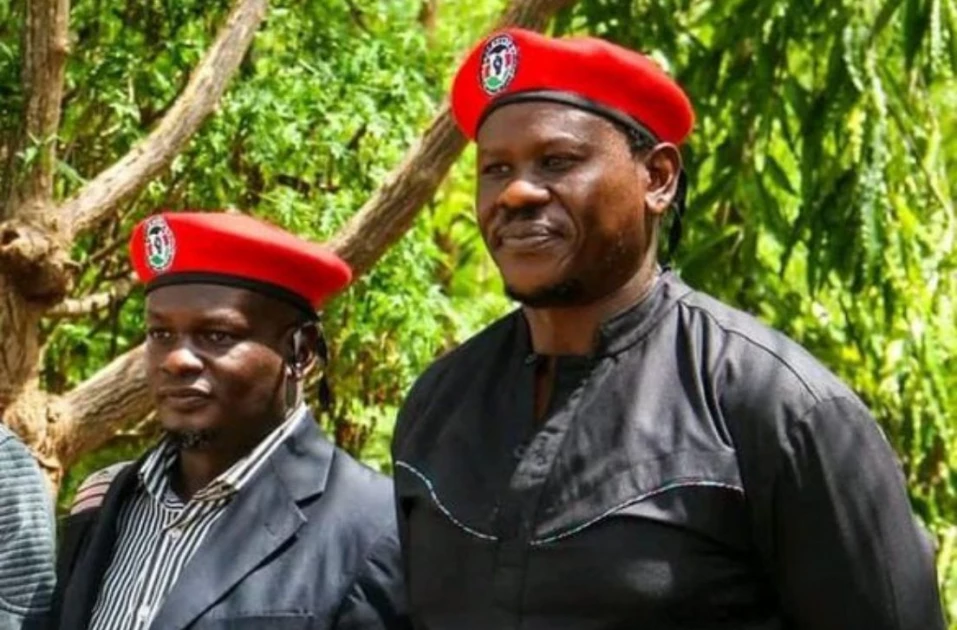
The disappearance of Kenyan activists Bob Njagi and Nicholas Oyoo in Kampala has prompted the High Court in Uganda to officially classify them as missing persons, nearly a month after they vanished under unclear circumstances.
In his October 22 ruling, Justice Simon Peter Kinobe concluded that there was no convincing evidence showing that Ugandan authorities or security officers were detaining the two men.
“I find that one cannot squeeze blood from a stone. The State can only produce what it has, and it would therefore be unrealistic to expect the desired outcome from circumstances that could not, in any case, yield it,” Justice Kinobe stated. “It would therefore be appropriate to categorise the applicants as missing persons. A missing person is a person who has disappeared and whose status as alive or dead cannot be confirmed, as their location and condition are unknown.”
The decision arose from a habeas corpus petition filed on behalf of the activists, who were reportedly abducted in Kampala on October 1, 2025, by armed individuals believed to be security personnel.
The petition targeted several top security officials, including the Chief of Defence Forces, Chief of Defence Intelligence and Security, the Inspector General of Police, and the Attorney General of Uganda.
Court says no evidence links state
Justice Kinobe observed that the case lacked sufficient proof connecting any government officials to the disappearance.
The activists’ lawyers had claimed Njagi and Oyoo were held without communication at a military facility in Mbuya for more than two days, arguing this violated their constitutional rights to freedom and due process.
The respondents, however, dismissed these claims as baseless.
“The application is frivolous, vexatious, and brought in bad faith, intended to damage the reputation of the respondents,” they told the court.
State representatives said comprehensive checks were carried out across all Uganda People’s Defence Forces (UPDF) detention centres, the Directorate of Military Intelligence, and the Uganda Police Force, but no evidence was found that the activists were held in custody.
Justice Kinobe agreed, noting that authorities could not be forced to produce individuals whose location was unknown.
“I also note from the pleadings that there is no cogent evidence that the respondents actually have the applicants. An attempt at interacting with the deponents of the affidavits in support was futile,” he said.
He advised that the activists’ lawyers should report the matter to the Uganda Police Force, the official body responsible for investigating missing person cases. The court dismissed the petition without awarding costs.
Activists’ disappearance linked to Bobi Wine campaign
Before their disappearance, Njagi and Oyoo were reportedly supporting the National Unity Platform (NUP) presidential candidate Robert Kyagulanyi, also known as Bobi Wine, when armed men allegedly forced them into a vehicle and disabled their phones.
Back in Nairobi, civil society group Vocal Africa has urged the Ministry of Foreign and Diaspora Affairs to take urgent action, warning that silence over the activists’ fate is escalating fear of cross-border repression.
“It has now been over three weeks since their disappearance, yet neither the Government of Uganda nor the Government of Kenya has provided any credible update on their whereabouts or safety,” the organisation said in a letter to the Principal Secretary.
While Kenya had initially engaged diplomatically, Vocal Africa said it is clear that these efforts have failed.
“Uganda’s continued silence and lack of cooperation cannot be met with passive diplomacy any longer,” the group warned.
The letter demanded that the Kenyan government take firm and decisive action, noting that Uganda has a legal and moral responsibility to locate and ensure the safety of the missing Kenyans.
Human rights and regional implications
Vocal Africa said Uganda’s failure to act raises serious human rights concerns and undermines the principles of cooperation under the East African Community Treaty.
The group called on Kenya to formally protest to Kampala, seek immediate disclosure of the activists’ location, and engage regional and international human rights mechanisms, including the African Commission on Human and Peoples’ Rights.
It also urged Nairobi to review bilateral ties with Uganda and provide direct support to the families, including legal representation and psychosocial assistance.
“The abduction of Bob Njagi and Nicholas Oyoo is not an isolated case; it signals a worrying pattern of shrinking civic space and suppression of activism across East Africa,” Vocal Africa said.
CEO Hussein Khalid emphasised that Kenya must take a principled stand to protect its citizens abroad.
“Kenya must take a firm and principled stand to ensure that such violations do not recur. The safety and dignity of every Kenyan citizen, whether at home or abroad, must remain non-negotiable,” he said.































Comments
Sign in with Google to comment, reply, and like comments.
Continue with Google