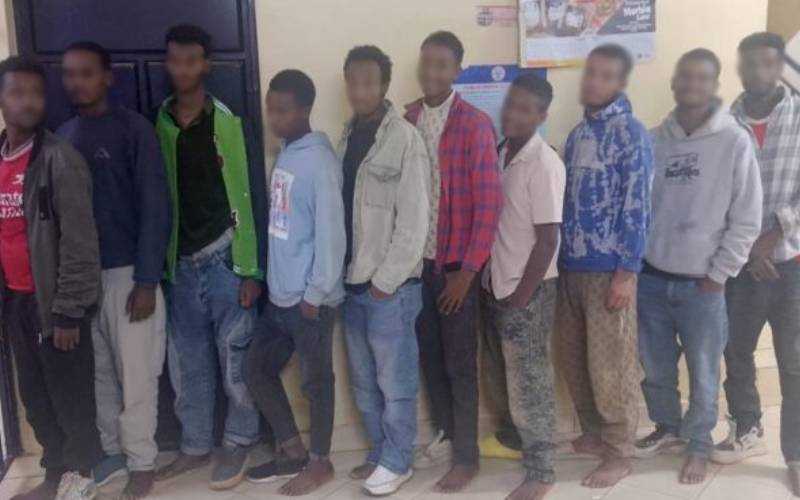
Authorities in Nairobi have arrested 10 Ethiopian nationals after discovering them walking along the Korogocho–Lucky Summer road without any identification or travel papers. Police say the swift intervention likely prevented a human trafficking attempt.
In a statement on Thursday, the Kenya Police Service said officers from Lucky Summer Police Station acted promptly to stop the group. “The group will now be processed for court appearance and further administrative action, including possible immigration proceedings,” the statement read.
The arrests come amid rising alarm over human trafficking in Kenya, which ranks among the highest in Africa for such crimes. Reports indicate that victims are often lured abroad with promises of employment, only to face forced labour or other forms of exploitation.
A recent study by the ENACT project, funded by the European Union, lists Nigeria as Africa’s top country for organised crime, followed by Kenya, South Africa, Libya and Uganda. The report warns that some officials may collude with criminal networks, shielding gangs that take advantage of desperate job seekers.
The Africa Organised Crime Index, which tracks developments up to 2024, identifies Kenya as both a source and transit hub for human trafficking. Cybercrime, financial crime, smuggling and trafficking remain the major drivers, with traffickers exploiting the country’s digital growth and regional mobility.
The findings echo a Jukwaa la Usalama report submitted to President William Ruto, which notes that Nairobi alone has more than 130 criminal gangs. Security analysts stress the urgent need for stronger policing and anti-corruption measures to curb organised crime.
In an effort to strengthen border control, Kenya and the United Kingdom recently signed a Memorandum of Understanding to improve security in border areas. The Interior Ministry said the agreement aims to combat cross-border threats, including human trafficking and migrant smuggling, while protecting local communities.
The Principal Secretary for Internal Security and National Administration said the agreement seeks to promote peace and development through a “holistic approach” combining law enforcement, community engagement, and peace-building initiatives.
The programme is expected to address complex challenges along the Kenya–Somalia and Kenya–Ethiopia borders and complements existing projects such as Deris Wanaag and the Land Border Programme. UK Deputy High Commissioner Diana Dalton said the initiative will strengthen cooperation in tackling organised crime and protecting vulnerable populations.
“Our renewed commitment to cooperation on border security will see us working together to tackle organised crime and prevent the exploitation of vulnerable people by unscrupulous and exploitative human traffickers,” Dalton said.
The Interior Ministry added that the initiative will use Kenya’s national security framework to coordinate early warning systems, intelligence sharing, security responses, and joint actions against irregular migration and trafficking.
Initially, the programme will focus on Turkana, Mandera, Marsabit, Wajir, and Busia counties, with potential expansion to other regions. It will also provide better understanding of mixed migration, organised crime, and protection risks, while building the capacity of local security teams and border authorities in partnership with community leaders.
Kenya and the UK have long-standing ties on security cooperation and regional stability. The ministry noted that the MoU follows President William Ruto’s visit to the UK in July 2025, when both countries agreed to deepen the Kenya–UK Strategic Partnership for another five years.































Comments
Sign in with Google to comment, reply, and like comments.
Continue with Google