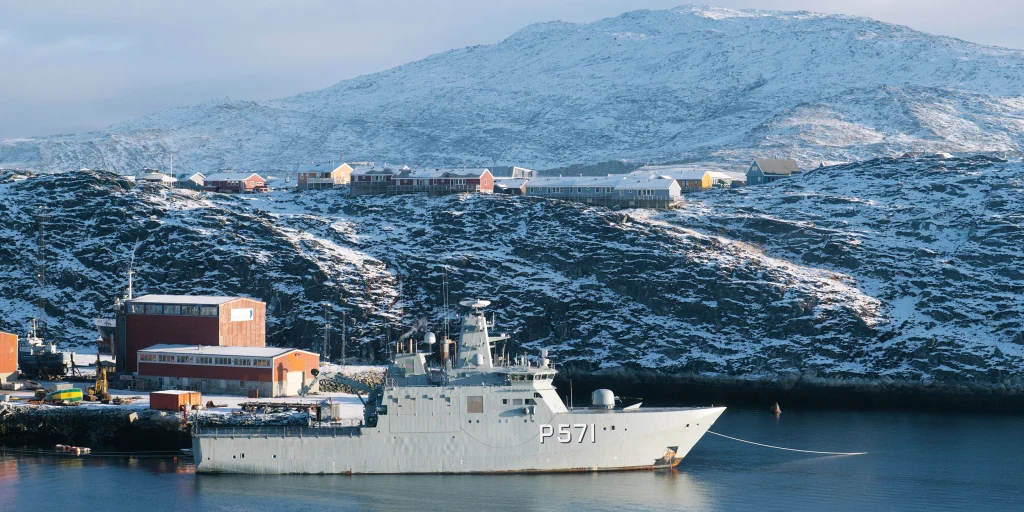
Greenland is witnessing an unusual increase in European military activity as the United States maintains pressure for access to the Arctic island. The deployments by Nato allies highlight growing tensions in a region that has become a strategic focus for global powers.
A French contingent has landed in Nuuk, Greenland’s capital, as part of a broader movement of European troops that includes Germany, Sweden, Norway, Finland, the Netherlands, and the UK.
While the operation is small, officials say it is meant to signal Europe’s commitment to Arctic security amid President Donald Trump’s persistent claims on the island, which is semi-autonomous under Denmark.
French President Emmanuel Macron announced that more personnel and equipment, covering land, air, and sea, would join the initial group.
French diplomat Olivier Poivre d'Arvor described the move as a political statement: “This is a first exercise... we'll show the US that Nato is present.”
The first team, consisting of 15 members, arrived just as Denmark and Greenland’s foreign ministers held talks in Washington with US Vice-President JD Vance.
Following the discussions, Danish Foreign Minister Lars Løkke Rasmussen said the talks were productive but noted a “fundamental disagreement” between the two countries.
He later criticised Trump’s attempt to buy Greenland. Trump defended his position in the Oval Office, saying, “we need Greenland for national security,” and suggested that the US could act if necessary.
He also argued that Denmark could not stop a possible Russian or Chinese move, adding, “The problem is there's not a thing that Denmark can do about it if Russia or China wants to occupy Greenland, but there's everything we can do. You found that out last week with Venezuela.”
White House Press Secretary Karoline Leavitt said the European deployments would not influence the president’s decisions regarding Greenland. “Nor does it impact his goal of the acquisition of Greenland at all,” she stated.
Polish Prime Minister Donald Tusk confirmed Poland would not join the deployment but warned that any US military action could lead to a political disaster.
“A conflict or attempted annexation of the territory of a Nato member by another Nato member would be the end of the world as we know it - and which for many years guaranteed our security,” he said.
Meanwhile, Russia expressed alarm over the developments. Its embassy in Belgium claimed Nato was increasing military presence in the Arctic under a “false pretext of a growing threat from Moscow and Beijing.”
Despite the political attention, the European Nato operation involves only a few dozen troops. The exercise, named Operation Arctic Endurance, is led by Denmark and is meant to strengthen joint training and preparedness. The duration of the deployments is currently uncertain.
Finland has sent two military liaison officers to gather information as the operation enters its planning phase. Defence ministry official Janne Kuusela said, “Right now we are not ruling anything out but we are not specifically considering anything.” Finland, an Arctic nation, said the mission aimed to strengthen the defence of allied territory.
Germany has dispatched an A400M transport plane with 13 soldiers to Nuuk, though they are scheduled to remain only until Saturday. Danish defence officials said the decision to increase military presence had been made jointly with the Greenland government to reinforce Nato’s footprint in the Arctic for both European and transatlantic security.
In his New Year address, Macron emphasized that Europeans have a particular responsibility toward Greenland, noting that “this territory belongs to the European Union and it's also one of our Nato allies.”
The United States already maintains a military base in Greenland with up to 150 personnel and can expand under existing agreements. However, the European initiative is seen as a clear message to Washington that allies are invested in Arctic security and that Greenland is not a solely American concern.
Sweden confirmed sending army officers to Nuuk, while Norway, the UK, and the Netherlands also deployed small contingents. Downing Street said the UK shared Washington’s concern over the High North’s security and stressed the move was intended to deter potential Russian and Chinese activity.
Danish Prime Minister Mette Frederiksen said that defending Greenland is a shared Nato responsibility. Defence Minister Troels Lund Poulsen added that the plan is to maintain a rotating presence of troops from allies, with a longer-term goal of establishing a permanent cooperative military presence on the island.
Copenhagen has rejected Trump’s reasoning for acquiring Greenland. Rasmussen said there is no “instant threat” from Russia or China that Greenland and Denmark cannot manage, though he acknowledged some American security concerns.
A Democratic-led US delegation is expected in Denmark for talks with lawmakers. Rasmussen, speaking after meetings with Vance and US Secretary of State Marco Rubio, said, “The president's ambition is on the table. Of course we have our red lines. This is 2026, you trade with people but you don't trade people.”
Greenland’s Prime Minister Jens-Frederik Nielsen described the island’s position as a geopolitical crossroads. He emphasized that Greenlanders would side with Denmark if asked to choose. “Greenland does not want to be owned by the United States. Greenland does not want to be governed by the United States. Greenland does not want to be part of the United States,” he said.































Comments
Sign in with Google to comment, reply, and like comments.
Continue with Google