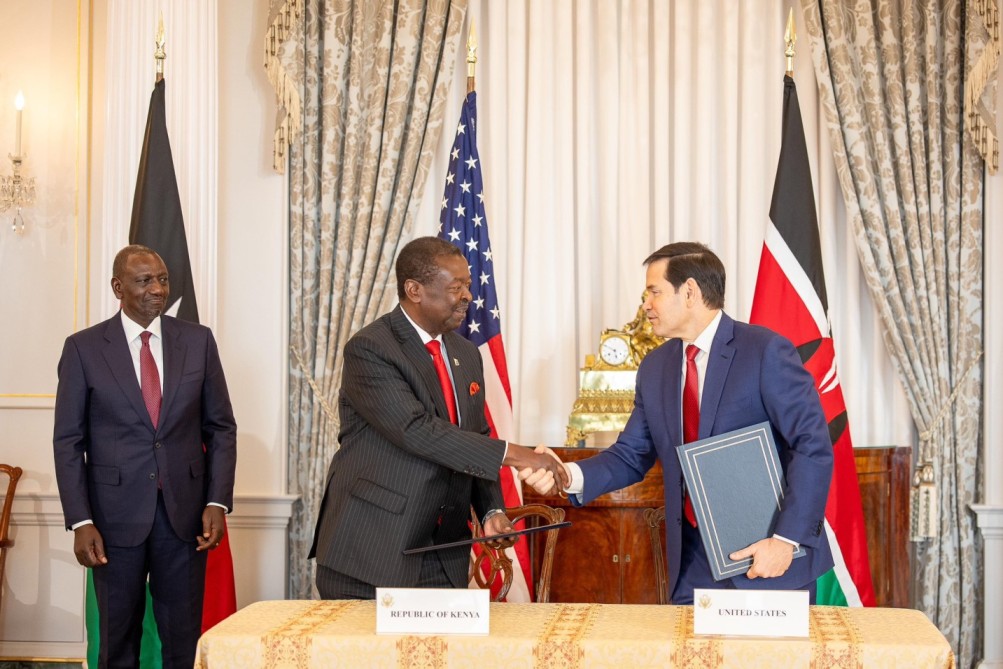
Kenya and the United States have signed a landmark Health Cooperation Framework that will reshape their 25-year partnership, moving the relationship from donor-driven programmes to a government-led health system.
The deal signals a major shift in how health services are funded and managed in Kenya, with both governments agreeing to work directly through national institutions instead of relying on external implementing partners.
Under the agreement signed on Thursday, the U.S. will provide USD 1.6 billion (Sh208 billion) over the next five years to support Kenya’s health systems, emergency preparedness, disease monitoring, and the transition to programmes fully owned by the country.
In return, Kenya has pledged to gradually increase its national and county health budgets, adding Sh10 billion in 2026/27, Sh20 billion in 2027/28, Sh35 billion in 2028/29, and Sh50 billion in 2029/30 as it prepares to fully manage key health commodities and personnel by 2031.
The government will also take on USD 141 million (Sh18.5 billion) worth of health commodities and health workers that have been supported by U.S. funding to date. Historically, U.S. aid to Kenya came through programmes like PEPFAR, the Global Fund, and CDC initiatives, many of which were run by non-state organisations.
While these programmes achieved significant results in controlling HIV, TB, and malaria, they also created “parallel systems for procurement, supply chain, human resources, and data management,” leading to inefficiencies. The statement notes that “only 40% of funding reached frontline workers and commodities” under the old model.
The new framework introduces a Government-to-Government (G2G) approach, routing funds directly through national institutions such as KEMSA, the Ministry of Health, the National Public Health Institute, IFMIS, and the State Department for Health Administration.
A structured transition plan will guide this process, with KEMSA expected to take over full procurement and distribution of health commodities by December 2026. Kenya will also absorb 515 laboratory staff and 13,293 health workers by 2028, strengthening control over the national health workforce.
The agreement establishes a robust data-sharing framework, recognising health data as a “national strategic asset” that must comply with the Data Protection Act (2019), the Digital Health Act (2023), and other Kenyan laws.
Government officials say the partnership will bring lasting benefits, including stronger national health sovereignty, predictable domestic financing, enhanced disease monitoring, and deeper diplomatic and economic relations with the U.S.
Officials add that the transition will reinforce institutions like KEMSA and the national laboratory network, position Kenya as a “regional health hub,” and accelerate progress toward universal health coverage.































Comments
Sign in with Google to comment, reply, and like comments.
Continue with Google