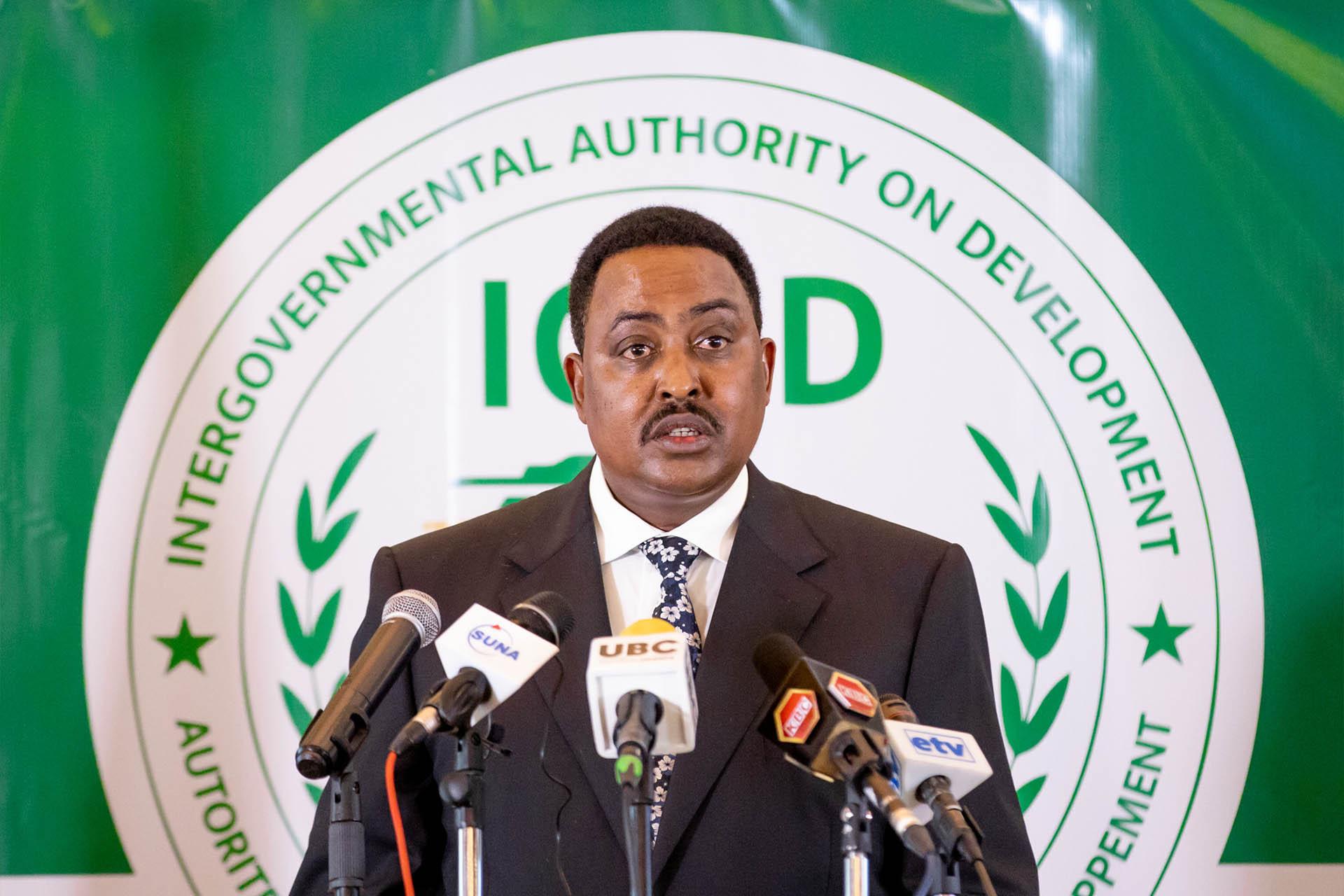
IGAD Executive Secretary Workneh Gebeyehu has called on East African nations and partners to strengthen regional cooperation and adopt long-term strategies to support the 5.1 million refugees in the IGAD region, noting that one in every five refugees worldwide finds safety there.
Speaking at the 3rd Ministerial Stock-take Meeting of the IGAD Support Platform in Nairobi on November 27, 2025, Gebeyehu emphasized the need for sustained political leadership, improved coordination, and broader partnerships to tackle displacement, climate challenges, and other humanitarian pressures.
“Displacement at this scale is not a temporary condition. It is a reflection of structural pressures that demand long-term vision rather than short-term reaction,” he said, adding that more than 70 percent of Africa’s displaced population either originates from or is hosted within the IGAD region.
He urged Member States and partners to address this growing challenge with unity and purpose.
Gebeyehu highlighted progress across the region, noting that Djibouti is strengthening its asylum systems, Ethiopia and Kenya are integrating refugees into national development strategies, Uganda is promoting self-reliance models, Somalia is focusing on reintegration, and South Sudan and Sudan are coordinating cross-border efforts despite ongoing challenges.
“These efforts demonstrate the power of regional action anchored in national ownership by our Member States,” he said.
The Executive Secretary also praised the role of international partners, including the EU, World Bank, Germany, Sweden, UNHCR, and UNDP, in turning political commitments into practical solutions.
“Our partners have been indispensable in translating political will into concrete results,” he added, emphasizing that close collaboration with humanitarian, development, and private-sector actors is key to sustaining progress.
Climate change and conflict were also central to his remarks.
“Climate events are accelerating displacement. Fiscal constraints strain national service delivery. Conflict dynamics continue to uproot communities. Without strengthened and coordinated systems, these pressures will only grow,” he warned, highlighting IGAD’s climate-action pledge and its work under the Humanitarian-Development-Peace Nexus to strengthen resilience and preparedness.
Gebeyehu urged Member States to unite around three priorities: sustained political leadership, stronger regional coordination, and enhanced partnerships to mobilize multi-year investments in education, livelihoods, basic services, and climate resilience.
“Let this be our legacy: a region where mobility is well-governed, where solutions are genuinely shared, and where the resilience of each of our countries strengthens the resilience of all,” he said.
The meeting highlighted IGAD’s commitment to durable, development-oriented approaches to displacement, aiming to make the region a model for refugee protection, stability, and inclusive growth.