With droughts returning more often and food imports taking a growing share of national spending, the government has renewed calls for a full shift to irrigated, large-scale farming, saying Kenya can no longer rely on rainfall to meet its food needs in a changing climate.
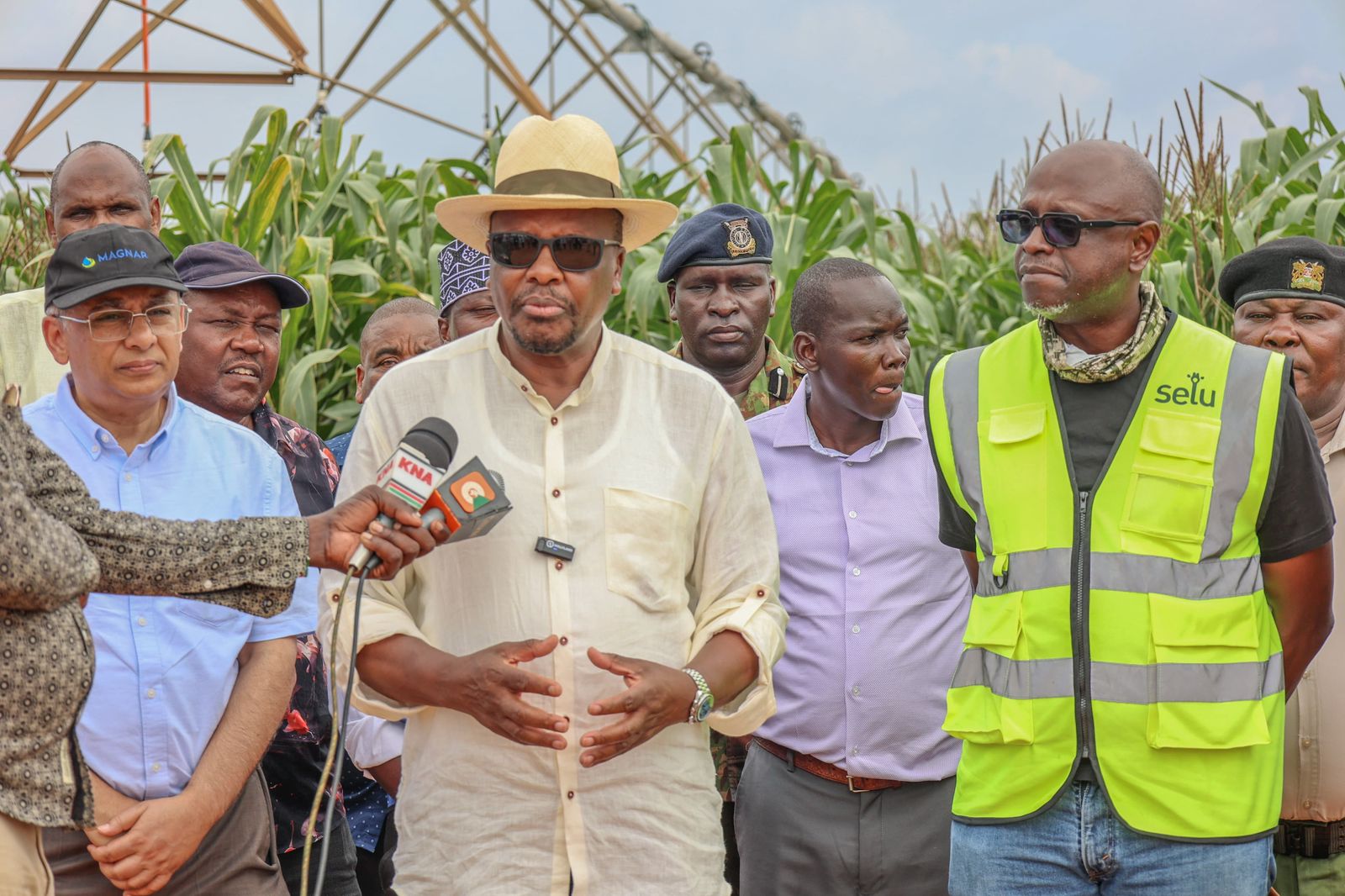
The Cabinet Secretary for Agriculture and Livestock Development, Mutahi Kagwe, said the future of food production lies in modern farming systems that use science, technology and digital tools to raise yields per acre.
Speaking on Friday, he said this approach is especially critical in the Arid and Semi-Arid Lands, which cover more than 80 per cent of the country and remain largely underused due to limited water infrastructure.
Kagwe said the Galana-Kulalu Food Security Project, covering 1.8 million acres, has been set aside entirely for mechanised and irrigated farming, with no room for small plots.
He said keeping the land intact is necessary to allow proper use of machinery and modern systems.
“We are making it clear in public that Galana-Kulalu is strictly for large-scale farming. Subdivision makes mechanisation impossible and defeats the purpose of this project,” Kagwe said.
The CS pointed to Kenya’s heavy food imports, noting that the country brings in about 92 per cent of its wheat, more than 80 per cent of its rice, and large volumes of sugar.
Kagwe said repeated droughts have weakened local production, making imports unavoidable, but added that irrigated farming at scale offers a clear way to stabilise supply, cut costs and improve food security.
Through the Land Commercialisation Initiative, the government is opening Galana-Kulalu to serious local and international investors, with assurances that land allocation will follow clear, open and competitive processes.
Kagwe said dividing land into smaller units reduces efficiency, limits use of machinery and lowers returns, making large projects unworkable.
Beyond farming, the project is expected to support many other sectors by increasing demand for locally produced fertilisers, irrigation materials, transport services and logistics, while encouraging agro-processing and trade.
As irrigation expands, the government plans to lower production costs, especially for irrigation pipes, power and water supply.
Kagwe urged pipe manufacturers and related industries to prepare for higher demand, saying Kenyan-made products are reliable and competitive.
Residents living near Galana-Kulalu were encouraged to see the project as a chance for economic growth.
Kagwe also said there are opportunities in housing, retail, services and supply chains needed to support a large agricultural workforce.
He praised investors who have worked closely with local communities by supporting schools, health centres and other social programmes, saying community support is essential for long-term success.
During a visit to the Nyumba Group, Kagwe commissioned an 800-acre earth dam with a storage capacity of six billion litres of water, built to allow farming throughout the year.
The project forms part of wider investments by the Nyumba Foundation, led by Kirtan Hasmukh Kanji, which has spent over Sh6.4 billion to develop more than 300,000 acres now under production.
Kagwe said the Nyumba Model shows how large-scale, technology-based farming can work in dry regions.
He also toured Selu, a major seed maize producer, stressing the need for steady access to quality seeds to support strong harvests and reliable food systems.
The CS pointed out that combining farming with water storage, long-term investment and community programmes is key to changing Kenya’s agriculture, reducing dependence on imports and preparing the country to cope better with future droughts.