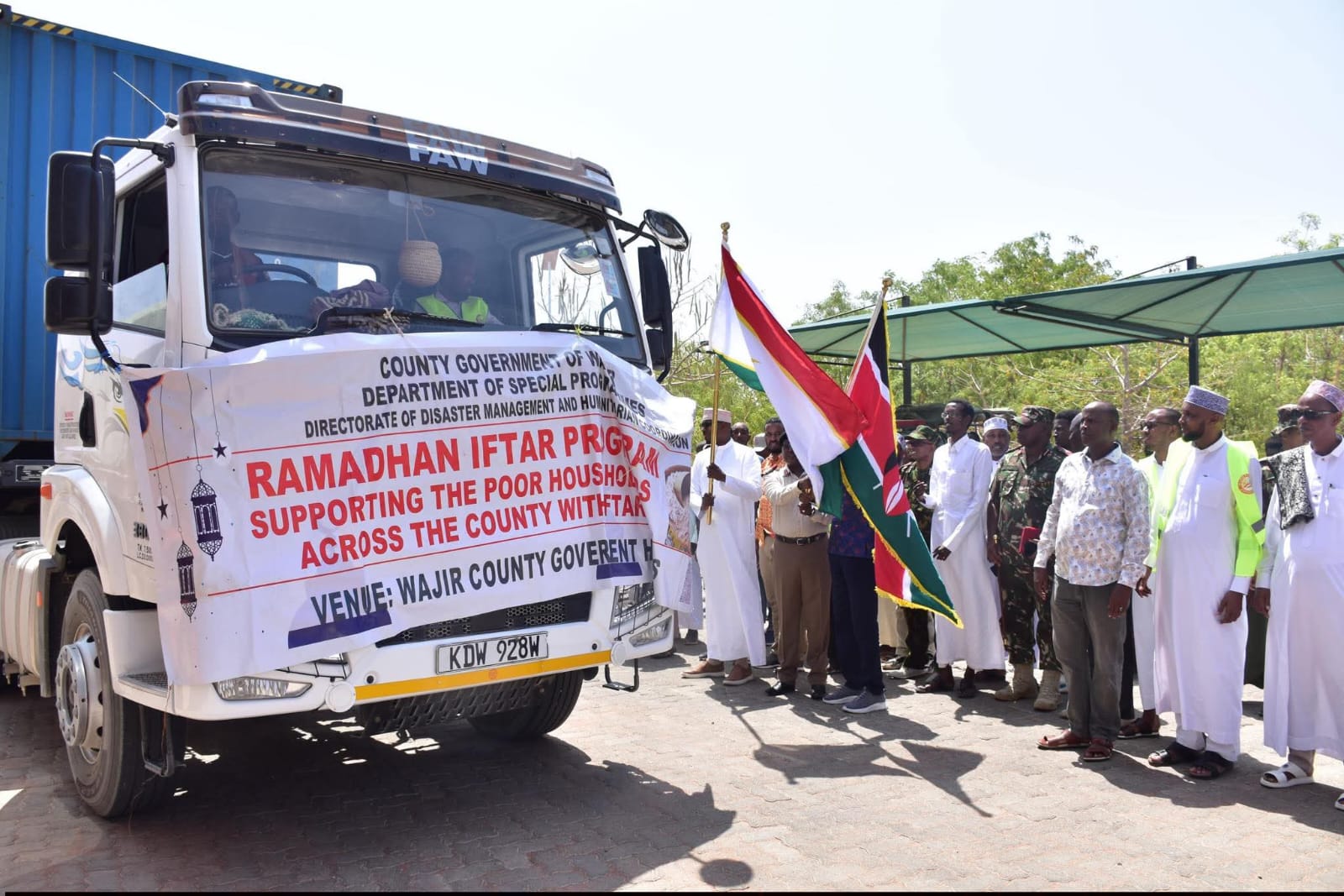
About 40,000 vulnerable households across all 30 wards of Wajir County have received support through the annual Ramadhan Iftar Programme.
Iftar, the daily meal that breaks the fast during the holy month of Ramadhan, holds deep significance for Muslims as a time for reflection, gratitude, and communal bonding.
Wajir Governor Ahmed Abdullahi flagged off 915 tonnes of essential food supplies, including sifted maize, fortified porridge flour, dates, and cooking oil at the county headquarters.
“Beyond households, the initiative will also benefit orphans, dialysis patients, and persons living with disabilities, groups considered most at risk amid the prevailing harsh economic and climatic conditions,” he said.
Governor Abdullahi noted that the Iftar Programme has become a consistent annual intervention. “This year’s exercise is especially critical due to the ongoing drought that has severely affected livelihoods in the county.”
Severe drought continues to worsen across many parts of Kenya, leaving millions in dire need of assistance. Over two million people are facing crisis-level food insecurity through early 2026, according to the Kenya Red Cross.
Coupled with water scarcity and widespread livestock deaths, the risks of disease outbreaks and malnutrition are rising.
Wajir, alongside Tana River, West Pokot, and Marsabit (Saku), has entered severe drought conditions.
Counties such as Turkana, Samburu, Garissa, Isiolo, Marsabit (North Horr, Laisamis), West Pokot (East), and Baringo (Tiaty) are also experiencing critical drought phases.
Abdullahi reiterated that the county administration remains committed to protecting vulnerable populations through timely humanitarian support.
“To further ease the impact of the drought, the county government has scaled up response measures, including repairing boreholes and providing free water trucking services to areas facing acute water shortages.”
The Chairperson of the Council of Governors also acknowledged the support of the National Government, citing strong intergovernmental collaboration as key to the successful delivery of relief services to residents.