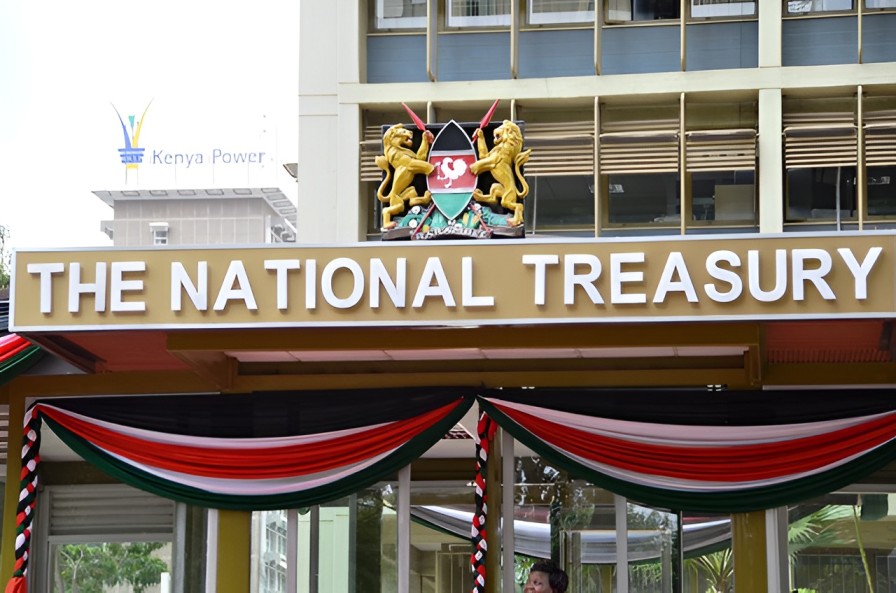
Kenya is preparing to rely on local financing for over 80 per cent of its borrowing in the coming five years, aiming to make debt management more sustainable and reduce vulnerability to currency fluctuations.
According to the Annual Public Debt Management Report 2024/5, launched on Wednesday, the government intends to source 82 per cent of gross borrowing from domestic sources, leaving only 18 per cent to come from abroad.
In the next financial year, the mix is expected to start at 78 per cent domestic and 22 per cent external.
Raphael Owino, Director General of Public Debt Management at the National Treasury, said the government plans to gradually reduce reliance on Treasury bills while increasing medium and long-term securities.
“This will help lower debt servicing pressure that has forced the country to take expensive loans to avoid defaults,” he said.
Kenya has historically depended on foreign loans, often in currencies that rise in cost when the shilling weakens. To ease this, flagship infrastructure projects such as roads, railways, airports, and power plants are being prepared for private-sector involvement.
“As we look for new ways to finance development without deepening debt burden, blended finance is increasingly being discussed as part of the solution,” Owino said.
“The approach, which combines public or concessional funding with private capital, is being positioned as a way to attract long-term investment into priority sectors while managing risk for investors.”
In December, the cabinet approved the creation of the National Infrastructure Fund (NIF) and the Sovereign Wealth Fund (SWF), initiatives led by President William Ruto to draw in private capital for development projects.
Every shilling invested in the Sh5 trillion Fund is expected to leverage up to Sh10 from long-term investors such as pension funds, sovereign partners, private equity, and development finance institutions.
The SWF will manage revenues from minerals and petroleum, dividends from public investments, and part of privatisation proceeds.
The government said external borrowing will focus on concessional and semi-concessional loans, with minimal commercial loans, and will explore new options such as sustainability-linked bonds.
By the end of the current financial year, public debt is expected to comprise 60 per cent domestic and 40 per cent external, up from a 55:45 ratio in 2024/5. External borrowing will include 10 per cent concessional, two per cent semi-concessional, and six per cent commercial loans.
By June 2025, Kenya’s total public and publicly guaranteed debt stood at Sh12.82 trillion, or 67.8 per cent of GDP, with Sh6.32 trillion domestic and Sh5.5 trillion external.
Multilateral and bilateral loans make up most of the foreign debt. While the report notes Kenya’s debt is manageable, it warns the risk of distress remains high.
“To safeguard debt sustainability and reduce elevated risk of debt distress, it is recommended that the government adopt targeted policy measures aimed at strengthening external debt indicators,” the report reads.
“Specifically, the government should prioritize broadening and diversifying the export base to enhance foreign exchange earnings, while simultaneously building and maintaining robust gross international reserves to provide a stronger buffer against external shocks.”
Implementing these measures, it says, will ease pressure on external debt, improve the debt service-to-exports ratio, and strengthen overall resilience in managing public finances.































Comments
Sign in with Google to comment, reply, and like comments.
Continue with Google