As Tanzania embarks on its General Elections, a wave of protests has erupted across the country, adding tension to an already charged political atmosphere.
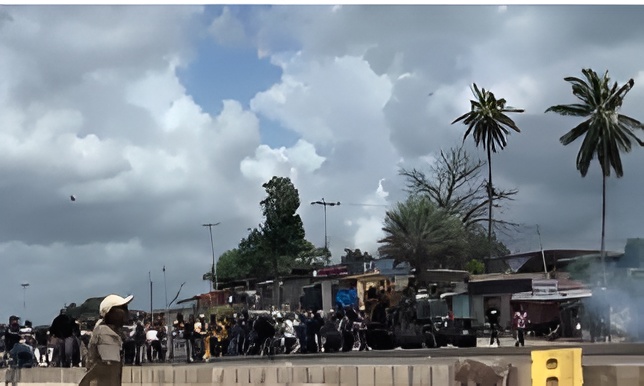
The unrest unfolded as groups of young people took to the streets, blocking roads, disrupting traffic, and clashing with police officers.
In a video seen by Radio Generation on Wednesday morning, protesters were seen chanting and waving banners while occupying a major highway, voicing their dissatisfaction with the election process.
The situation rapidly escalated when some demonstrators threw stones at law enforcement, prompting the police to deploy tear gas in an effort to disperse the crowds.
The government had previously warned against such protests, making it clear that any form of unrest would not be tolerated. To ensure order, police forces stationed military tanks around Dar es Salaam, the country’s commercial hub, in a show of strength to prevent any disturbances during the crucial election day.
The elections, which began early this morning, have seen a relatively low turnout, as many of the leading challengers to President Samia Suluhu were either imprisoned or barred from running.
Suluhu, who assumed office in 2021 following the sudden death of President John Magufuli, faces a critical test in her bid for a full term.
The former vice-president had initially won praise for her steps toward loosening Magufuli’s stringent policies. She lifted the ban on political rallies and made efforts to engage opposition leaders, offering a more open political environment than under her predecessor.
These early moves earned her international acclaim, but the optimism was short-lived. Critics soon accused her government of backtracking on these reforms, reviving some of the same restrictive measures that characterized Magufuli’s rule.
Today’s elections are historic, with Tanzania potentially on the cusp of electing its first female president. Over 37 million registered voters are expected to make their decision on whether Suluhu will secure a full term in office.
However, the election process is clouded by concerns over fairness, especially given the treatment of opposition candidates and the limitations imposed on their campaigns.
In a statement released earlier, Justice (Rtd) Jacobs C.M. Mwambegele, chair of the Independent Electoral Commission (INEC), called for widespread voter participation, praising the generally peaceful conduct of the campaign period.
“I commend all Tanzanians for the maturity shown throughout the campaign period. To a large extent, campaigns were conducted peacefully, and where minor hitches occurred, local teams addressed them successfully,” he said. However, despite these reassurances, opposition groups and human rights organizations have raised concerns that the absence of violence during the campaigns does not necessarily reflect a free and fair democratic process.
While 17 political parties are participating in the presidential race, many have faced significant obstacles. For instance, ACT-Wazalendo’s candidate, Luhaga Mpina, experienced a series of reversals in his candidacy, while Chadema, one of the main opposition parties, has been entirely excluded from presidential, parliamentary, and local elections.
The party’s leader, Tundu Lissu, is currently imprisoned on treason charges, and his deputy, John Heche, was recently arrested after attending the funeral of Kenya’s former Prime Minister Raila Odinga. Lissu, in a post on X, shared that he is being held in solitary confinement under constant surveillance.
With the political landscape tense and the eyes of the nation on these elections, the outcome is expected to have significant implications for Tanzania’s democratic future and its political reforms.