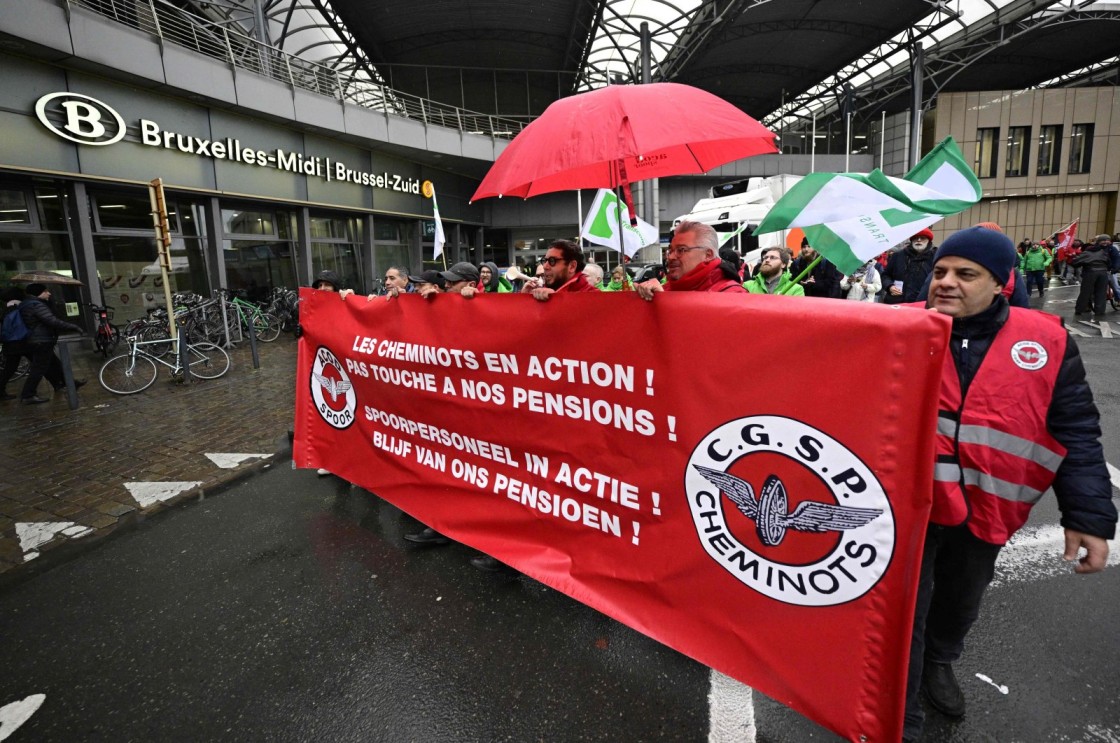
Belgium on Monday braced for sweeping nationwide disruptions as unions launched a three-day strike to protest the government’s proposed budget cuts, pension reforms and labour law changes.
The coordinated action threatens to cripple transport, schools, hospitals and airport operations across the country, even as Prime Minister Bart De Wever confirmed that his coalition government had secured a long-awaited budget agreement early Monday morning.
The strike is being staged in three successive waves. Transport workers kicked off the protest on Monday, with the national railroad company SNCB warning that it expected to operate “out of three trains, or just one out of three on some lines.
Several Eurostar services linking Brussels to Paris have also been cancelled. The disruptions are expected to intensify on Tuesday when public services such as schools, creches, and hospitals join the strike.
A full general strike is scheduled for Wednesday, when unions expect the largest shutdown.
Authorities reported that no flights are expected Wednesday at the country's two main airports, Bruxelles-Zaventem and Charleroi, signalling one of the most significant national stoppages in recent years.
The strikes are moving forward despite the government announcing a major breakthrough on the 2025 budget.
Prime Minister Bart De Wever confirmed that an agreement had been reached on the national budget for next year after marathon negotiations that began on Sunday morning and continued into early Monday.
He had previously set a Christmas deadline for his five-party coalition to resolve internal disagreements over how to repair government finances.
According to financial daily reports cited in government communications, the budget deal will include tax hikes on share purchases, airplane tickets and natural gas and a new tax on banks.
The measures, combined with significant spending cuts, aim to lower Belgium’s deficit by Sh1.37 trillion by 2029.
However, the breakthrough has done little to placate unions or avert the scheduled strike action.
Union leaders argue that the government’s broader push for austerity, particularly its reforms targeting pensions, labour market liberalisation and unemployment benefits, threatens the country’s foundational social protections.
In a strongly worded statement, union leaders described the national action as “an appeal to Prime Minister De Wever and the entire government to put an end to the dismantling of social programs.”
The socialist union FGTB accused the prime minister of showing “contempt” and “disrespect” toward the social movement.
Prime Minister De Wever’s conservative Flemish-led government has argued that reforms are necessary to reduce Belgium’s sizable public debt and rebuild financial stability.
But only a fraction of his proposed structural reforms have been implemented, largely due to divisions within the coalition.
The unions’ strike is intended to escalate pressure on the government as internal negotiations continue, particularly around demands for deeper spending cuts in order to accommodate increased military spending.
Tensions have been mounting for weeks. Earlier demonstrations in mid-October drew “tens of thousands of protesters” into the streets of Brussels to oppose “brutal budget cuts.”
The three-day strike marks the most significant escalation of union pressure since De Wever took office in February.
As the first wave of disruptions began Monday morning, commuters across Belgium faced long delays and cancellations, and public institutions prepared for widespread closures in the days ahead.
Despite achieving a budget accord, the government now faces a new test, navigating the political and social fallout of a strike that threatens to grind Belgium to a halt for 72 hours.































Comments
Sign in with Google to comment, reply, and like comments.
Continue with Google