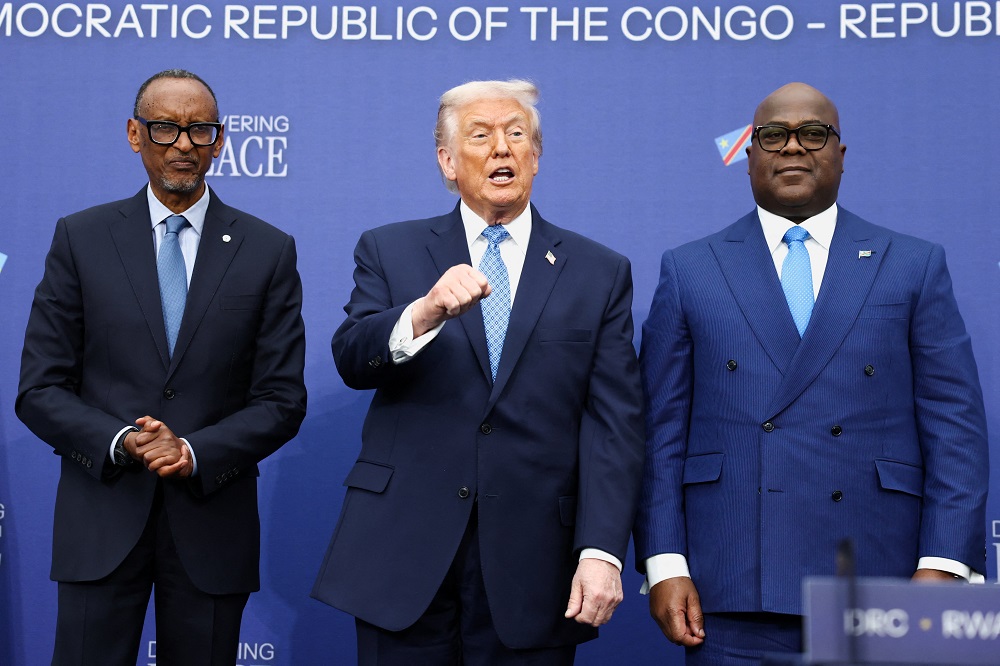
In eastern Democratic Republic of Congo, the town of Bukavu remains on edge following the signing of a major peace agreement between DRC President Felix Tshisekedi and Rwandan President Paul Kagame in Washington.
The accord, designed to halt years of fighting and establish lasting stability along the DRC-Rwanda border, includes measures for a permanent ceasefire, disarmament of non-state actors such as the M-23 militia, and new economic initiatives involving US investment in the region’s mineral resources.
Despite the fanfare surrounding the deal, human rights groups in Congo have voiced concerns that it overlooks the causes of the longstanding conflict.
Nobel laureate Denis Mukwege criticized the accord as being imposed without the participation of local communities, saying, “This is an agreement that is made, not for us. Everything that is done for you, without you, is not done for you. This peace agreement for us is not inclusive. Civil society is not involved. As a result, we consider it a peace agreement that is not sustainable either.”
The signing ceremony in Washington was attended by several world leaders, including US President Donald Trump and Kenyan President William Ruto.
Tshisekedi described the deal as a defining moment, stating, “The Washington agreements are not yet another document. This represents a turning point. They bring together a declaration of principles.” Kagame acknowledged the challenges ahead, adding, “There will be ups and downs ahead. There is no doubt about it. Rwanda, I know, will not be found wanting. I can assure you of that.”
The agreement aims not only to end violence but also to hold perpetrators of illegal acts accountable and to create an economic framework that could benefit the local population.
President Trump highlighted the economic potential, noting, “We will be sending our biggest and greatest companies over to the two countries and we are gonna get the rare earth minerals and everybody is gonna make a lot of money.” He also remarked, “They have spent a lot of time killing each other and now they will spend a lot of time hugging, holding hands and taking advantage of the USA like other countries do.”
President Ruto emphasized Kenya’s role in supporting the accord, saying, “We will spare no effort to ensure this agreement is fully realised, mobilising every resource to secure peace and unlock the region’s economic potential.”
Meanwhile, back in Bukavu, uncertainty looms as reports suggest the planned disarmament of non-state forces is causing fear among communities.
The region has also recently seen attacks in Kaziba, Katogota, and Lubarika, with the Congolese army and M-23 militia trading accusations over possible attempts to sabotage the peace process.
Human rights activists warn that unless local voices are included and the deeper issues fueling conflict are addressed, the Washington accord risks being short-lived, leaving ordinary residents in a precarious situation even as international attention focuses on the deal.