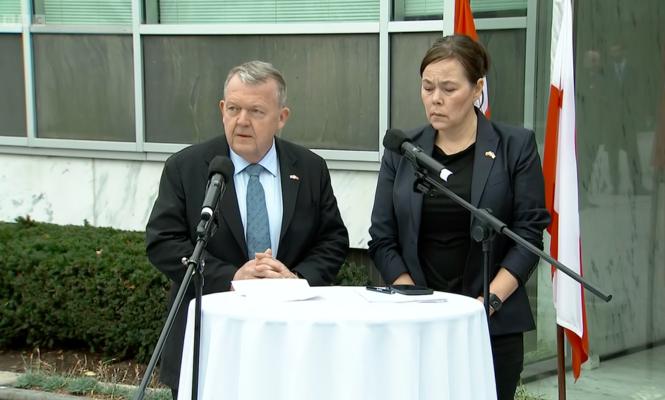
Denmark has raised serious concerns about a growing rift with the United States over Greenland after high-level meetings at the White House.
Danish Foreign Minister Lars Lokke Rasmussen described the discussions with US Vice-President JD Vance and Secretary of State Marco Rubio as “frank but constructive,” but warned that President Trump’s insistence on “conquering” Greenland crossed a line that Denmark cannot accept.
“We made it very, very clear that this is not in the interest of [Denmark],” Rasmussen said, noting that certain limits must not be violated. While the talks lasted an hour without a major breakthrough, all parties agreed to form a senior working group to examine the island’s future. This group is set to meet in the coming weeks to explore compromise solutions, including the possibility of expanding US military presence, which Denmark and Greenland said they would consider.
Rasmussen also acknowledged that Trump has a point about the need to strengthen security in the Arctic to counter Russia and China, but dismissed the president’s claims about Russian and Chinese warships near Greenland as false.
Despite its small population, Greenland occupies a key position between North America and the Arctic, making it strategically important for early missile warning systems and monitoring sea routes.
Trump has repeatedly emphasized that controlling the island is crucial for US national security. The US currently maintains over 100 personnel at the Pituffik military base in northwestern Greenland, a facility under American operation since World War Two, with agreements allowing the US to deploy additional troops as needed.
Greenland’s Foreign Minister Vivian Motzfeldt said the territory is open to stronger cooperation with the US but strongly opposes any takeover. “We have shown where our limits are,” she said.
After the meeting, Trump told reporters, “We need Greenland for national security. The problem is there's not a thing that Denmark can do about it if Russia or China wants to occupy Greenland, but there's everything we can do,” suggesting he doubts Denmark’s ability to defend the island. Vance and Rubio did not comment immediately after the discussions.
European countries moved quickly to support Denmark in the face of escalating tensions. Sweden promised to deploy armed forces at Denmark’s request, France plans to open a consulate next month, and Germany will send a reconnaissance team to explore potential military support.
Denmark emphasized that its expansion plans in Greenland will proceed “in close co-operation with allies,” adding that “geopolitical tensions have spread to the Arctic.”
Trump’s growing interest in Greenland comes amid broader global security concerns. While he has suggested purchasing the territory, Denmark and Greenland insist it is not for sale. Trump has linked Greenland’s importance to his planned Golden Dome missile defense system, calling on NATO to assist the US.
Public opinion in Greenland and the US largely opposes any change in control. A Reuters/Ipsos poll shows only 17 percent of Americans support taking Greenland, compared with 47 percent opposed. Similarly, most Greenland residents reject US control.
The debate over Greenland unfolds alongside US military operations in Venezuela, Syria, and threats against Iran, highlighting the Arctic’s rising strategic significance.































Comments
Sign in with Google to comment, reply, and like comments.
Continue with Google