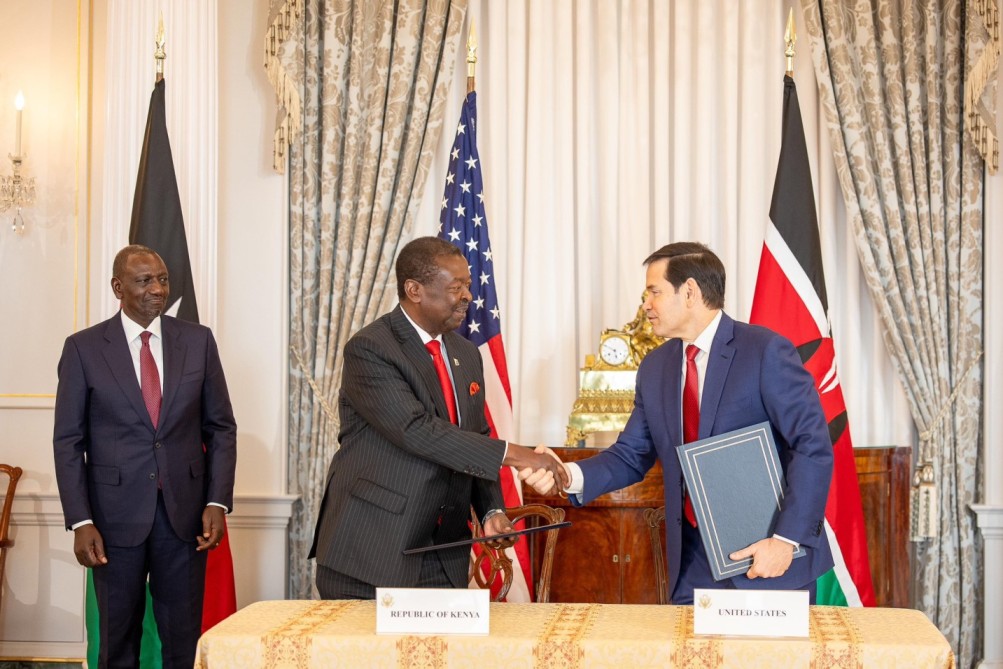
UNAIDS has welcomed a landmark five-year Health Cooperation Framework signed between Kenya and the United States, calling it a key milestone in efforts to strengthen the country’s HIV response and overall health systems.
The agreement, inked on Thursday in Washington, D.C., by US Secretary of State Marco Rubio and President William Ruto, is expected to inject new energy into Kenya’s fight against HIV and align the country with global targets to end AIDS by 2030.
Under the framework, the United States will contribute up to US$1.6 billion (Sh208 billion) over five years, while Kenya has pledged around US$850 million (Sh110.04 billion) from domestic resources.
UNAIDS described the deal as “a renewed demonstration of shared solidarity, co-investment, self-reliant systems and resolve to save lives, reduce new HIV infections, and advance progress towards ending AIDS in Kenya.”
The partnership builds on decades of collaboration through PEPFAR, one of the world’s largest and most influential global health programmes. It aims to achieve the UNAIDS 95-95-95 targets: ensuring 95% of people living with HIV know their status, 95% of those diagnosed are on sustained treatment, and 95% of those on treatment achieve viral suppression.
Recent data from UNAIDS showed that Kenya is close to meeting these goals, with approximately 95% awareness, 97% of diagnosed individuals on treatment, and 97% achieving viral suppression.
However, challenges such as dwindling donor support, medication stockouts, and persistently high infection rates among specific populations highlight the need for renewed partnerships and targeted interventions.
Beyond HIV, the framework aims to reduce new infections and AIDS-related deaths by 90% by 2030 compared to 2010 levels. It will support technical assistance, capacity building, community-led initiatives, and overall strengthening of Kenya’s health system.
US Secretary of State Marco Rubio noted that Kenya is the first of 50 countries expected to sign similar bilateral agreements, highlighting Washington’s renewed focus on global health cooperation.
UNAIDS emphasized that the agreement “brings renewed momentum to advance Kenya’s outstanding response to HIV and US leadership in the global HIV response.” The agency also pledged to support governments, civil society, and community partners with technical expertise and data as the initiative begins.
“The historic global effort to end AIDS is advanced when governments and people stand together,” UNAIDS stated, underscoring the importance of collaboration to achieve zero new infections, zero discrimination, and zero AIDS-related deaths by 2030.































Comments
Sign in with Google to comment, reply, and like comments.
Continue with Google