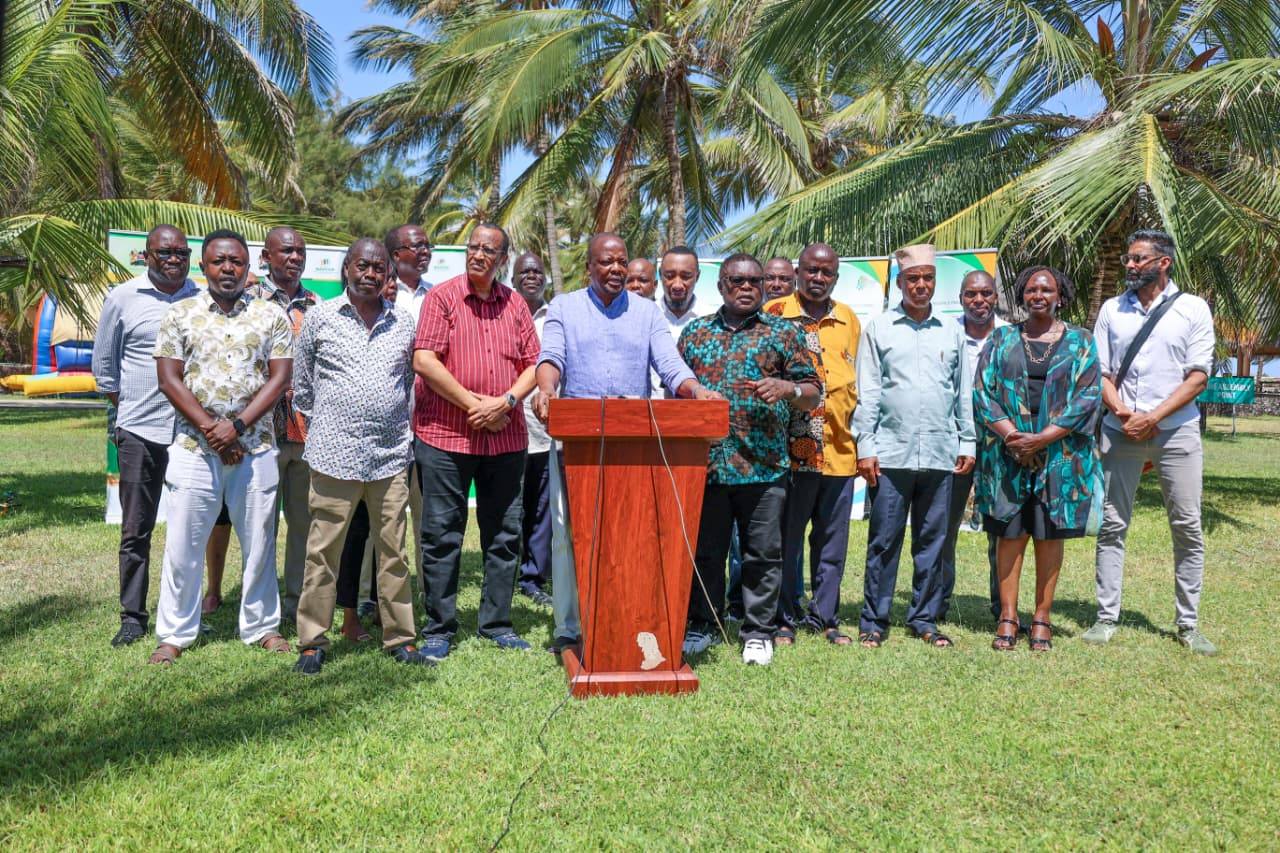
In order to combat Kenya’s worsening drought, the national government and Council of Governors will reprogramme World Bank-funded agriculture projects. Agriculture Cabinet Secretary Mutahi Kagwe said the funds, sourced from the Food Systems Resilience Program (FSRP) and the National Agricultural Value Chain Development Project (NAVCDP), will be redirected to immediate relief efforts, including fodder transport, water delivery, and livestock protection, with at least 85% of resources going directly to on-the-ground interventions.
Speaking after a high-level meeting in Malindi with the Council of Governors-Kenya Agriculture Committee and the ASAL Governors Caucus, Kagwe explained that the response will adopt an all-of-government approach, treating crops, livestock, and livelihoods as a single interconnected system.
“Our focus is on supporting affected communities while strengthening long-term resilience,” he said.
Discussions during the meeting focused on the FSRP, which covers 13 counties severely affected by drought, and the NAVCDP, which operates in the remaining 34 counties nationwide. Leaders agreed that some planned activities under the two programs will be temporarily paused to ensure resources are reallocated to urgent drought mitigation.
Counties will play a central role in planning and implementing the reprogrammed projects, including the joint design of donor-funded programs at national and county levels.
Kagwe emphasized that the strategy prioritizes not only immediate relief but also measures to reduce reliance on rain-fed agriculture and prepare for future climate shocks.
“We are scaling up irrigation, establishing fodder reserves, improving livestock disease control, and integrating digital agriculture systems, while ensuring youth inclusion in the process,” he said.
The programs will also address livestock health, with renewed efforts to combat Foot and Mouth Disease (FMD) and advance Kenya’s goal of becoming tsetse-fly-free.
“This holistic approach ensures that both crops and livestock are protected, securing livelihoods and food systems across the country,” Kagwe added.
The meeting was chaired by CS Kagwe, alongside Council of Governors Agriculture Committee Chair and Bungoma Governor Ken Lusaka, and ASAL Governors Chair and Garissa Governor Nathif Jama.
Together, they highlighted the importance of targeting resources efficiently and ensuring that the majority of funds have direct impact on communities most affected by the drought.
By reprogramming the FSRP and NAVCDP, the government aims to provide immediate relief while laying the foundation for long-term agricultural resilience, safeguarding livelihoods, and strengthening Kenya’s capacity to withstand future climate shocks.































Comments
Sign in with Google to comment, reply, and like comments.
Continue with Google