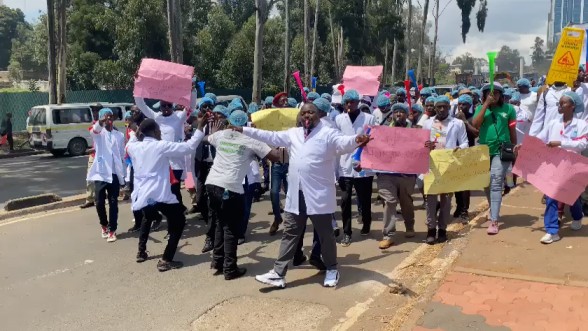
Health Cabinet Secretary Aden Duale has dismissed claims by Kiambu Governor Kimani Wamatangi that the county recorded no maternal deaths for eight months, saying government data confirms several mothers and newborns died in the county’s hospitals during the doctors’ strike.
Speaking before the Senate on Wednesday, Duale said his ministry has credible records proving that a number of women and infants lost their lives when healthcare services were disrupted by the 151-day nationwide strike. He urged the governor to retract his statements, saying they do not reflect the reality on the ground.
“The maternal mortality figures given for Kiambu County are not correct. It’s wrong, and I think it’s good you withdraw it. Many mothers died, particularly when doctors were on strike,” Duale told senators.
He said the ministry’s statistics align with reports earlier released by the Kenya Medical Practitioners, Pharmacists and Dentists Union (KMPDU), which had raised the alarm over the rising number of deaths.
“I have the names of the mothers and the newborns. Before the strike, Kiambu was doing well. But as the Minister for Health, I want to confirm to the nation that several maternal deaths occurred, and I’m ready to provide that evidence,” Duale stated.
Earlier this month, KMPDU reported that more than 105 people had died in Kiambu hospitals since the strike began in May. Union chairperson James Githinji said two major hospitals in the county recorded 53 infant deaths in September alone.
Data compiled by the union also showed that Thika Level 5 Hospital had recorded 18 infant deaths in both May and June, 14 in July, 18 in August, and 34 in September.
KMPDU Secretary General Davji Atellah accused the county of neglecting patients, saying many had been transferred to other counties in poorly equipped ambulances.
“It is unacceptable that people are suffering because of the county government’s inaction,” Atellah said.
However, the Kiambu County Government dismissed the report, accusing KMPDU of inflating figures on maternal and neonatal deaths to discredit the county’s health management.
At the same session, Duale told lawmakers that the national government is working to resolve a Sh10 billion debt left behind by the defunct National Health Insurance Fund (NHIF), which has left many health facilities in financial distress.
He said the crisis facing hospitals is not due to the roll-out of the Social Health Insurance Fund (SHIF), but the backlog of unpaid NHIF claims accumulated over time.
Appearing before the National Assembly’s Committee on Health, Duale said the Cabinet had agreed to prioritise settling verified claims below Sh10 million, which make up the bulk of the inherited debt.
“The Cabinet has decided that we start by clearing claims below Sh10 million, which represents the largest portion of the debt—subject to verification,” he told MPs.
Out of the total Sh10 billion, Sh5.3 billion consists of small claims under Sh10 million per hospital, with the smallest claim amounting to Sh300 and the largest to Sh9.9 million.
“Once the Supplementary Budget is passed and the Sh5.3 billion is released, it will be easy to pay these claims. I am ready to share with the Committee a breakdown of the Sh5.3 billion by county, and verification has already begun in collaboration with the Social Health Authority,” he said.
He explained that some claims were as low as Sh1,500, which required verification to confirm authenticity before any payment is made.
“So we were just looking for the people, whether these are real people. Every day they are coming to SHA, and we are verifying. Within one month, we’ll be through with the Sh5.3 billion because we have to verify every payment. This is public money, and these are claims that are under 10 million,” he said.
The CS appealed to lawmakers to support the ministry’s effort to clear the pending bills, warning that several facilities could shut down if the matter is not urgently addressed.
“I urge Members to support us because the biggest challenge health facilities are facing today is not SHIF, but the old NHIF debt. I can confirm to this Committee that several facilities—private, public and faith-based—are on the verge of closure, not because of delayed SHIF reimbursements, but due to the huge pending bills inherited from NHIF,” he said.
He cited St. Mary’s Mumias Mission Hospital in Kakamega as one of the facilities affected, noting that although it had received payments from SHA, it still owed NHIF nearly Sh40 million.
“St. Mary’s Mumias has received payment from SHA, yet it still carries an NHIF debt of close to Sh40 million,” he said.
Duale revealed that more than 15 doctors had been assigned to verify hospital claims and ensure only genuine ones are included in the Supplementary Budget.
“We now have more than 15 doctors deployed to support verification, and the system has been fully taken over. Within a month, by the time the Supplementary Budget is presented to the House, we expect the verification to be complete and a final list of facilities to be paid ready. Only verified claims will be included in the Supplementary Budget,” he said.
He added that the verification exercise would be finalised within a month and a complete report submitted to Parliament for approval.


























Comments
Sign in with Google to comment, reply, and like comments.
Continue with Google