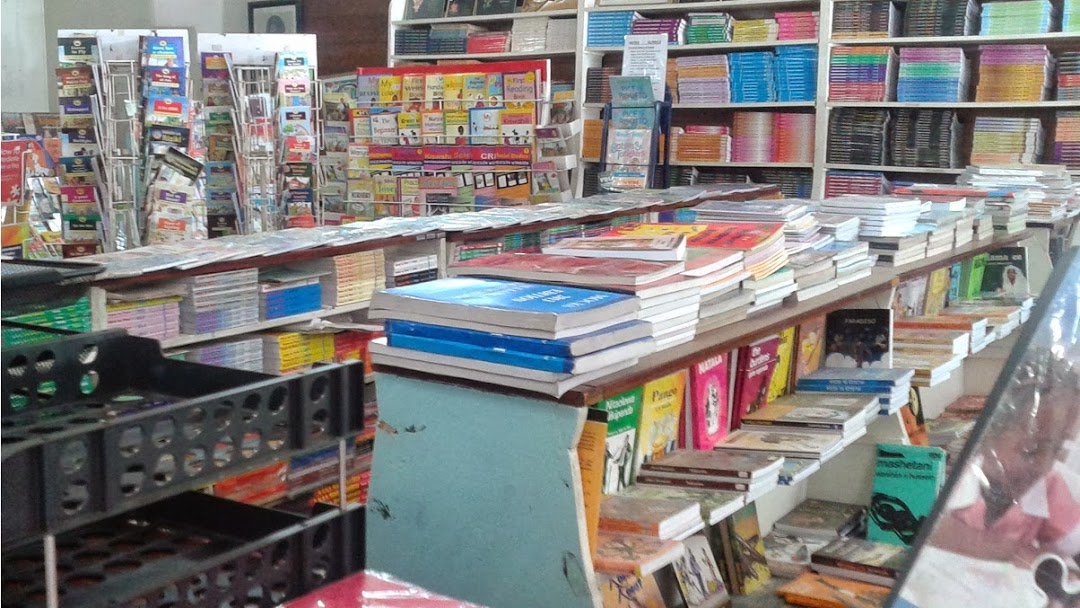
Grade 10 learners in public schools are spending their first weeks in senior school without textbooks for several subjects, as delays linked to unpaid government bills and printing backlogs continue to disrupt learning across the country.
Although the books were approved months ago, distribution has lagged behind, leaving teachers to improvise using curriculum designs from the Kenya Institute of Curriculum Development (KICD) and textbooks from the former 8-4-4 system.
The situation has exposed a tense standoff between the government and publishers over billions of shillings owed for previously supplied books.
KICD Chief Executive Officer Prof Charles Ong’ondo said the delay had nothing to do with the institute’s evaluation process, noting that publishers had completed manuscripts early but could not move to distribution without payment.
“These books were print-ready by June (2025) and have been waiting for a signal to start distribution. That signal is mainly the payment of publishers’ dues, which also translates into printers’ and transporters’ dues,” he said in December 2025.
The government released Sh5.6 billion to publishers in January, a portion of more than Sh11 billion owed for textbooks supplied to other grades. Printing began in the second week of January after the payment was made, according to Prof Ong’ondo.
On Friday, he said KICD had remained on track throughout the process and had already completed work for the next classes.
“We’ve already evaluated and approved books for Grade 11 and will be awarding tenders on Tuesday next week. With adequate funding, distribution of books for Grade 11 could even begin in May. We will start evaluating books for Grade 12 in August this year,” he said.
He said he had expected feedback on the status of distribution by Friday evening but acknowledged that publishers were facing challenges on the ground. “Some are ahead of others. Distribution is also not uniform across the country, but they are all in the field,” he said.
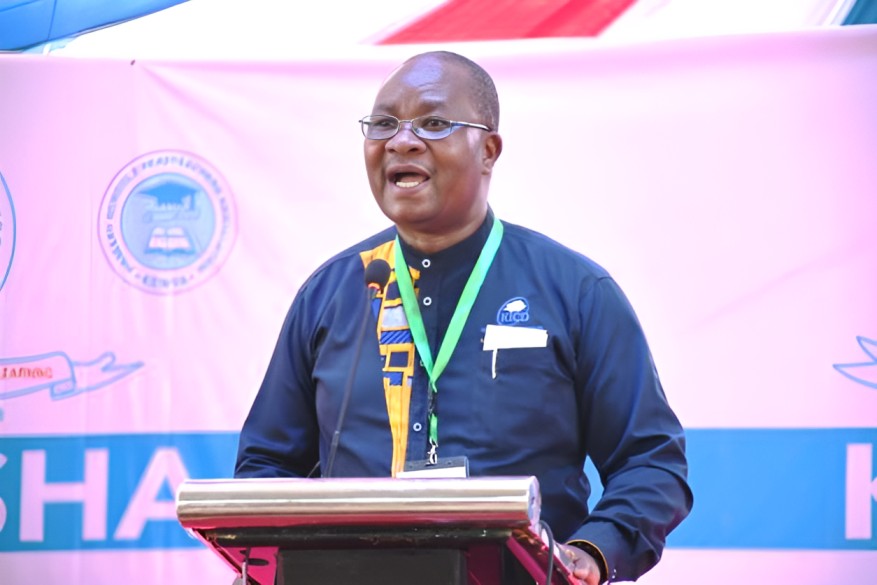 KICD CEO Charles Ong’ondo. PHOTO/Education News
One of the difficulties, he added, was inaccurate learner data, with enrolment figures supplied by the Ministry of Education differing from actual numbers in schools.
Differences in subject combinations across senior school pathways have also complicated delivery, as schools do not offer identical subjects.
While public schools wait, private schools have already received textbooks. After KICD approved Grade 10 materials, publishers printed copies for sale in the open market but did not include those meant for the government order. Parents in private schools have therefore been able to buy the books directly for their children.
The delays have drawn attention to the fierce competition surrounding government textbook tenders. Winning a supply contract guarantees publishers sales of millions of copies over at least two years, making the process highly contested.
With more than one million learners expected to join Grade 10, securing a core subject tender means supplying close to a million books at once under the government’s one-to-one learner-to-textbook policy.
A publisher familiar with the process said some companies may have overcommitted. “Unfortunately, it appears some publishers awarded tenders lack the capacity to print the volumes they promised. Some took loans to print and supply Grade 9 textbooks, and when government payments delayed, they struggled to remain operational,” the publisher told Saturday Nation.
Figures from KICD show that 11,867,325 textbooks have been ordered across 35 learning areas. Under the competency-based education system, all senior school learners take four compulsory subjects: English, Kiswahili or Kenyan Sign Language, Core or Essential Mathematics, and Community Service Learning.
The remaining subjects depend on pathway choices, which include Arts and Sports Science, Social Sciences, and Science, Technology, Engineering and Mathematics.
Ideally, printing should be completed by August, with books delivered during the third term so that schools are fully equipped by January. However, checks indicate that many schools have received books for only a few subjects.
With printers still handling large orders, concerns are growing that some schools may not receive all textbooks before schools close on April 2, 2026.
The current tendering model was introduced in 2018 after it emerged that the one-to-one learner-to-book target was not being met despite the government sending billions of shillings to schools to buy textbooks from the open market.
Under the system, once KICD approves books, the top two publishers are selected. The highest-ranked supplies 60 per cent of the books, while the second supplies 40 per cent.































Comments
Sign in with Google to comment, reply, and like comments.
Continue with Google