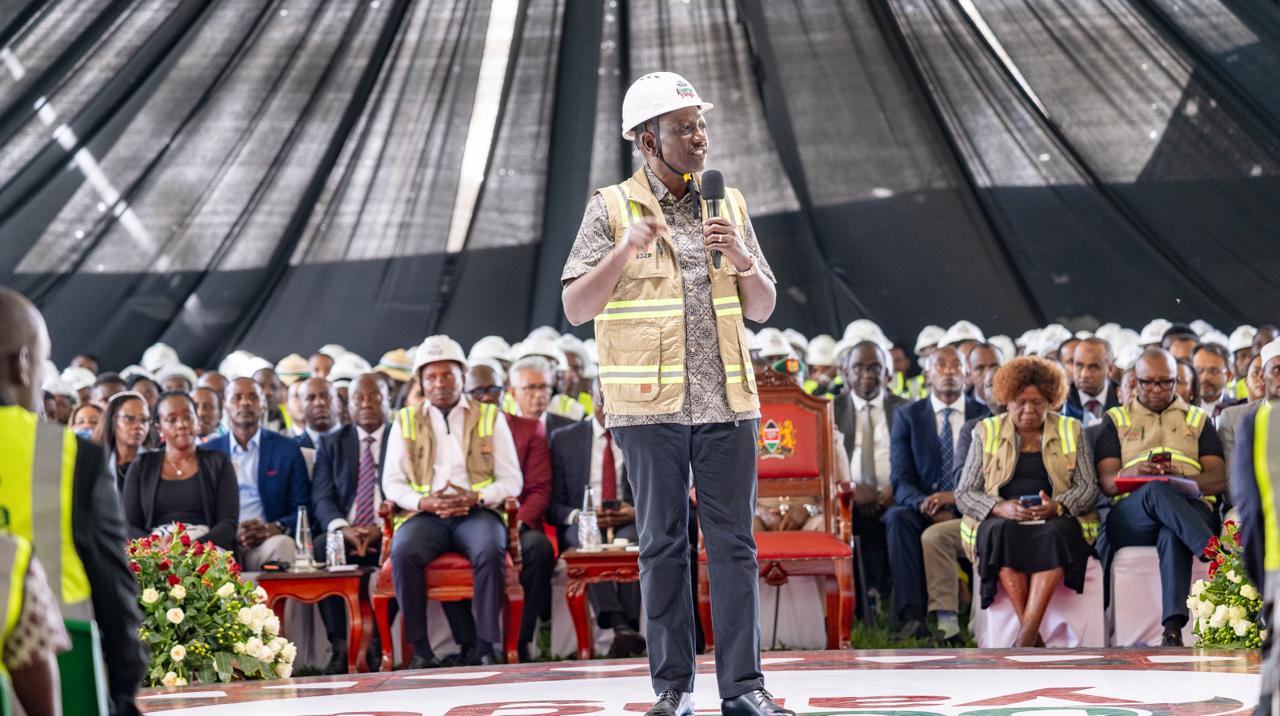
President William Ruto has raised concern over the rising cost of school uniforms, calling for immediate action to prevent children from being excluded from education due to clothing expenses.
He noted that in some schools, parents are being asked to pay as much as Sh38,000 for uniforms, a burden he said was unfair and unnecessary.
Addressing the issue on Friday at State House during the launch of the Affordable Housing Programme Internship Programme, Ruto described expensive uniform policies as a potential avenue for corruption.
“We are going to look into this uniform issue because uniforms are another source of corruption,” he said.
The President emphasized that children must be allowed to attend classes even if they cannot afford new uniforms, noting that continuity in learning is more important than strict dress codes.
“There is no child who will be kept out of class because of uniform. Even if they have the uniform for junior school, they can transition to secondary school without uniform as they wait for parents to organise themselves.”
Ruto said rigid school uniform regulations are creating unnecessary challenges for families already facing economic pressure. He assured that the government will collaborate with parents, school leaders, manufacturers, and other stakeholders to reduce costs and eliminate exploitative practices.
“We must not erect additional impediments to access to education,” he added, stressing that the focus should remain on learning rather than appearance.
The Affordable Housing Programme Internship Programme, which was launched during the event, seeks to create career opportunities for 5,500 young Kenyans in the building and construction sectors. Graduates from over 40 professional fields, including engineering, architecture, urban planning, ICT, finance, environmental studies, surveying, and construction management, are part of the initiative.
Currently, the government is engaging 5,500 graduate interns, including architects and civil, mechanical, and electrical engineers, along with quantity surveyors.
Ruto highlighted that the wider housing initiative has already provided employment to over 500,000 Kenyans, with more than 240,000 housing units under construction across the country. He explained that large-scale public infrastructure projects are central to stimulating economic growth and reducing youth unemployment.
“We are aggressively investing in public infrastructure to create jobs and unlock opportunities for our young citizens,” the President said.
He pointed to examples from countries such as the United States, Germany, and the Philippines, where public infrastructure investments have successfully generated employment and boosted economies.
Beyond housing, Ruto said the government is increasing spending on roads, railways, airports, seaports, energy, and water projects. He said these investments aim to transform Kenya’s economy while providing opportunities to absorb the growing number of young graduates entering the workforce every year.
The President concluded that ensuring access to education and sustained investment in public infrastructure will make opportunities available to all, preventing poverty from becoming a barrier to success.































Comments
Sign in with Google to comment, reply, and like comments.
Continue with Google