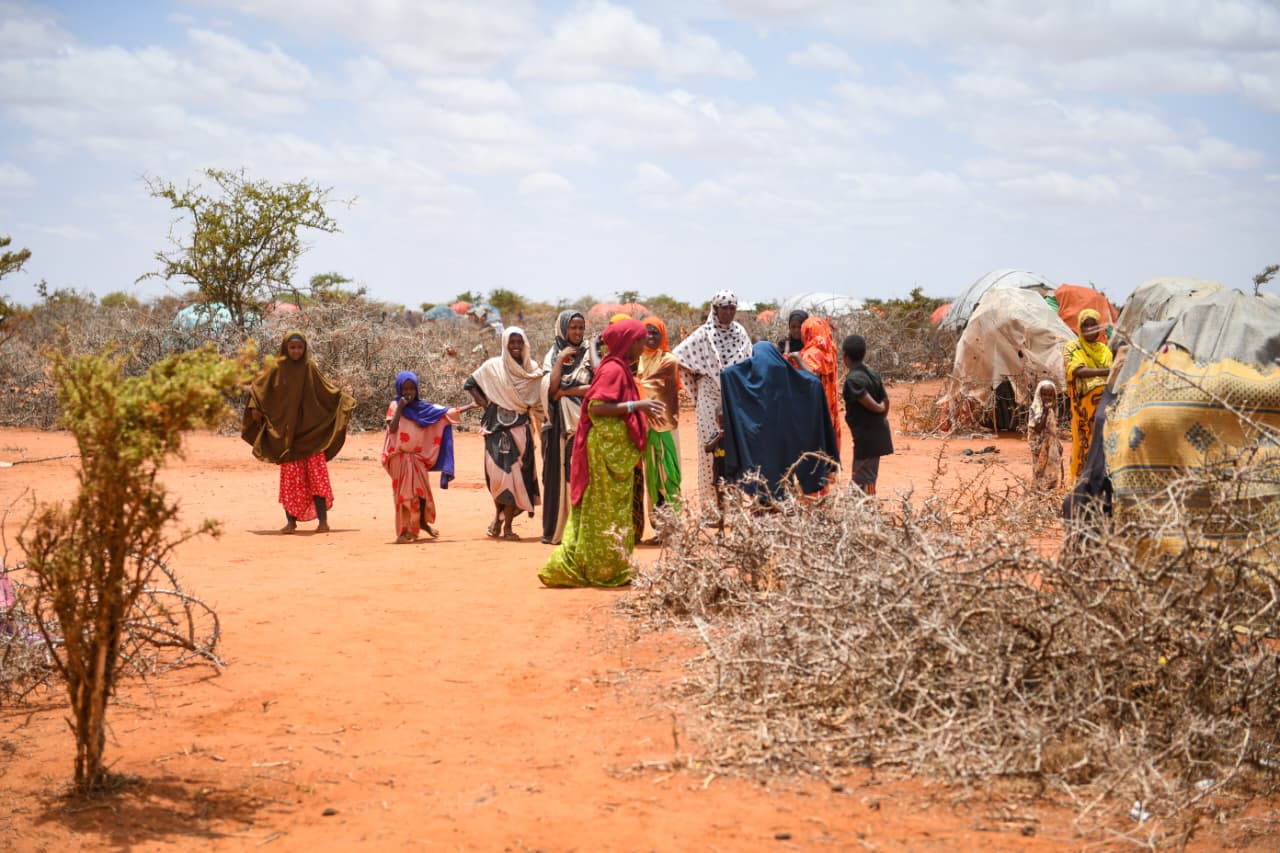
Somalia is confronting a rapidly worsening water crisis as key sources across the country dry up following consecutive failed rainy seasons.
The Federal Government has declared a national drought emergency and urged immediate humanitarian support as millions face hunger, displacement and severe water shortages.
The crisis comes after the April–June and October–December rains performed poorly, deepening an already fragile humanitarian situation.
According to the United Nations Office for the Coordination of Humanitarian Affairs (OCHA) projections, more than 4.4 million people experienced high levels of acute food insecurity between October and December 2025. At least 1.85 million children under five are at risk of acute malnutrition through mid-2026.
OCHA said Northern regions have been hit especially hard. In Togdheer, Sanaag and Sool, an estimated 156,000 people have fled their homes due to extreme drought, with nearly 55,800 crossing into Ethiopia in search of water and pasture.
More than 60,000 livestock have died, and a further 120,000 are in critical condition. Similar conditions are being reported in Bari and Mudug, where rising food prices and loss of livestock are pushing households deeper into crisis.
An OCHA mission to Siinaay village in Gedo region revealed stark conditions. The area last recorded light rainfall in May, leaving the land parched and a reservoir built by aid agencies completely empty.
A water trucking initiative by Lifeline Gedo briefly offered relief in November, but operations were halted on 1 December after funding ran out.
“We were delivering 10,000 litres of water a day,” said Abdi Abdullahi, the organisation’s technical manager. “We are appealing for support to continue providing water for this community.”
Demand for health and social services has also surged. Siinaay Clinic, which previously served around 5,000 people, now receives twice as many due to increased pressure from both village residents and surrounding pastoralist communities.
Across Gedo, Lower Juba and Middle Juba, more than 570,000 people face serious water shortages. Many families are trekking up to 30 kilometres in search of water, while commercial water prices have soared beyond the reach of most households.
“People move long distances to look for water,” said Abdikani Hassan, the humanitarian and development coordinator in Doolow.
Even along the Juba and Dawa rivers, water levels have dropped sharply. Aid workers warn that continued decline could undermine irrigation, reduce crop yields and expose communities to waterborne diseases.
Falling river levels are also causing nearby wells to become more saline, rendering them undrinkable.
Humanitarian organisations are preparing for a surge in displacement as pastoralist and agro-pastoralist families migrate in search of water and grazing land.
Movements are already being reported toward Kenya, Ethiopia and urban centres. In Doolow district, where displaced people already make up half the population, new arrivals continue to stream into camps.
One of them is Fatuma Ali, a grandmother of six, who travelled nearly 170 kilometres from Bakool region after her family ran out of food.
“The rains we relied on failed for more than a year,” she said at Kabasa camp. “We arrived here with nothing; we are seeking help.”
Authorities warn that the coming months will be critical, with the next rainy season not expected until April 2026.
Rising tensions over access to dwindling water and grazing resources have already been reported in Middle Juba, raising fears of further instability.
Aid agencies say their response capacity remains severely constrained. The 2025 Humanitarian Needs and Response Plan is only 24 per cent funded, leaving millions at risk as the crisis deepens.































Comments
Sign in with Google to comment, reply, and like comments.
Continue with Google