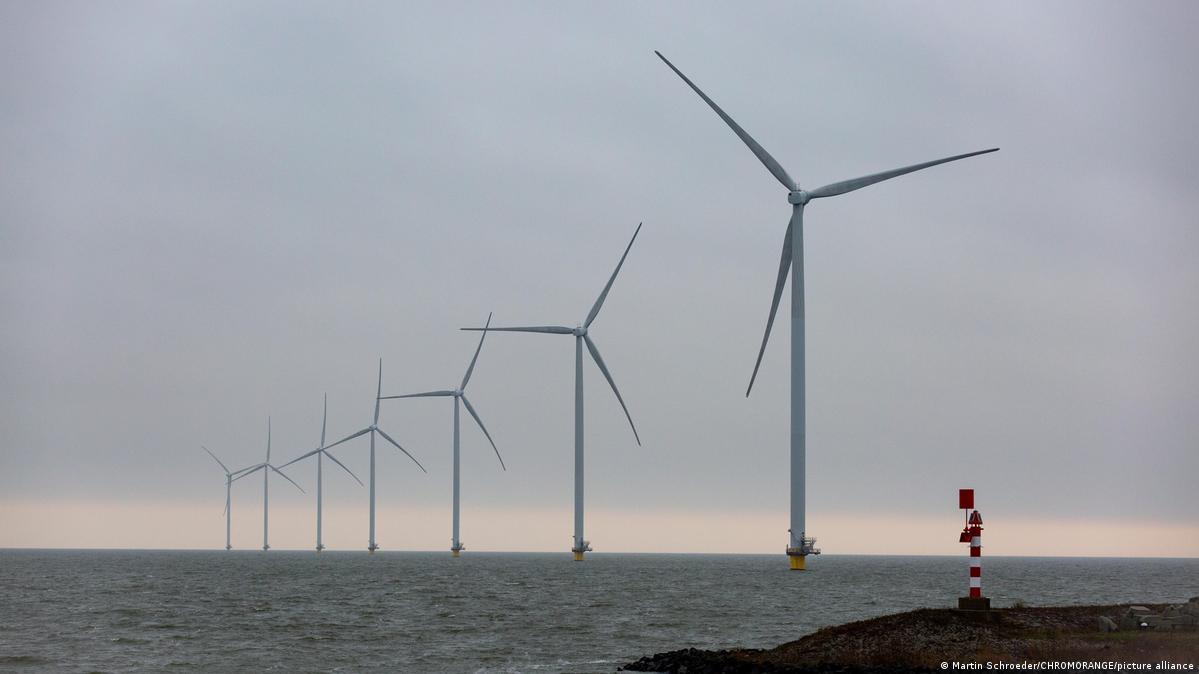
European leaders gather in Germany to boost North Sea clean energy, aiming to create the world’s largest reservoir of clean energy.
Yet, US President Donald Trump’s Greenland ambitions and rising security threats, including sabotage and surveillance linked to Russia, cast a shadow over the summit’s agenda.
Hosted on Monday by German Chancellor Friedrich Merz, the summit aims to accelerate the cross-border expansion of offshore wind energy, develop the hydrogen market, and create interconnected offshore infrastructure.
Merz described the North Sea project as “crucial” for a “strong, secure and independent Europe,” with ambitions to make the region “the world’s largest reservoir of clean energy.”
However, the talks come against the backdrop of recent geopolitical strains triggered by US President Donald Trump’s push to acquire Greenland, an autonomous territory of Denmark.
The issue has stirred unease among European nations, overshadowing the summit’s clean energy ambitions.
Trump had previously threatened to seize Greenland by force and impose tariffs on European NATO allies, obstructing his plans.
Though he recently claimed to have reached a framework agreement with NATO Secretary General Mark Rutte, details remain unclear, sparking both relief and confusion among European leaders.
“We will have to pay increased attention to all parts of NATO’s European territory,” Merz said following an extraordinary European Council meeting. “This concerns the North above all.”
The summit’s guest list includes Danish Prime Minister Mette Frederiksen, who recently visited Greenland, alongside representatives from NATO, the European Commission, and countries bordering the North Sea, including Norway, the Netherlands, Ireland, Belgium, and Luxembourg. Britain and France will send ministers.
“Given the make-up of the meeting, I am certain that security in the High North will also be of interest to the participants,” said Steffen Meyer, spokesman for Chancellor Merz.
Security concerns are paramount given the North and Baltic Seas’ history as targets of “hybrid attacks,” often attributed to Russia.
These have included sabotage of undersea communication cables and surveillance of critical infrastructure.
In Germany, a series of mysterious drone flights over airports, military bases, and industrial sites have heightened alarm, with authorities suspecting these drones were launched from Russian vessels.
Merz emphasized that maritime security alongside shared economic success in the North will be key topics.
The summit builds on commitments made in 2023, when countries agreed to develop up to 300 gigawatts of offshore wind capacity by mid-century, with a 2030 target of 120 GW.
Yet consultancy Baringa warns that, on current trends, only 82 GW will be installed by 2030.
Addressing the industry’s current difficulties will be vital. These include logistical bottlenecks at ports, parts shortages, and grid infrastructure unable to handle variable power inputs.
Another contentious issue is the involvement of Chinese turbine manufacturers, raising concerns about European industrial self-reliance.
Proponents highlight that wind energy is both environmentally beneficial and strategically resilient.
“We’ve learnt a lot over recent years from hybrid attacks and the Ukraine-Russia situation,” said Simon Skillings of think tank E3G.
“Dispersed assets are more resilient. A more dispersed infrastructure is more robust. You need basically multiple attacks rather than single attacks to knock out an energy supply.”
Skillings suggested offshore wind farms could also aid maritime security if equipped with surveillance tools or drones.
However, he noted that very little coordination on these issues in the North Sea exists and warned that building resilience into the system would also drive up costs.
As Europe seeks to navigate a complex intersection of climate ambition, security risks, and geopolitical rivalry, the Hamburg summit will test leaders’ ability to balance cooperation with vigilance in the strategically vital North Sea region.































Comments
Sign in with Google to comment, reply, and like comments.
Continue with Google