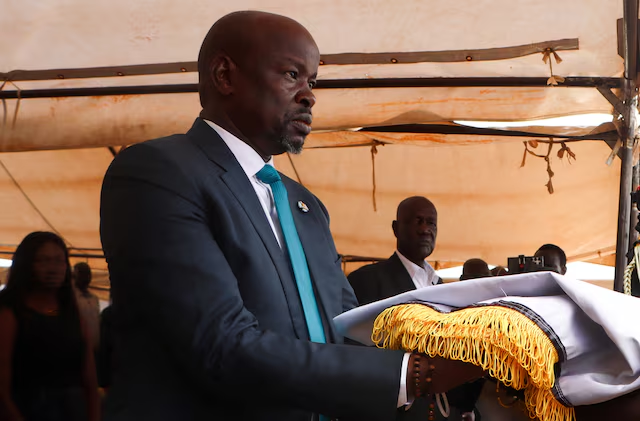
President Salva Kiir has removed Vice President Benjamin Bol Mel from office in a major shake-up of South Sudan’s leadership that also saw the dismissal of the central bank governor and the head of the revenue authority. The decision marks one of the most significant changes in the country’s top ranks in recent months, further reshaping the political balance within the ruling party.
The announcement came just hours after Bol Mel’s office rejected reports on social media claiming he had been placed under house arrest and stripped of his security detail. “The Vice President continues to implement the H.E. President Salva Kiir Mayardit’s vision for a prosperous and self-reliant South Sudan,” his office said in a statement.
Bol Mel, who took office as one of the country’s five vice presidents in February, has also been demoted from the military rank of general, which he was awarded in September. His appointment earlier in the year followed a decree by President Kiir that replaced Wani Igga, with Bol Mel taking the role on behalf of the ruling Sudan People’s Liberation Movement (SPLM).
The vice president’s dismissal comes amid continued controversy surrounding his business dealings. He has been under United States sanctions since 2017 for alleged corruption, and a United Nations report released in September accused companies linked to him of receiving $1.7 billion for incomplete road projects. Bol Mel has not publicly responded to these accusations. The U.S. Treasury had earlier described him as Kiir’s “principal financial advisor,” an assertion that the president’s office has denied.
Analysts have said Bol Mel’s rapid rise in government and within the SPLM made him a key political figure and a possible successor to Kiir, but also attracted resistance from senior political and security figures in Juba. His removal, along with the firing of other senior officials, adds to growing unease within the ruling establishment and raises fresh doubts about the country’s stability.
South Sudan, which became independent in 2011, has struggled with persistent political divisions. National elections have already been delayed twice — in 2022 and again in 2024 — as rival factions continue to clash over power-sharing and constitutional reforms.
First Vice President Riek Machar, who was Kiir’s main opponent during the civil war, was arrested in March and charged with treason, further heightening tensions. In recent months, fighting between forces loyal to Kiir and several armed groups has intensified, deepening fears of renewed unrest.
Observers warn that Bol Mel’s ouster and the broader reshuffle could worsen internal rivalries and increase uncertainty about who will eventually succeed President Kiir. The country operates with five vice presidents under the 2018 peace agreement, a power-sharing structure that was meant to secure unity but has often exposed divisions at the top of government.
With the latest changes, South Sudan faces a renewed test of its fragile peace as questions over leadership and governance continue to shape the nation’s uncertain path forward.































Comments
Sign in with Google to comment, reply, and like comments.
Continue with Google