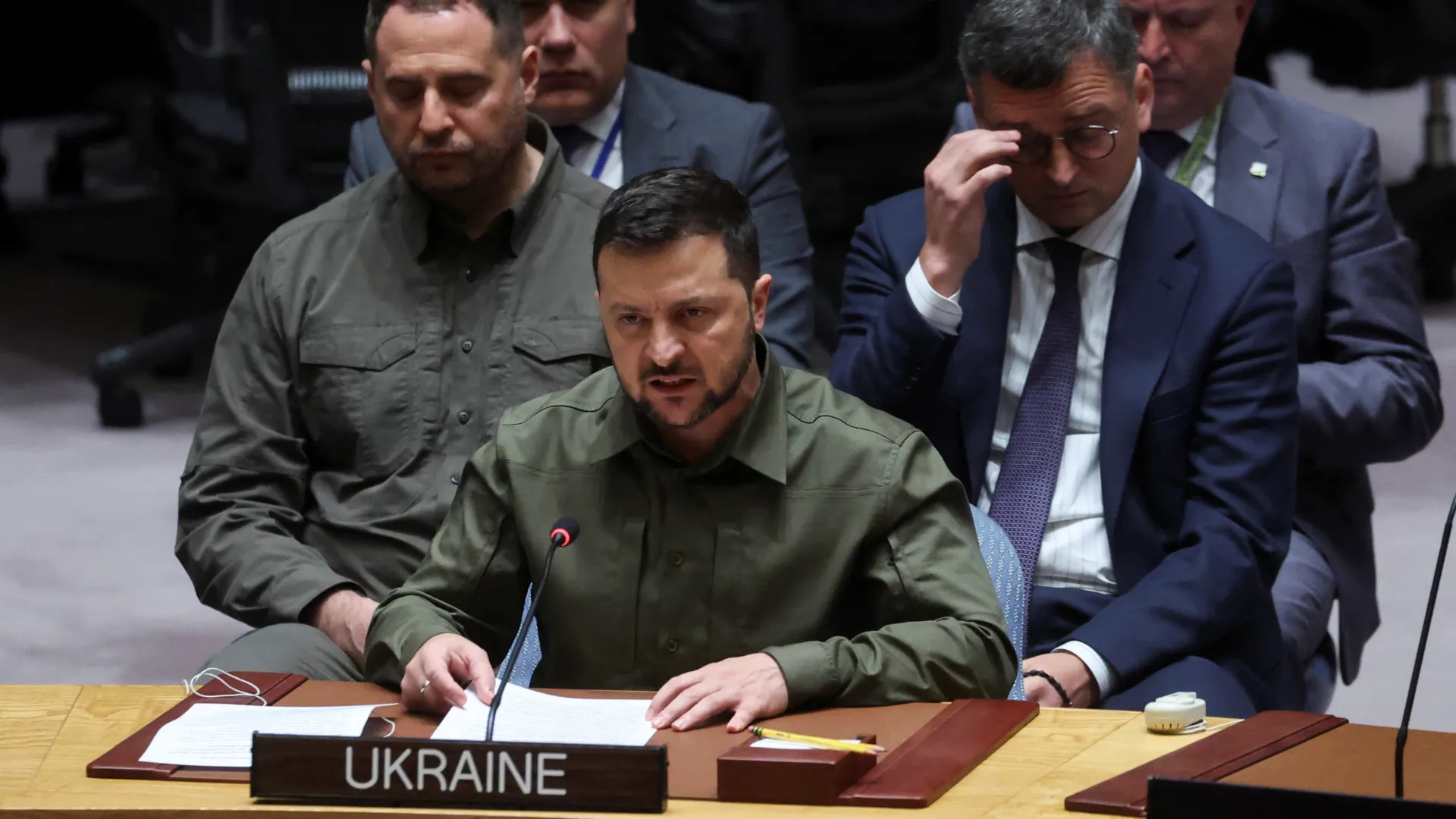
Ukraine could hold elections within the next two to three months if security is assured, President Volodymyr Zelensky said, responding to claims by former US President Donald Trump that Kyiv is delaying polls to stay in power.
Zelensky’s five-year term was scheduled to end in May 2024, but elections have been suspended since martial law was imposed after Russia’s full-scale invasion in February 2022.
Speaking after Trump’s remarks in a broad interview with Politico, Zelensky said he would seek proposals to change the law to allow voting under secure conditions.
“I'm asking now, and I'm stating this openly, for the US to help me, perhaps together with our European colleagues, to ensure security for the elections,” he told reporters.
He emphasized that decisions on elections belong to Ukrainians. “The issue of elections in Ukraine, I believe, depends first and foremost on our people, and this is a question for the people of Ukraine, not the people of other countries. With all due respect to our partners,” Zelensky said.
He dismissed claims that he is clinging to power or prolonging the war for political gain, calling them “frankly, a completely unreasonable narrative.” Zelensky won the 2019 election with over 73% of the vote.
Russia has repeatedly demanded new elections as part of ceasefire negotiations, a position echoed by Trump. “They talk about a democracy, but it gets to a point where it's not a democracy anymore,” Trump told Politico.
Despite Zelensky’s statement, experts say practical challenges make wartime elections difficult. Soldiers on the front line may be unable to vote, millions of Ukrainians are displaced abroad, and extensive security measures would be required to ensure a fair process.
Opposition voices have raised doubts. Oleksiy Goncharenko, an MP from the European Solidarity party, said, “I am completely against the idea, I can't even understand why Zelensky would say it. It is completely impossible. Maybe Zelensky sees it as an opportunity to hold quasi-elections that will be favourable to him, while he controls the media and his opponents are likely not ready.”
Even within Zelensky’s party, there is little push to hold elections while martial law remains. Oleksandr Merezhko, chairman of the foreign policy committee in Ukraine’s parliament, said, “Even the opposition, which is against Zelensky and would like to see him removed are against elections, because they understand the danger of attempting to hold elections during the war.”
Merezhko added that attempting elections now would serve Russia’s interests. “An election campaign would be divisive. Having failed to destroy us from outside, Putin wants to destroy us from within, using elections as another tool to do so.”
Public opinion also favors delaying elections until the conflict ends. Anton Grushetsky, director of the Kyiv International Institute of Sociology, said only about 10% support holding polls before a ceasefire or peace agreement. A September KIIS poll showed 63% of Ukrainians believed elections should wait until after a complete settlement.
Despite the challenges, Zelensky remains the most popular politician in Ukraine, with 22.3% support in October polls, followed closely by Gen Valerii Zaluzhnyi, ambassador to the UK.
Citizens on the ground are cautious. Yulia Tovkach, a business owner in Bucha, said, “If we don't [end martial law], we will be accused of not having a legitimate, proper election. And to end martial law, we need a truce with security guarantees.” Yana Kolomiets, a casting director in Odesa, described the idea as “foolish” even if she is dissatisfied with Zelensky.
Zelensky is also under pressure to engage with Trump’s proposed peace plan, which the US leader claims could end the war but would require Ukraine to cede territory. Zelensky has indicated that a 20-point plan will soon be shared with the US after “our joint work with President Trump's team and partners in Europe,” though he offered no further details.
Meanwhile, Trump spoke with UK Prime Minister Keir Starmer, French President Emmanuel Macron, and German Chancellor Friedrich Merz about a potential ceasefire. European leaders described the talks as a “critical moment for Ukraine, its people and for shared security across the Euro-Atlantic region.”
The Kremlin welcomed Trump’s statements, noting they align with Russia’s view on NATO, territorial claims, and the ongoing war.
Zelensky continues diplomatic efforts in Europe, seeking security guarantees and opposition to any deal that could leave Ukraine vulnerable to future attacks, while firmly rejecting territorial concessions.































Comments
Sign in with Google to comment, reply, and like comments.
Continue with Google