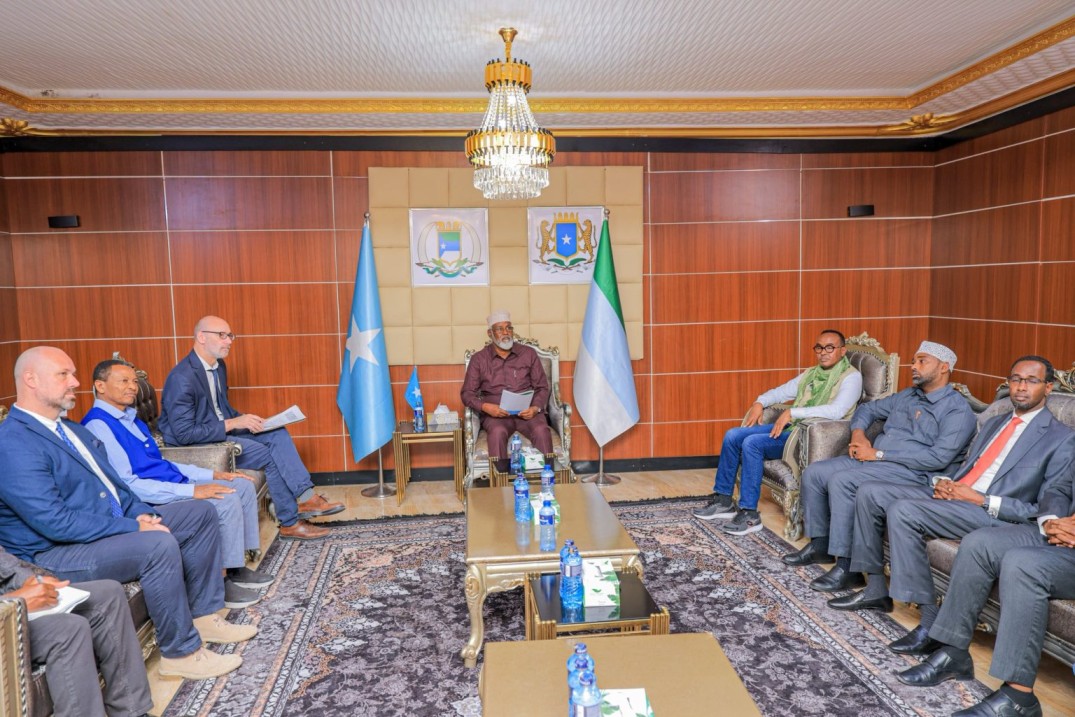
More than 1.5 million people in Jubbaland have been directly affected by a severe drought, State President Ahmed Mohamed Islam Madobe has confirmed.
Thousands of livestock have perished, undermining the livelihoods of communities that rely heavily on pastoralism.
President Madobe said people displaced by the drought are currently receiving limited assistance through the Jubbaland Drought Response Committee, which is delivering water and food to the hardest-hit areas.
“Water and food are the most pressing challenges currently facing affected communities,” he said, warning that without urgent local and international support, the situation could escalate into famine.
President Ahmed Madobe called on the Somali people, the diaspora, and the international community to participate in ongoing relief efforts.
The Commissioner of Somalia’s Disaster Management Agency (SoDMA), Mohamud Abdulle, and George Conway, United Nations Deputy Special Representative and Humanitarian Coordinator, visited parts of Jubbaland areas to assess the crisis.
They met displaced families and pastoralists who have lost livestock, as well as local community leaders, women, and youth groups, to better understand urgent humanitarian needs such as food, water, healthcare, and livelihood support.
Commissioner Abdulle described the living conditions as harsh, emphasizing that the drought continues to threaten lives and livelihoods across the region.
He urged stronger cooperation among government agencies, humanitarian partners, and local communities to mitigate the crisis.
Somalia is taking historic steps to anticipate and reduce disaster impacts before they escalate.
Mohamud Mo’allim Abdullahi, a Commissioner at the Disaster Management Agency, said the National Anticipatory Action Roadmap (2025–2028) is a transformative framework for disaster risk management.
The roadmap aims to harmonize early warning systems, response triggers, financing mechanisms, communication strategies, and legal structures.
It will ensure that anticipatory action becomes a central part of Somalia’s resilience architecture.
“Our recent experiences with the 2023–2024 El Niño-driven floods show that forecast-based early action saves lives, protects critical assets, and reduces the financial burden of emergency responses,” Abdullahi said.
He stressed that the roadmap places communities, particularly the most vulnerable, at the center of all disaster preparedness and response efforts.
The roadmap was developed through an inclusive, multi-stakeholder process involving national government institutions, UN agencies, international partners, technical experts, and community-based actors.
It aligns with Somalia’s National DRM Policy, the National Multi-Hazard Early Warning System Strategy, the National Transformation Plan, and the IGAD Regional Roadmap.
“Together, we can ensure Somalia moves from reactive crisis response to proactive resilience, turning risk into opportunity and vulnerability into strength,” Abdullahi said, calling on all partners to work collectively to operationalize the roadmap.
Recurring droughts in Somalia have displaced thousands of families, putting further pressure on already limited resources in Jubbaland.






























