A call for humanitarian support has been renewed as communities across Kenya grapple with worsening hunger, damaged livelihoods and spreading disease following months of harsh weather.
The International Federation of Red Cross and Red Crescent Societies says its appeal aims to prevent a deepening crisis, warning that families already struggling with drought are now facing fresh threats from flooding and waterborne illness.
In a detailed update, the federation outlined its request for 15 million Swiss Francs, about Sh2.1 billion, to help the Kenya Red Cross Society expand relief activities in the most affected areas.
The financial support will assist 2.1 million people who have been hit hard by climate shocks and have limited means to rebuild. Emergency food supplies, safe water, medical care, shelter and livelihood recovery are among the priority needs highlighted.
The federation noted that Kenya has faced continuous weather extremes, resulting in severe pressure on aid systems. It said prolonged drought in the ASAL counties, followed by heavy rains and floods, has left families without time to recover or rebuild their sources of income.
“The compounded nature of these shocks means vulnerable households have had no time to recover. We urgently need international solidarity to prevent further loss of life,” the federation stated.
The assistance plan focuses on supporting 300,000 people directly through immediate aid and early recovery programs, while also strengthening coordination with government departments and partners to ensure help reaches those most at risk.
“An emergency appeal for 15 million Swiss Francs enables KRCS to scale up lifesaving and early recovery efforts to 300,000 people across health, nutrition, shelter, water, and livelihoods,” the statement added.
According to the appeal, the failure of short rains in late 2024 worsened food shortages across arid and semi-arid regions that make up most of the country and are home to millions of pastoralist families.
“Kenya’s Arid and Semi-Arid Lands (ASALs) are facing one of the worst droughts in recent years. Failed rains, water scarcity, and livestock deaths have left 2.1 million people at risk of acute food insecurity,” the federation said.
Forecasts show that rainfall deficits will continue in many drought-hit areas, while parts of Turkana and the Lake Basin will likely receive above-normal rains, potentially leading to displacement and more disease outbreaks.
Current estimates show 1.8 million people already need urgent food support, with the number expected to rise. “Within this group, 179,000 people are already in IPC Phase 4 (Emergency), mainly in Baringo, Mandera, Marsabit and Turkana,” the appeal reads.
The federation further reported that more than 740,000 children are malnourished, including nearly 179,000 facing severe malnutrition. Over 109,000 pregnant and breastfeeding women are also in need of urgent nutrition and health services.
The situation has been made worse by rising cases of cholera, Rift Valley Fever and brucellosis in remote counties where health resources are limited. Narok County has recorded 55 suspected cholera cases, six confirmed and five deaths.
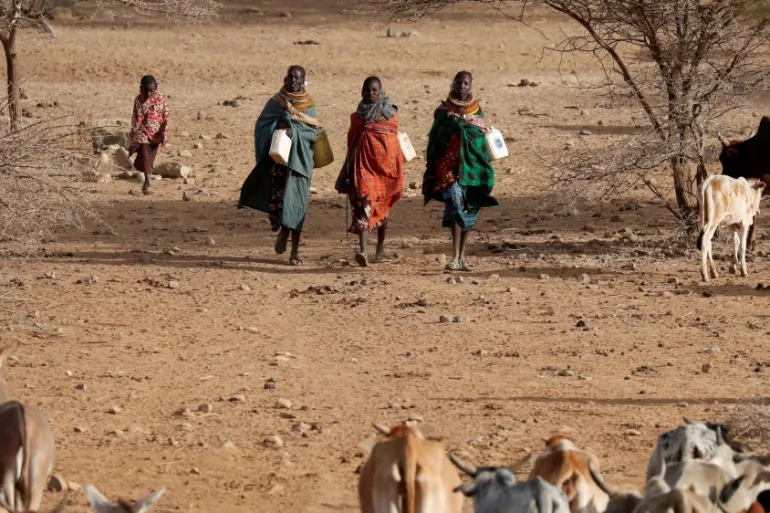
Water shortages have forced households to travel long distances for supplies as rivers and dams dry up. Loss of livestock has also pushed more people into poverty, while cases of gender-based violence and early marriage have risen as families adopt harmful coping methods.
The Kenya Red Cross Society has continued operating despite stretched resources, supported by more than 262,000 volunteers and hundreds of staff across all counties.
Relief efforts include clean water supply, food distribution, medical treatment, shelter and hygiene support. The federation said the appeal will fund solarising boreholes, water trucking, distribution of hygiene supplies, cash support, drought-resistant seeds, livestock feed and mobile health clinics.
Shelter materials and essential household items will be provided to displaced families to help them start rebuilding. The federation emphasised that timely international backing will strengthen resilience and protect lives across affected regions.