President Donald Trump has dismantled a central Obama-era environmental ruling that has guided U.S. efforts to limit greenhouse gas emissions for over a decade.
The 2009 decision, known as the endangerment finding, declared that several greenhouse gases pose a risk to human health. The administration argues that undoing the policy will make vehicles more affordable and reduce costs for industry, but environmental groups warn it could have serious health and climate consequences.
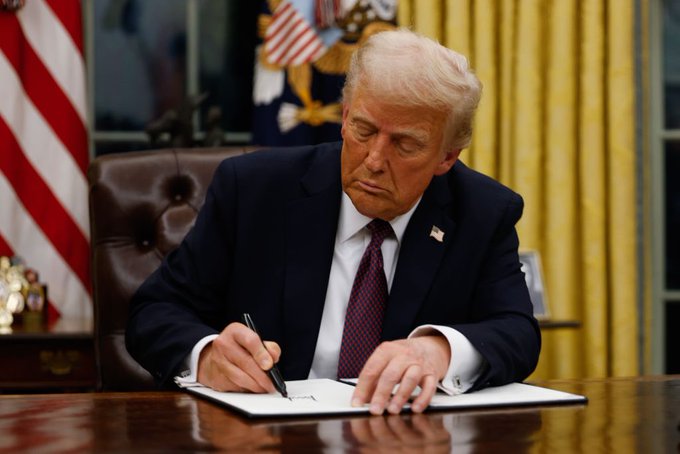
Trump spoke from the Oval Office on Thursday, criticising the original policy. He said the 2009 ruling was "a disastrous Obama era policy that severely damaged the American auto industry and massively drove up prices for American consumers".
"This radical rule became the legal foundation for the Green New Scam, one of the greatest scams in history," he added, referring to the Democrats’ climate agenda.
The White House labelled the move the largest deregulation in American history. Officials said the rollback could save the U.S. economy more than 1 trillion dollars and ease energy and transportation costs. Press secretary Karoline Leavitt said it would cut expenses for carmakers by around 2,400 dollars per vehicle.
Barack Obama, who rarely comments on sitting presidents, criticised the decision. "Without it, we'll be less safe, less healthy and less able to fight climate change — all so the fossil fuel industry can make even more money," he wrote on X.
The 2009 finding was issued by the Environmental Protection Agency early in Obama’s first term, identifying six greenhouse gases, including carbon dioxide and methane, as a danger to public health.
With Congress unable to agree on climate legislation, this finding became the foundation for federal rules targeting emissions in transportation, energy, and other industries.
Meghan Greenfield, a former EPA and Department of Justice attorney, highlighted the ruling’s broad impact. "The endangerment finding has really served as the lynchpin of US regulation of greenhouse gases," she said.
"So that includes motor vehicles, but it also includes power plants, the oil and gas sector, methane from landfills, even aircraft. So it really runs the gamut, all of the standards for each of the sectors is premised on this one thing."
Environmental groups have raised doubts about the Trump administration’s claimed savings. Peter Zalzal from the Environmental Defense Fund warned, "It's going to force Americans to spend more money, around $1.4tn in additional fuel costs to power these less efficient and higher polluting vehicles".
He added that public health could also suffer. "We've also analysed the health impacts and found that the action would result in up to 58,000 additional premature deaths, 37 million more asthma attacks," he said.
Analysts also note the potential impact on the U.S. car industry, which may face challenges exporting less fuel-efficient vehicles to countries with stricter standards. Michael Gerrard, a climate law expert at Columbia University, said the move could place automakers in a difficult position.
"This rollback is sort of cementing things that have already been done, such as the relaxation of the fuel economy standards," he explained.
"But it really does put the US automakers in a bind, because nobody else is going to want to buy American cars."
Beyond industry concerns, the ruling had previously allowed the federal government to block states from adopting stricter carbon standards and limited climate-related lawsuits. Greenfield said this federal control had prevented numerous cases from reaching court.
"The endangerment finding decision has blocked any number of lawsuits, and has been pretty powerful in keeping plaintiffs' claims out of court," she said.
"I would expect states and non-profit groups to bring suits, probably primarily in our state courts, to try to figure out where the contours of this new law are."
Science is expected to be a central issue in any legal challenge. Last year, the Department of Energy assembled a panel to question mainstream climate science, which supported the administration’s proposal. Critics argued the panel was biased and its report misleading, and a federal judge recently ruled the team had been improperly formed.
Some legal experts believe the administration may be aiming for a Supreme Court test before the end of Trump’s term, hoping for a permanent ruling. Greenfield said a victory could lock in the policy, leaving future administrations unable to reverse it without new legislation.
"This is really different as the EPA is exiting the space entirely and wants to do it on a permanent basis," she said.
"If they were to win that issue as they framed it before the Supreme Court, a new presidential administration could not change that position, in the absence of new legislation."































Comments
Sign in with Google to comment, reply, and like comments.
Continue with Google