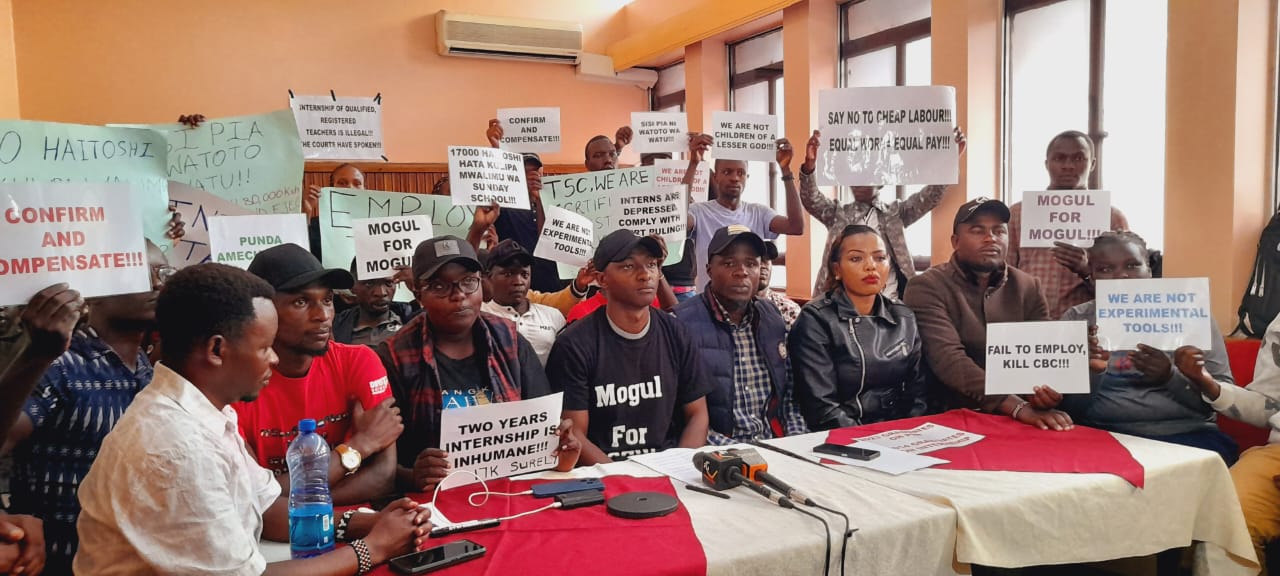
The government has decided to extend the contracts of Junior School intern teachers by a year, postponing their permanent absorption into the Teachers Service Commission (TSC) payroll until January 2027.
The move affects 20,000 interns and comes amid rising concerns about job security and workplace morale.
Basic Education Principal Secretary Prof Julius Bitok said the contract extension, which runs until December 31, 2026, is part of a planned transition to permanent and pensionable terms. He stressed that the government remains committed to ensuring interns are fully integrated into the TSC system at the start of 2027.
“All serving Junior School teacher interns have had their contracts renewed from January 1, 2026, to December 31, 2026,” Bitok said. He added that the extension follows the Teacher Internship Policy and Guidelines (2019) and is designed to allow uninterrupted learning while preparing the way for permanent employment.
The renewed contracts follow a directive by President William Ruto requiring all intern teachers to complete at least two years of service before confirmation.
“President Ruto has already pronounced himself on this issue. First, he said he had listened to the Junior School intern teachers. He gave us a directive that, because they have been given a one-year contract, we extend it by another year and, in the next financial year, provide resources so that they can be confirmed on January 1, 2027,” Bitok said.
Despite these assurances, frustrations persist. The Kenya Junior School Teachers Association said the extension has affected morale, especially since interns earn a monthly stipend of Sh20,000 before deductions. Many teachers had expected permanent letters after a year of service, seeing the two-year internship as a pathway to stable employment.
“I want to assure every intern that after two years, they will be automatically absorbed. That is the plan,” President Ruto had said months earlier, noting that the programme helps address staffing gaps while offering teachers a clear career path.
Alongside the employment issue, debates over Junior School governance continue. Junior School teachers want full autonomy, but the government supports a Comprehensive School model that places both primary and junior sections under one administration.
Under this system, a principal would manage both sections, assisted by two deputies: a Deputy Principal (Primary) for Grades 1–6 and a Deputy Principal (JS) for Grades 7–9.
“According to the Presidential Working Party on Education Reforms, there should be a comprehensive school model, which is an international model consisting of both primary and junior school under one principal with two deputies, one in charge of the primary section and the other in charge of junior school,” Bitok said, describing the plan as a balanced approach.
He added that granting full autonomy to Junior Schools is “unfeasible” due to high resource demands. However, the proposal has faced pushback from more than 23,000 primary school heads and the Kenya National Union of Teachers, who insist that Junior School teachers should work within the current leadership structure or transfer to senior schools.
Kejusta argued that many primary school heads lack the qualifications needed to supervise Junior School teachers.
Kejusta Chairperson James Odhiambo said the matter is awaiting a court ruling. The dispute escalated after 39 Junior School educators, represented by Kejusta, filed a petition at the High Court in Nairobi against Education CS Julius Ogamba, the TSC and Attorney General Dorcas Oduor.
The petitioners argue that placing Junior Schools under primary school heads undermines professional independence, that the government is acting beyond its powers by changing governance without legislation, and that there was no public participation in creating the Comprehensive School policy.
Earlier, TSC Director of Staffing Antonina Lentoijoni suggested a similar structure to ease tensions between Junior School teachers and primary school heads. Lentoijoni said the framework, which involves a principal and two deputies, would be implemented once the National Assembly passes the necessary laws.
President Ruto has also promised to guide the TSC in resolving the standoff.
“I will work with TSC. I know it is an independent organisation, but we are going to give them a policy direction on what they need to do,” the President said in a recent discussion with teachers.
For now, the contract renewal ensures that all Junior School interns remain in classrooms from January 1 to December 31, 2026, while preparations are made for their full absorption into permanent and pensionable positions at the start of 2027.































Comments
Sign in with Google to comment, reply, and like comments.
Continue with Google