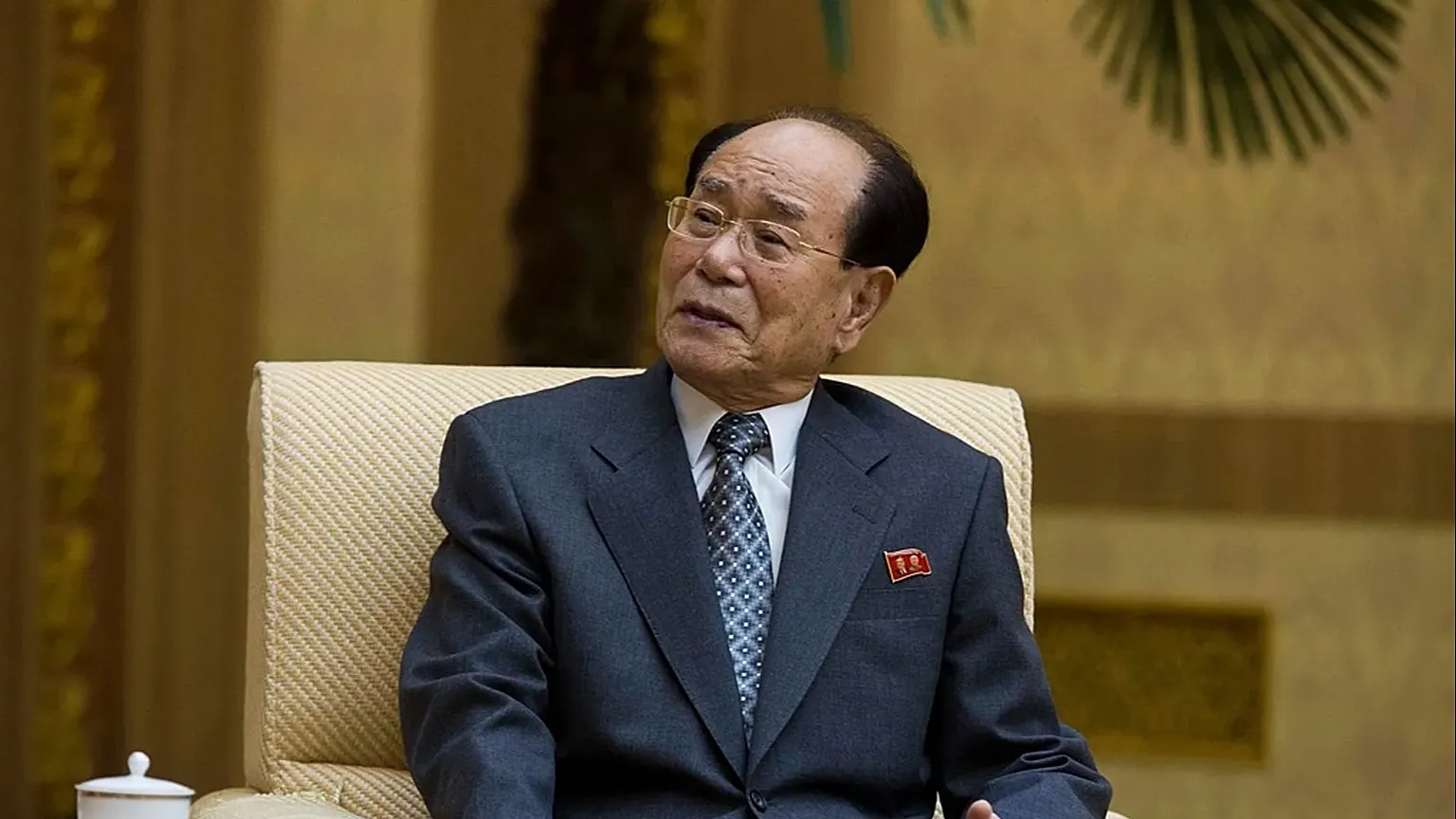
North Korea’s former ceremonial head of state, Kim Yong Nam, a veteran diplomat and one of the country’s most enduring figures of loyalty to the ruling Kim dynasty, has died at the age of 97, according to state media.
The Korean Central News Agency (KCNA) reported that Kim died on Monday, November 3, 2025, due to multiple organ failure.
He had served as president of the Presidium of the Supreme People’s Assembly, a post that made him North Korea’s nominal head of state, from 1998 until April 2019.
“Kim Yong Nam, former president of the Presidium of North Korea’s Supreme People’s Assembly, died Monday of multiple organ failure at the age of 97,” KCNA said.
North Korean leader Kim Jong Un visited the bier of the late statesman on Tuesday, expressing deep condolences over his death.
His funeral is scheduled to take place on Thursday, according to the agency.
Although he held the country’s top ceremonial title for over two decades, the true power, as KCNA noted, always remained with the Kim family, which has ruled North Korea since its founding in 1948.
Kim Yong Nam was not related to Kim Jong Un, the third-generation leader who succeeded his father, Kim Jong Il, in 2011 after the latter’s death.
His loyalty to the Kim family, however, cemented his position at the core of North Korea’s leadership for decades.
Throughout his career, Kim Yong Nam became known for his propaganda-laden speeches delivered in a deep, booming voice during major state functions.
He was often featured in official photographs and television broadcasts greeting visiting foreign dignitaries on behalf of both Kim Jong Il and Kim Jong Un.
One of Kim Yong Nam’s most high-profile moments came in February 2018, when he traveled to South Korea alongside Kim Jong Un’s sister, Kim Yo Jong, to attend the opening ceremony of the Pyeongchang Winter Olympics.
The visit marked one of North Korea’s most significant diplomatic gestures in years, as the country sought to ease tensions with Seoul and Washington.
At the Pyeongchang opening ceremony, Kim Yong Nam and Kim Yo Jong sat within feet of then-US Vice President Mike Pence, KCNA reported, noting that while the two delegations did not interact, the moment symbolized a rare instance of proximity between the rival nations.
The trip made Kim the highest-ranking North Korean official to visit the South in decades.
It also coincided with a brief period of diplomatic outreach that led to the historic summits between Kim Jong Un and then-US President Donald Trump in 2018 and 2019.
However, Kim Yong Nam did not attend those summits, and observers noted that his influence appeared to have waned with age.
In April 2019, he was succeeded by Choe Ryong Hae, a close confidant of Kim Jong Un and a key figure in the country’s ruling elite.
Kim’s career reflected the steadfastness of North Korea’s bureaucracy.
He joined the ruling Workers’ Party soon after the 1950–1953 Korean War and managed to survive the sweeping political purges that consumed many others through the 1970s.
In 1978, he was appointed to the Politburo, and in 1983, he became foreign minister, a post he held for 15 years.
His tenure spanned a turbulent period marked by the collapse of the Soviet Union and the end of the Cold War, events that left North Korea isolated on the global stage.
The media highlighted that Kim Yong Nam’s legacy includes his work in third-world diplomacy.
He was a frequent participant in international gatherings such as the 2012 Non-Aligned Movement summit in Iran, where North Korea sought solidarity among nations outside the influence of major power blocs.
Those who met him described him as “mild-mannered but staunch in his opinions,” reflecting his reputation as a disciplined and loyal bureaucrat who spent his life serving the state.
As the country prepares for his funeral, North Korea’s leadership has framed Kim Yong Nam’s death as the passing of one of its most trusted servants, a man who symbolized the continuity, loyalty, and resilience of the system he served for nearly seven decades.































Comments
Sign in with Google to comment, reply, and like comments.
Continue with Google