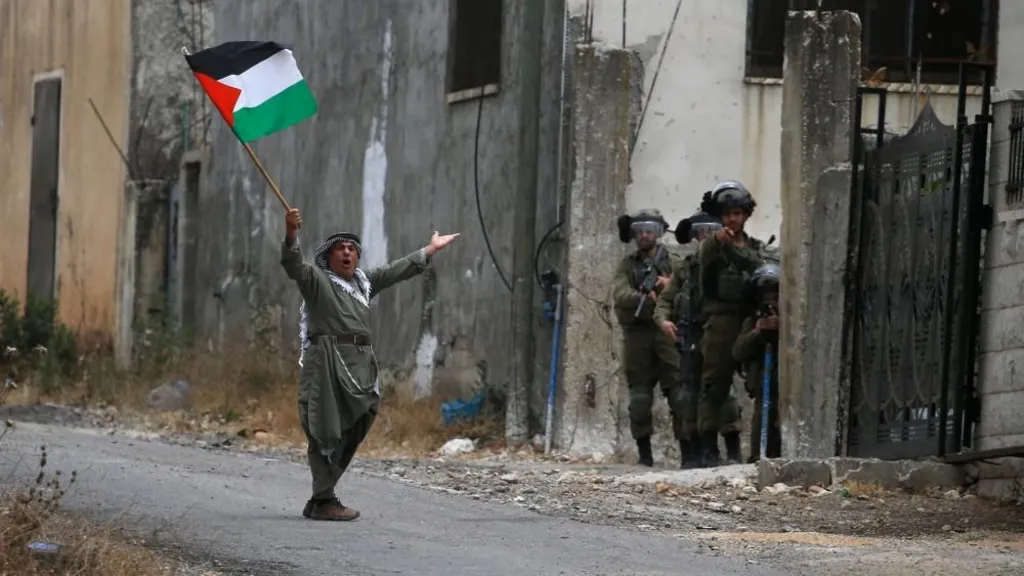
Across the occupied West Bank, the pressures weighing on the Palestinian Authority are no longer confined to political offices in Ramallah.
They are playing out in villages such as al-Mughayyir, where residents say land is slipping away, schools are barely functioning and support from the governing body has thinned as its finances sink deeper into crisis.
Al-Mughayyir sits on rolling terrain dotted with olive trees, yet its quiet landscape has been disturbed by repeated army incursions and the arrival of Israeli settlers establishing new outposts. Local officials say fields that once sustained families are now out of reach.
Marzoq Abu Naim from the village council says the pressure is deliberate. "They're doing it silently, not openly, it's true. But this is annexation. We can't reach our lands."
He explains that when he turns to the Palestinian Authority for help, there is little it can offer. "When I go to them, they can't give me the support I need," Abu Naim says. "The Authority has no money!"
Much of the village lies in an area where Israel retains security control, while the Palestinian Authority is expected to provide civil services. In practice, residents say, the system is failing.
The financial downturn worsened after the October 7 Hamas-led attacks on Israel, when around 100,000 Palestinians lost their permits to work inside Israel.
At the same time, Israel stopped transferring tax revenues it collects on behalf of the Palestinian Authority. The disagreement involves Palestinian school materials and payments to families of Palestinians jailed or killed by Israel, including attackers. Palestinian officials say more than four billion dollars is now being withheld.
With its income restricted, the Authority has reduced payments to public sector employees to about 60 percent of their wages. Teachers, doctors and police officers are among those affected. Public schools serving more than 600,000 students have cut classroom time to three days a week.
In al-Mughayyir, education has become one of the clearest signs of decline. A mother of eight says uncertainty has become routine. "It's truly hard," she says, noting that schools sometimes close altogether when settlers or soldiers are nearby out of concern for children’s safety.
The result, she says, is a generation struggling to keep up. "There is so much disruption that some children have reached fourth grade and still can't read. We put them in private lessons with a teacher in the village. She starts with the alphabet so that they can learn to read from scratch."
Travel across the West Bank has also grown more complicated. Israeli army gates can shut off Palestinian communities with little notice, and checkpoints slow movement between towns. On nearby hillsides, bulldozers are carving wider roads that link settlements and provide faster routes toward Jerusalem. Settlement building continues despite international law deeming such communities illegal.
For the Palestinian Authority, these developments cut to the heart of its purpose. Formed after the Oslo Accords more than thirty years ago, it was meant to serve as a step toward full Palestinian statehood in the West Bank and Gaza, with East Jerusalem as capital. Negotiations and diplomacy were the path it chose.
But direct talks with Israel collapsed over a decade ago, and since then settlement growth has continued. Many Palestinians now question whether the Authority can defend their interests or move closer to independence. Discontent has been fueled by allegations of corruption, a lack of elections and continued security coordination with Israel.
Back in Ramallah, the Authority still maintains visible control in certain districts, with Palestinian police directing traffic and manning offices. Yet conversations in the city increasingly center on whether the governing body can endure the present strain.
Sabri Saidam, a former minister and deputy head of the president’s political party, sees the moment as decisive. "It is a turning point in our lives," he says.
"Palestinian statehood, Palestinian identity, Palestinian existence on this very territory of their ancestors is being now compromised by Israel, and the existence of the Palestinian Authority at large is also questionable."
For communities like al-Mughayyir, these concerns are not abstract. They are reflected in unpaid salaries, interrupted lessons and land that farmers can no longer access. As revenues remain frozen and settlement expansion advances, residents are left wondering how much longer the current system can hold.































Comments
Sign in with Google to comment, reply, and like comments.
Continue with Google