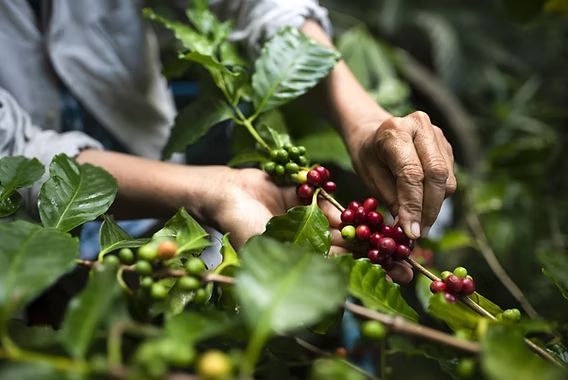
Kenya has launched a new push to restore its struggling coffee sector by expanding farming into counties that have not traditionally grown the crop, in a bid to boost production and secure future supply.
The State has created national and county teams to oversee a two-year plan that seeks to recover land lost to real estate, macadamia and avocado farming, and revive interest among smallholders who over the years abandoned coffee due to low earnings.
A gazette notice by Cooperatives Cabinet Secretary Wycliffe Oparanya says the two-tier structure will prepare and supervise strategies for scaling the crop into emerging zones while supporting existing growers.
The plan will run through the cooperative model, which remains central to organising small farmers and linking them to markets.
“The County Steering Committee shall have similar functions to the National Steering Committee at the county level and shall report on progress and outcomes to the National Steering Committee,” Oparanya said in the notice.
For decades, coffee thrived in highland regions like Kiambu, Murang’a and Nyeri, but those belts have steadily shrunk as growers turned to more profitable alternatives or sold land to developers.
Kiambu, once one of the most productive coffee areas, has seen large portions of farmland replaced with gated housing and commercial developments as urban expansion spreads.
The government now wants to build on gains seen in newer coffee frontiers, including Laikipia, Taita Taveta, Elgeyo Marakwet, Siaya and Baringo, where farmers have been testing the crop with encouraging results.
These counties have recorded an increase in acreage as farmers explore diversification, and the State plans to formalise that shift and spur more planting through coordinated support and cooperative mobilisation.
As part of the wider recovery effort, the committees will bring together key public institutions and sector agencies to align policy and streamline implementation.
Officials say the cooperative approach will allow farmers in new regions to pool produce, gain bargaining power and build the scale needed to attract buyers and financing, something individual farmers would struggle to achieve on their own.
This initiative adds to reforms rolled out since early 2023, when the Nairobi Coffee Exchange was placed under the Capital Markets Authority and licensed brokers were allowed in the trade system.
Recent official export data showed a sharp rise in the value and volume of raw coffee shipped in the first half of the year, climbing to Sh35.4 billion. The rebound suggests renewed farmer engagement and rising confidence in the ongoing reforms, even as the State works to widen the crop’s footprint beyond its traditional heartland.






























Comments
Sign in with Google to comment, reply, and like comments.
Continue with Google