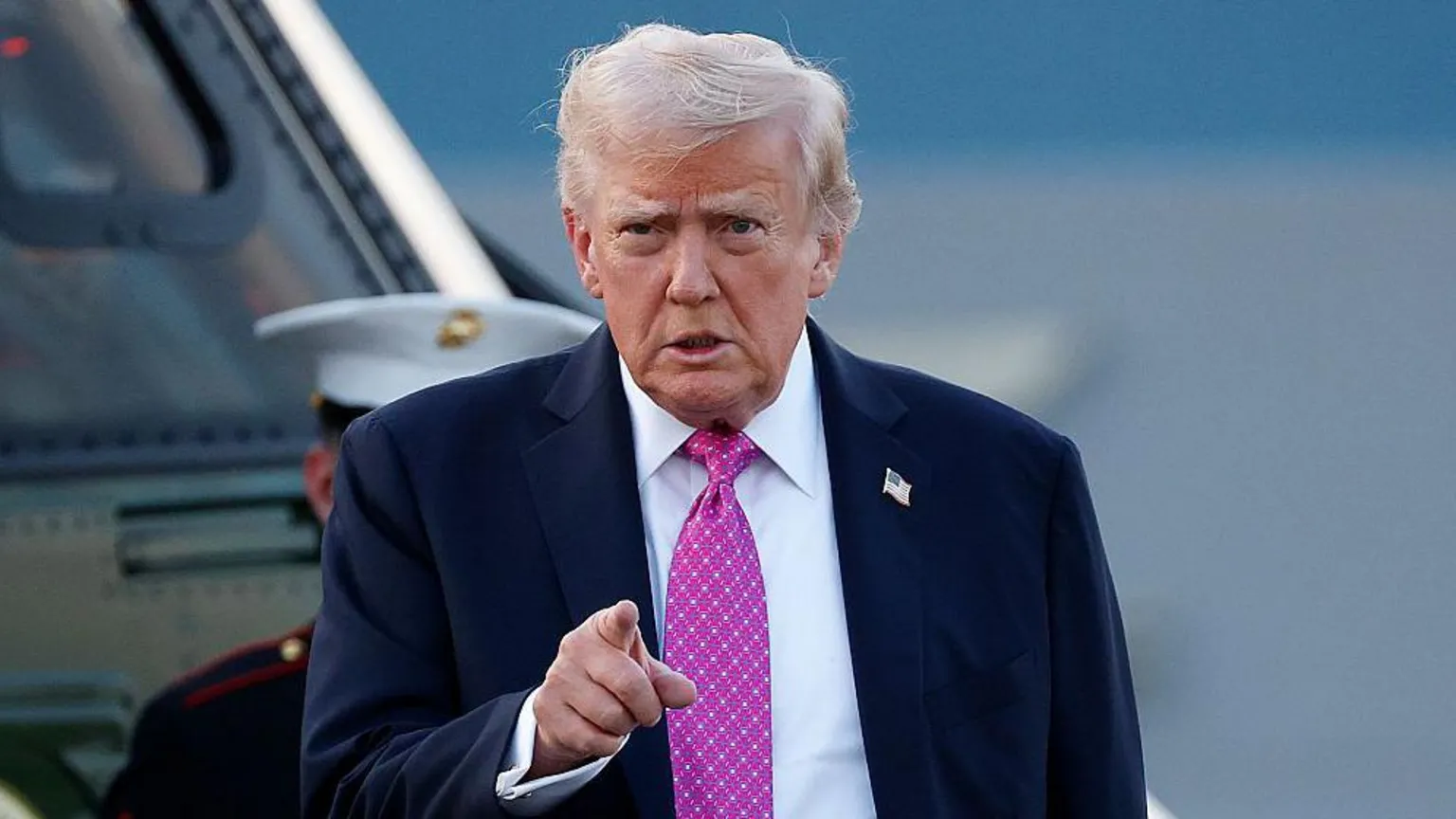
President Donald Trump says the US has captured Venezuela's leader, Nicolas Maduro, and his wife as he confirmed a "large-scale" strike against the country on January 3, 2026.
In a post on Truth Social, Trump said the operation was done in conjunction with US Law Enforcement.
“The United States of America has successfully carried out a large-scale strike against Venezuela and its leader, President Nicolas Maduro, who has been, along with his wife, captured and flown out of the Country. This operation was done in conjunction with U.S. Law Enforcement. Details to follow. There will be a News Conference today at 11 A.M., at Mar-a-Lago. Thank you for your attention to this matter!” Trump said.
In a statement posted on social media, Trump added that more details would follow. He announced a news conference at 11am at his Mar-a-Lago residence in Florida.
The announcement came hours after Venezuela declared a nationwide state of emergency following alleged overnight air and missile strikes on Caracas and the states of Miranda, Aragua, and La Guaira.
The Venezuelan government said explosions were reported at both civilian and military locations.
Videos circulating on social media appeared to show low-flying aircraft over Venezuelan airspace and plumes of smoke, though the footage has not been independently verified.
US officials told CBS News that President Trump had ordered the raids.
The government of Maduro condemned the attacks as a “grave military aggression” and a violation of the United Nations Charter, warning that the strikes threaten regional peace in Latin America and the Caribbean. Caracas accused Washington of attempting to seize strategic resources and undermine Venezuela’s sovereignty.
“The objective of this attack is none other than to seize Venezuela’s strategic resources, particularly oil and minerals, and to break the nation’s political independence by force,” the government said.
“They will not succeed. After more than 200 years of independence, the people and their legitimate government remain steadfast in defence of sovereignty and the inalienable right to decide their own destiny.”
President Maduro signed a decree citing constitutional and national security laws, declaring a State of External Commotion, which authorises nationwide deployment of the Comprehensive Defence Command, increased mobilisation of the armed forces, and collaboration with civilian authorities.
Venezuela said it would raise the matter at international forums, including the UN Security Council, the UN Secretary-General, the Community of Latin American and Caribbean States (CELAC), and the Non-Aligned Movement, seeking condemnation and accountability.
Regional leaders reacted swiftly. Colombian President Gustavo Petro called for immediate international attention:
“Right now they are bombing Caracas. The OAS and the UN must meet immediately,” he wrote on social media.
Cuban President Miguel Díaz-Canel denounced the operation as a “criminal attack”, urging a response from the international community and warning that the region’s peace is at risk.
The developments follow sharply deteriorating relations between Washington and Caracas.
In recent months, US forces have stepped up maritime operations in the Caribbean and eastern Pacific, targeting vessels suspected of drug trafficking.
US officials say more than 30 interdictions occurred over the past three months.
President Trump has also intensified pressure on Venezuela, imposing a blockade in December, designating Maduro and senior officials as leaders of a foreign terrorist organisation, and seizing Venezuelan-linked oil tankers in the Caribbean.
Notably, just days before the alleged strikes, Maduro had indicated willingness to hold dialogue with Washington on drug trafficking and oil-related issues.
In a state television interview, he said talks could take place “wherever they want and whenever they want,” signalling openness to negotiations despite rising tensions.































Comments
Sign in with Google to comment, reply, and like comments.
Continue with Google