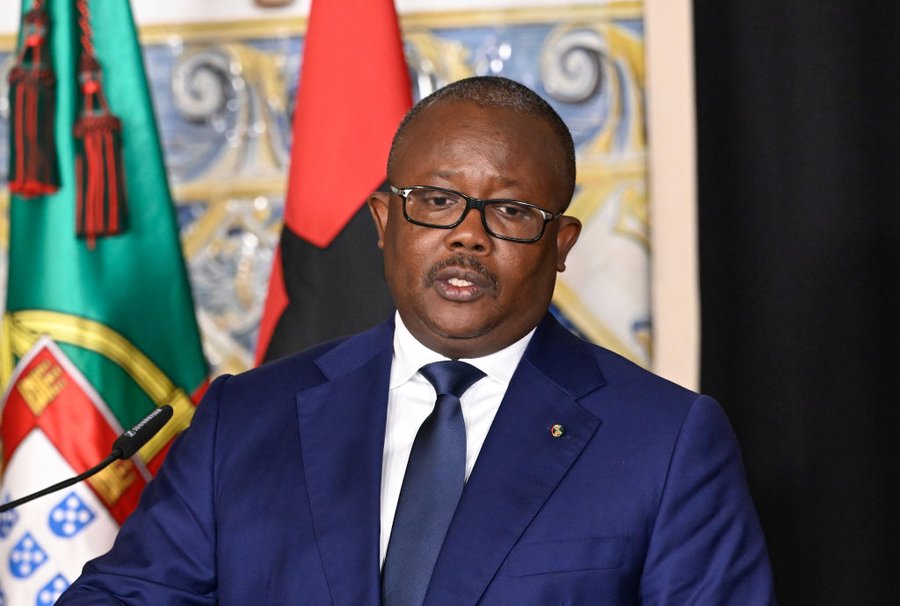
Guinea-Bissau’s toppled leader Umaro Sissoco Embaló has been flown to Senegal after being freed by the military officers who removed him from power this week, bringing a tense chapter in the country’s latest political upheaval to a temporary close.
Senegal’s authorities confirmed his arrival late Thursday following talks led by the West African bloc Ecowas, which had pushed for his safe transfer as uncertainty deepened back home.
In a statement, Senegal’s foreign ministry said Embaló landed “safe and sound” aboard a chartered military aircraft, marking the first public sighting of the former president since soldiers took control in Bissau.
His removal came only a day before authorities were expected to release provisional results from a presidential and parliamentary vote. The military, which has now taken charge of the country, halted the electoral process and stopped the results from being published.
It claimed its intervention was meant to prevent a scheme by unnamed political actors who, according to the soldiers, had “the support of a well-known drug baron” seeking to destabilise the nation. A night-time curfew has been imposed.
The army has already installed General Horta N’Tam, previously the military’s chief of staff, as the transitional leader for a one-year period. After being sworn in on Thursday, Gen N’Tam said the military stepped in “to block operations that aimed to threaten our democracy”. Soon after, land, air and sea borders that had been closed during the takeover were reopened.
The shock move unfolded in a country long troubled by power struggles. Wedged between Senegal and Guinea, Guinea-Bissau has wrestled with political instability for decades, with the military holding considerable influence since independence from Portugal in 1974.
The country is also known as a transit point for drug trafficking, a reality that has shaped many of its political crises.
Both Embaló and his main challenger Fernando Dias had declared victory in Sunday’s presidential race, raising tensions even before the military intervened. Dias enjoyed the backing of former Prime Minister Domingos Pereira, who had earlier been barred from contesting.
Government sources told the BBC that Dias, Pereira and Interior Minister Botché Candé were also detained by the junta.
The military has banned public gatherings and prohibited what it described as actions that could disturb peace, as reported by AFP. Many shops and markets in Bissau remained closed on Thursday while soldiers patrolled major roads.
Some civil society groups have accused Embaló of staging what they called a “simulated coup”, claiming he used the military to block the release of election results in case he lost. Dias echoed this view, describing the takeover as an “organised coup”.
He told AFP he considered himself the rightful winner, saying he believed he secured about 52% of the vote. Embaló has not replied to the allegations. The 53-year-old has previously said he survived several coup attempts during his tenure, though critics have long accused him of creating crises to silence opponents.
The reaction from international bodies was swift. Ecowas suspended Guinea-Bissau from all its decision-making organs and demanded that soldiers withdraw to the barracks, branding the takeover a “grave violation of Guinea-Bissau’s constitutional order”.
The African Union issued a separate statement condemning the coup and urging respect for constitutional rule. UN Secretary-General Antonio Guterres added that he was “deeply concerned” and called for the “immediate and unconditional restoration of constitutional order”.
Guinea-Bissau has now recorded at least nine coups or attempted coups over the last 50 years, underlining how fragile its political landscape remains as the country enters yet another uncertain transition.































Comments
Sign in with Google to comment, reply, and like comments.
Continue with Google