Several countries supporting Donald Trump’s newly formed Board of Peace have pledged over $7bn to aid Gaza, as the US pushes a ceasefire plan that ties the territory’s reconstruction to Hamas disarmament.
Trump shared the announcement during the board’s first gathering in Washington on Thursday. The organisation, launched last month, has faced reluctance from some Western allies, who worry it could overshadow the United Nations even though it was introduced as a forum to help end the conflict between Israel and Hamas.
The US-led ceasefire framework has two main priorities: dismantling Hamas’ military capabilities and rebuilding Gaza’s infrastructure. Speaking to the board, Trump said it “looks like” Hamas would disarm. Yet reports from Gaza indicate the militant group is consolidating control rather than giving up weapons.
Israeli Prime Minister Benjamin Netanyahu, addressing the session, stressed that Israel had “agreed with our ally the US there will be no reconstruction of Gaza before the demilitarisation of Gaza”.
The conflict erupted following the Hamas-led assault on southern Israel on 7 October 2023, which left roughly 1,200 people dead and 251 taken hostage. Israel’s subsequent military campaign in Gaza has claimed more than 72,000 lives, according to the Hamas-run health ministry.
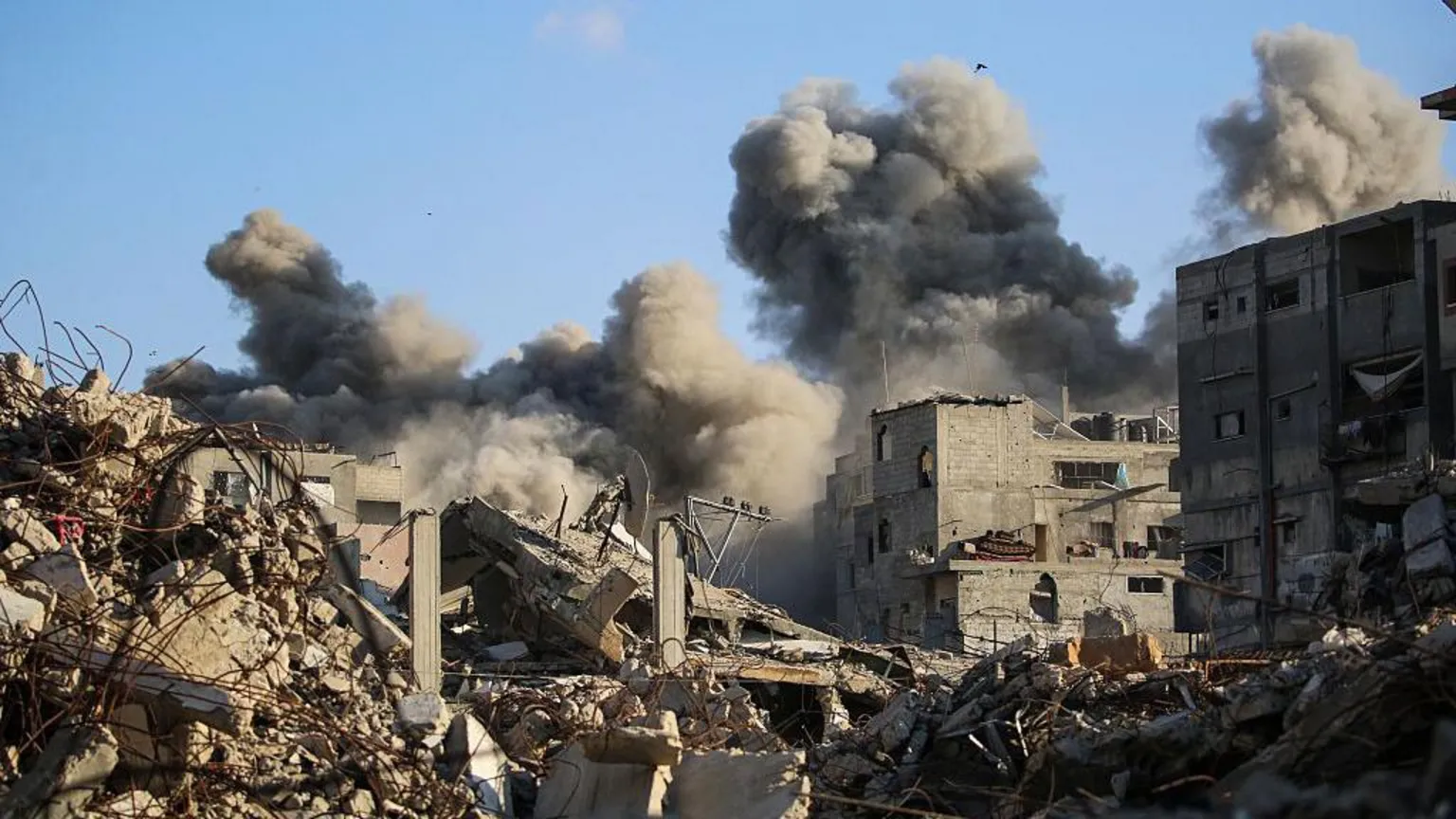
Gaza’s economy and infrastructure lie in ruins. The United Nations estimates the damage at about $70bn. Despite the scale of destruction, countries including the UK, Canada, France, and Germany have refused to join Trump’s Board of Peace, citing fears it might weaken the UN’s involvement.
In an attempt to reassure critics, Trump told attendees, “we're going to be working with the United Nations very closely, we're going to bring them back.” He added that Gaza was “no longer a hotbed of radicalism and terror” and welcomed contributions from Kazakhstan, Azerbaijan, UAE, Morocco, Bahrain, Qatar, Saudi Arabia, Uzbekistan, and Kuwait, which collectively exceed $7bn.
“Every dollar spent is an investment in stability,” he said. The UN will contribute $2bn toward humanitarian aid, while Fifa plans to provide $75m for soccer programs in Gaza.
Nickolay Mladenov, appointed as the board’s high representative for Gaza, said efforts to form a transitional Palestinian police force have begun. “Just in the first few hours we have 2,000 people who have applied.”
Both Israel and the US emphasise that the new force cannot be drawn from the current Hamas-controlled police without strict vetting and must not simply consist of Palestinian Authority security personnel from the West Bank. Starting from scratch makes the task complex and challenging.
Mladenov has stressed that the Palestinian police should be the main security body in Gaza, with support from the International Stabilisation Force, rather than the reverse. Under the US plan, the ISF will coordinate with Israel and Egypt, alongside the new Palestinian force, to secure border areas and supervise the permanent disarmament of non-state armed groups, including Hamas.
Still, Mladenov noted there is little evidence at this stage that such a force can enforce disarmament. During the Washington meeting, Hamas gave no indication it would surrender weapons, despite Trump’s mix of encouragement and warnings. Publicly, Hamas has tied any handover of arms to Israeli withdrawal from Gaza.
Without an effective security force, reconstruction and governance plans cannot advance, as the structure must be broadly accepted by Palestinians and maintain control over the use of force in Gaza.
The Washington gathering reflected Trump’s approach to Israeli-Palestinian diplomacy, which often emphasises investment and development. Israel has shown caution, particularly over invitations to Turkey and Qatar, nations it does not want influencing Gaza’s future.
Trump’s team describes the initiative as “new thinking” to tackle a longstanding deadlock. Yet Mladenov warned that without rapid progress, Gaza risks remaining divided between Israeli-controlled and Hamas-held areas, detached from the West Bank, threatening the viability of a future independent Palestinian state and the safety of both Israelis and Palestinians.






























