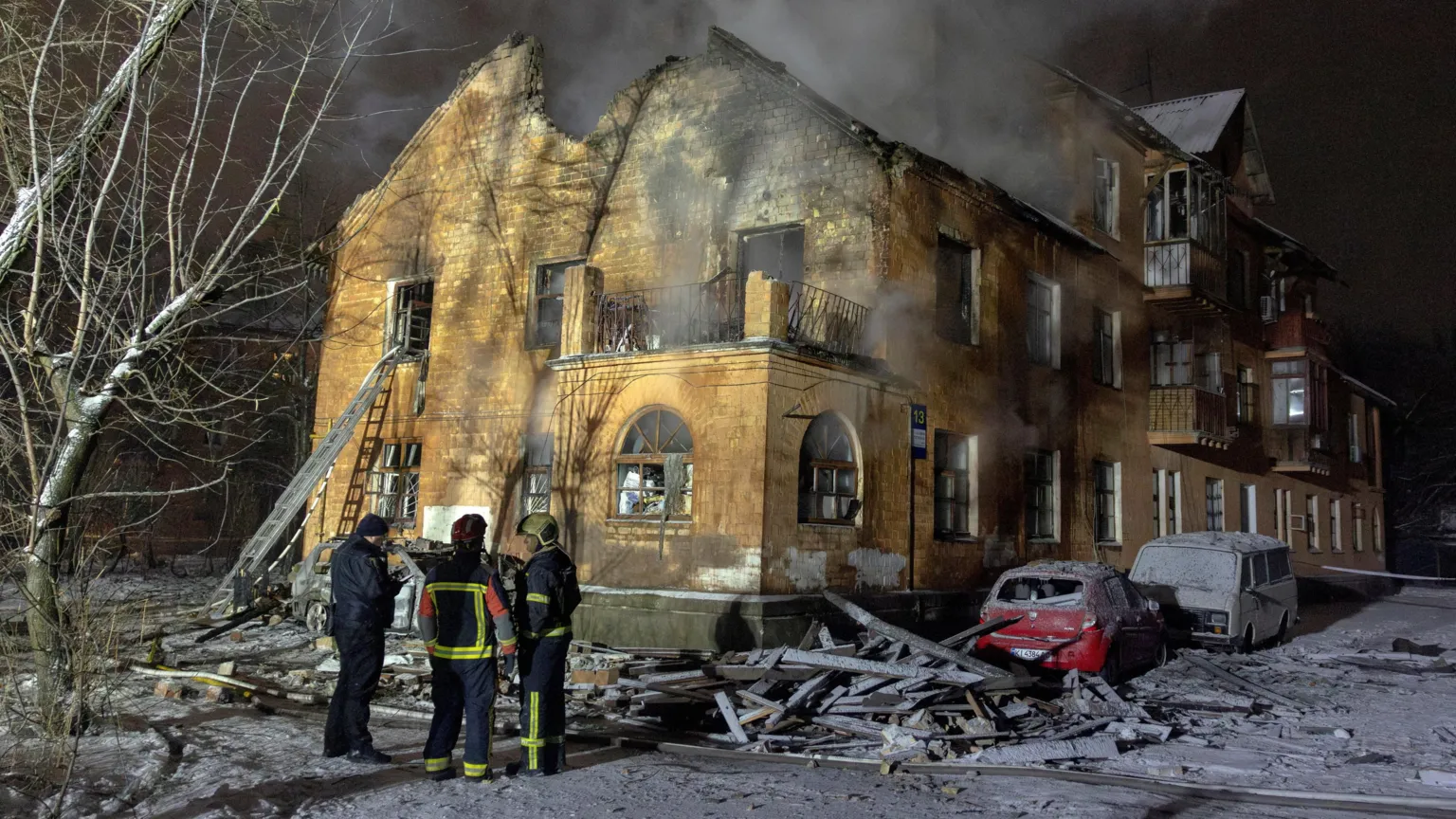
A powerful overnight assault by Oreshnik missile on Ukraine left cities reeling, as a seldom-used Oreshnik missile joined a barrage of rockets, drones, and cruise missiles targeting civilian areas and critical infrastructure.
The attacks, which continued for several hours, caused multiple fatalities, injuries, and widespread disruption to electricity and heating systems during one of the harshest cold spells this winter.
In Kyiv, four people died and 25 were wounded, including a paramedic killed while responding to a damaged apartment building.
The capital’s mayor, Vitali Klitschko, and President Volodymyr Zelensky described the strikes as “double-tap” attacks, where a second blast hits rescuers arriving at the scene. Residential buildings, high-rise apartments, and energy facilities along the Dnipro River sustained heavy damage.
This was only the second recorded use of the Oreshnik missile by Russian forces, following its first deployment against Dnipro in November 2024. Russia’s defence ministry claimed the strike was retaliation for an alleged Ukrainian drone attack on Vladimir Putin’s residence in late December, an assertion Ukraine denies.
While Moscow did not reveal the missile’s precise targets, videos surfaced shortly before midnight showing explosions on the outskirts of Lviv, around 60 kilometres from the Polish border. Zelensky confirmed that ballistic missiles struck energy and civilian infrastructure, causing further disruption. One missile also damaged a building at the Qatari embassy.
The Oreshnik is a hypersonic intermediate-range ballistic missile, thought to travel up to 5,500 kilometres. Its warhead is designed to break apart during descent into multiple fragments, producing rapid, successive explosions.
Ukrainian foreign minister Andrii Sybiha warned of the broader implications, saying, "Such a strike close to EU and Nato border is a grave threat to the security on the European continent and a test for the transatlantic community."
He added that the attack was launched "in response to [Putin's] own hallucinations," referencing the alleged drone strike.
EU foreign policy chief Kaja Kallas described the Oreshnik attack as a signal to Europe and the United States. "Putin doesn't want peace, Russia's reply to diplomacy is more missiles and destruction. This deadly pattern of recurring major Russian strikes will repeat itself until we help Ukraine break it," she wrote on X.
In addition to the Oreshnik missile, Russia launched 13 other ballistic missiles, 22 cruise missiles, and 242 drones against Ukrainian targets overnight. Zelensky said the strikes were aimed "against the normal life of ordinary people," adding that authorities were doing everything possible to restore electricity and heating.
Kyiv’s streets are now filled with the noise of diesel generators as residents and businesses attempt to cope. Half of the city’s apartment buildings—around 6,000—remain without heat, according to Klitschko. As temperatures are expected to drop to minus 15 degrees Celsius, he urged residents to temporarily leave if they could.
Damage to power plants and infrastructure has become a recurring feature of the war. Ukraine has increasingly responded with similar strikes on Russian facilities, leaving hundreds of thousands of people in Russian regions without electricity and heating.
On the night of the attacks, the Belgorod region lost power after Ukrainian shelling, and a power plant in Oryol further north also suffered damage that affected local water and heating systems.
Despite the destruction, life is continuing where possible. Some businesses reopened the morning after the strikes, and residents are working to restore daily routines amid the wreckage of buildings and drones scattered across the streets.































Comments
Sign in with Google to comment, reply, and like comments.
Continue with Google