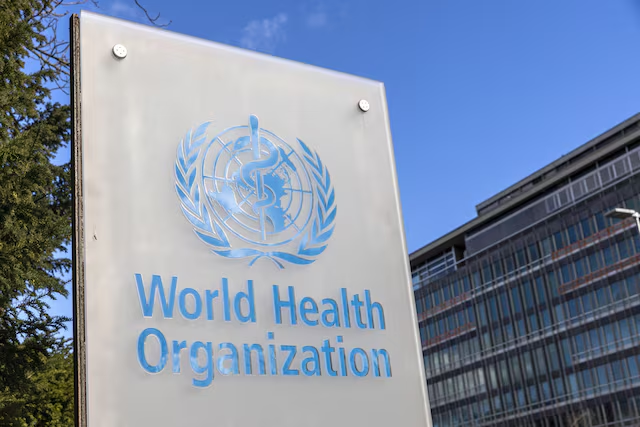
The World Health Organization (WHO) has unveiled a new global plan to combat rising drug resistance in HIV, hepatitis B and C, and sexually transmitted infections (STIs), cautioning that decades of progress in public health could be undone without urgent action.
The strategy, known as the Integrated Drug Resistance Action Framework 2026–2030, sets out a coordinated approach to protect the effectiveness of essential medicines and keep global disease elimination targets achievable.
Drug resistance is emerging as a major barrier to treatment and prevention efforts worldwide. WHO warns that without a collective response, resistance could lead to more new infections, higher treatment failure rates, and preventable illness and death.
The framework emphasizes “integrated, people-centred strategies” to prevent the development and spread of resistant strains while minimizing their impact on communities. It focuses on five key areas: prevention and response, monitoring and surveillance, research and innovation, laboratory capacity, and governance.
WHO is calling on countries to strengthen antimicrobial stewardship, expand access to accurate diagnostics, and ensure equitable and quality treatment services for all affected diseases.
“Drug resistance threatens decades of progress in HIV, hepatitis and STI control. This framework is a call to action for countries, communities and partners to unite around a shared agenda,” said Dr. Tereza Kasaeva, Director of WHO’s Department for HIV, Tuberculosis, Hepatitis and Sexually Transmitted Infections. “Together, we can preserve the effectiveness of life-saving antimicrobial drugs and accelerate progress toward ending these epidemics.”
The new strategy builds on WHO’s Global Health Sector Strategies and aligns with the Sustainable Development Goals and the Global Action Plan on Antimicrobial Resistance. It also reflects a renewed global commitment following the 2024 UN High-Level Meeting on Antimicrobial Resistance.
Over the past decade, access to antiretroviral therapy (ART) has increased from 7.7 million people in 2010 to 31.6 million in 2024, saving millions of lives. However, the rise in ART use has coincided with growing levels of HIV drug resistance.
These resistant strains occur when changes in the virus reduce the ability of medicines to suppress HIV replication. WHO warns that “all current antiretroviral drugs, including newer classes, are at risk of becoming partly or fully inactive” if resistance continues to rise.
By fostering stronger coordination among governments, researchers, communities, and global partners, the framework aims to strengthen health systems and expand access to stigma-free services. Its ultimate goal is to halt the emergence and spread of drug resistance, keeping the target of ending AIDS, hepatitis B and C, and STIs as public health threats by 2030 within reach.































Comments
Sign in with Google to comment, reply, and like comments.
Continue with Google