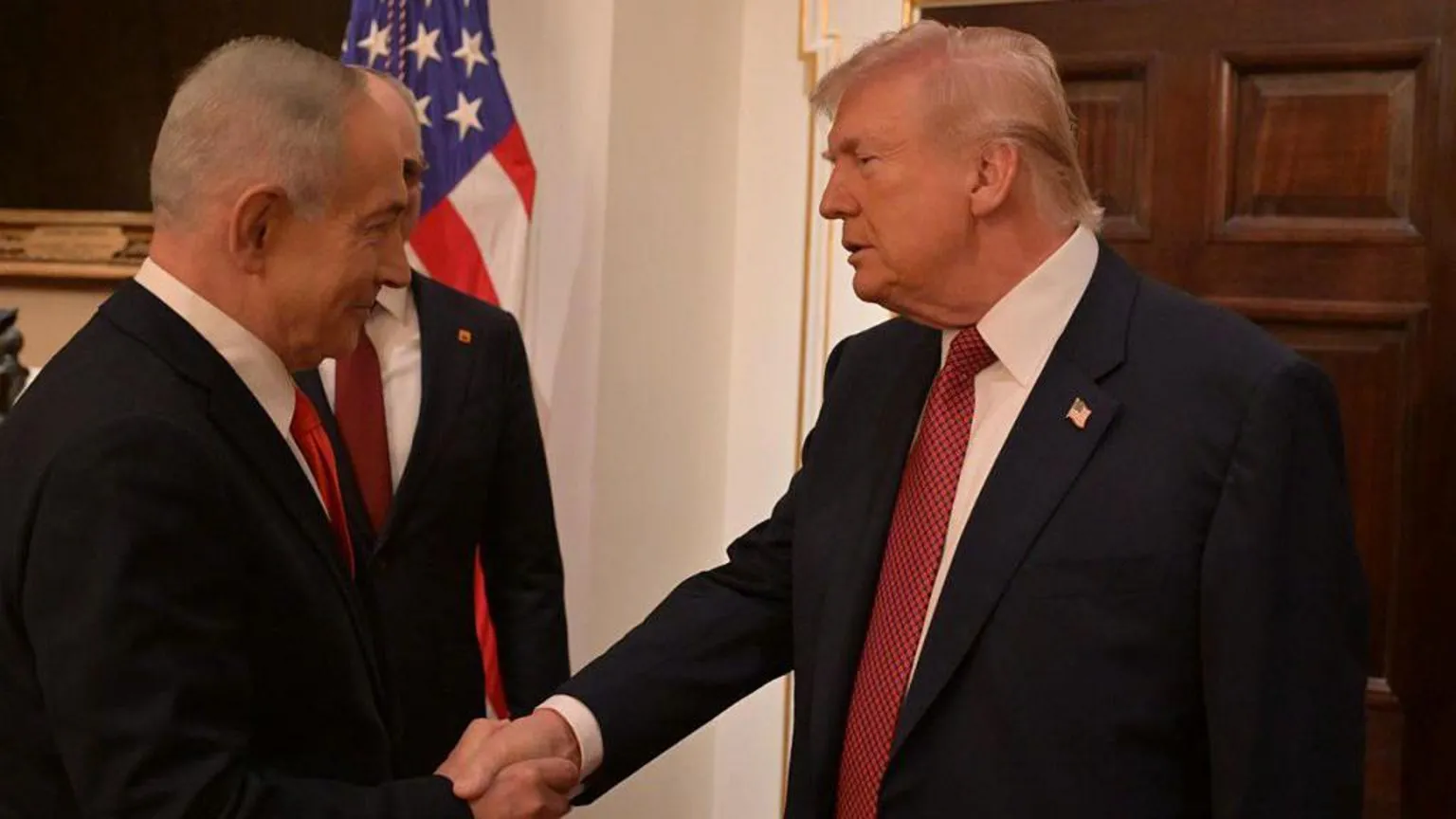
US President Donald Trump has emphasized the need for continued engagement with Iran on its nuclear programme, following a closed-door meeting with Israeli Prime Minister Benjamin Netanyahu at the White House on Wednesday.
While no binding agreement emerged from the talks, Trump said he had stressed that negotiations must go on.
The meeting took place amid mounting tensions across the Middle East and ongoing efforts to curb Iran’s nuclear ambitions.
Netanyahu, who has visited Washington six times since Trump returned to office, the most by any foreign leader, was expected to push for a deal that would not only halt uranium enrichment but also restrict Iran’s ballistic missile programme and curb its support for armed groups like Hamas and Hezbollah.
In a statement posted on Truth Social after the meeting, Trump described the discussions as "very good," but added, "There was nothing definitive reached other than I insisted that negotiations with Iran continue to see whether or not a deal can be consummated."
Trump said a deal was his "preference" but cautioned that the outcome remained uncertain if an agreement could not be reached. Netanyahu’s office confirmed that the two leaders discussed "the security needs of the State of Israel in the context of the negotiations" and agreed to maintain their "close coordination and relationship."
Ahead of his trip, Netanyahu’s team stressed that any negotiation must address ballistic missile limitations and end Iran’s support for proxy groups. "The prime minister believes that any negotiations must include limiting ballistic missiles and ending support for the Iranian axis," his office said.
Iran has indicated a willingness to limit its nuclear programme in exchange for easing of economic sanctions but has refused to meet broader demands, including curbing missile development and regional influence. Iranian President Masoud Pezeshkian warned ahead of the White House talks that Tehran would "not yield to their excessive demands."
At a Tehran rally marking the 47th anniversary of the Islamic revolution, Pezeshkian said, "Our Iran will not yield in the face of aggression, but we are continuing dialogue with all our strength with neighbouring countries in order to establish peace and tranquillity in the region." He also reaffirmed Iran’s stance on nuclear weapons: "We have stated this repeatedly and are ready for any verification."
Netanyahu, a close ally of Trump, has consistently described Iran as an existential threat to Israel. His visit included meetings with Trump’s special envoy Steve Witkoff and son-in-law Jared Kushner, who briefed him on the first round of talks with Iran held last Friday.
Meanwhile, the US has reinforced its military presence in the region. Trump has warned of potential strikes if Iran fails to agree to limits on its nuclear activities or continues to suppress protesters. He said he was considering sending a second aircraft carrier strike group to the Middle East, adding, "We have an armada that is heading there and another one might be going."
Trump described a successful deal as one that ensures "no nuclear weapons, no missiles," highlighting his preference for a diplomatic solution while keeping military options open. Israeli officials have also indicated that Israel reserves the right to act militarily if Iran fails to reach a comprehensive agreement.
Experts note that Netanyahu faces pressure from far-right coalition partners to leverage his close relationship with Trump to secure a broad deal that satisfies Israel’s security concerns.
Daniel Byman, professor at Georgetown University, warned, "Israel is concerned that in the haste to get a deal with Iran, the president might embrace a deal that doesn't address Iran's missile programme or support for proxy groups, or that allows it to have some remnant of its nuclear programme."
"One worry Israel and other allies have about the US under Trump is that he wants a deal more than he wants a particular outcome," Byman added. Analysts say Iran’s current negotiating position is weaker following domestic protests and a US-Israel air campaign last year, which targeted nuclear and military sites.
Mohammed Hafez, an expert on Middle Eastern politics at the Naval Postgraduate School, said, "The Iranian regime today is really vulnerable. The US and Israel feel they hold all the cards, Iran is on its back foot, and they can make these maximalist demands."































Comments
Sign in with Google to comment, reply, and like comments.
Continue with Google