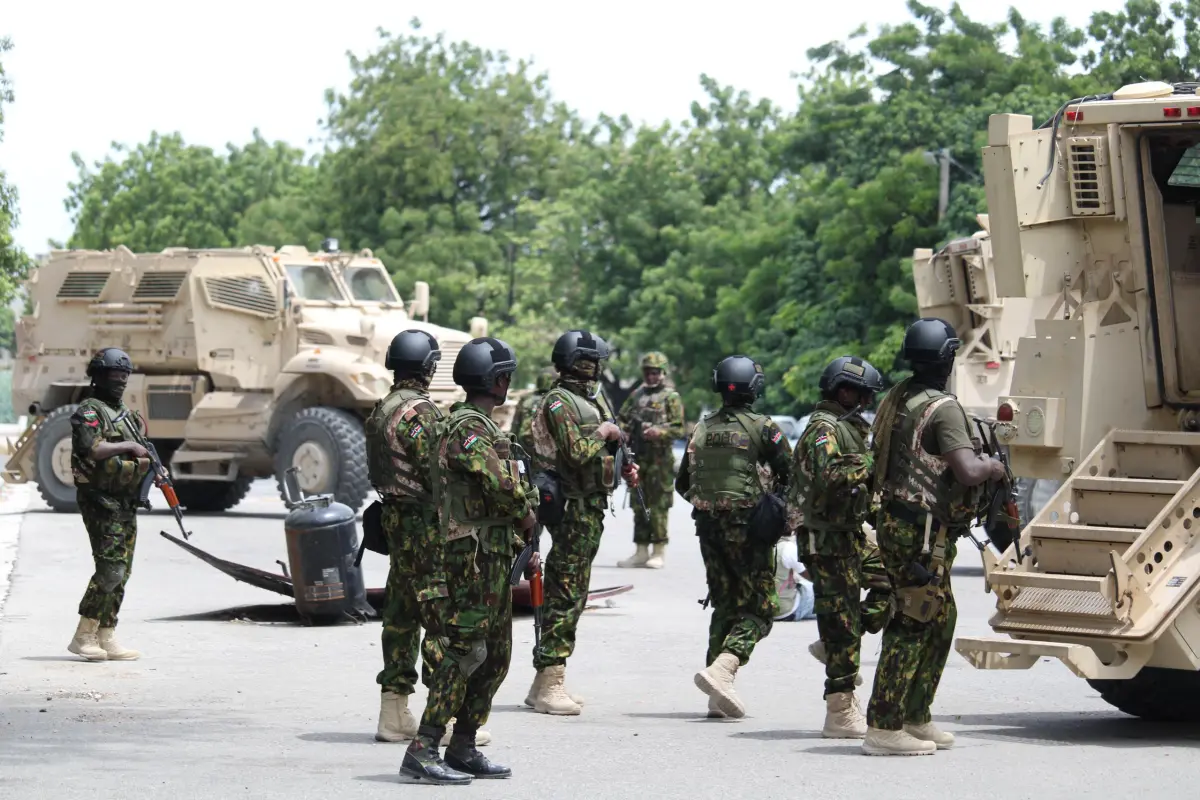
US Secretary of State Marco Rubio said on Wednesday that progress had been made in assembling an international anti-gang force for Haiti, raising hopes that improved security could allow long-delayed elections to go ahead this year. Yet with armed groups controlling much of the capital, the prospect of a credible vote remains uncertain.
Speaking on the sidelines of the Caribbean Community (CARICOM) summit on Wednesday, US Secretary of State Marco Rubio welcomed additional commitments to the Kenya-led mission in Haiti, with countries such as Canada and Japan expected to contribute. If successfully deployed, the force could stabilise parts of the country and create conditions for a return to constitutional rule, he said.
Yet on the ground in Haiti, the scale of the political and institutional breakdown raises serious doubts about whether elections can be organised in any credible form.
“Those gangs are not a new phenomenon,” said Roromme Chantal, a former Haitian journalist and now professor of political science at the Université de Moncton. “The weakness of the state has repeatedly led those in power to rely on irregular armed groups. Over time, those groups gain autonomy.”
Under the Duvalier dictatorship, the Volontaires de la Sécurité Nationale (VSN) acted as a paramilitary force to secure the regime. In the 2000s, armed loyalists known as “chimères” were mobilised around former president Jean-Bertrand Aristide. What began as political instruments gradually morphed into entrenched armed actors with their own territorial and financial bases.
The withdrawal in 2017 of the UN Stabilisation Mission in Haiti (MINUSTAH), deployed after Aristide’s ouster, left behind a fragile police force and unresolved political tensions.
Chantal argues that the mission gradually substituted itself for national institutions rather than strengthening them. “MINUSTAH replaced the Haitian National Police instead of building its capacity,” he said. “When it withdrew, the police were not in a position to take over.”
The security vacuum widened. Political instability deepened after the diversion of billions of dollars from the PetroCaribe oil programme triggered mass protests beginning in 2018. Armed groups expanded, growing wealthier and more visible, asserting control over large swathes of Port-au-Prince and key transport routes.
As of July 2025, nearly 90 per cent of the capital is estimated to be under their influence.
“The Haitian police are not up to the task,” said Alex Dupuy, retired sociology professor emeritus at Wesleyan University. “They don’t have the firepower or the equipment to do what an army could do”. Dupuy also warned that the Kenyan-led mission “hasn’t done much so far to pacify the country” and that its forces “know nothing about Haiti and don’t speak the language,” limiting their effectiveness outside the capital.
More than a million people have been displaced by gang violence, creating another hurdle for elections. “They will need to be able to return to their homes to participate in these elections,” Dupuy said. “If that hasn’t happened, universal participation is simply impossible.”
And even if the anti-gang force is successfully deployed, the scale of the political and institutional breakdown makes holding a credible vote a daunting challenge.
“There is no credible electoral registry, no functioning political party system and no real capacity to organise a vote that would be recognised as legitimate,” said Eduardo Gamarra, a professor at Florida International University. “A reliable voter roll is the foundation of any democratic process.”
Beyond the technical obstacles lies the issue of impunity. “The United States, Canada and the United Nations have sanctioned prominent Haitian political and business figures accused of financing armed groups,” Chantal argued. “Yet none of them have been prosecuted. If those who finance and arm these groups are never held accountable, it becomes very difficult to dismantle the system.”
A regional agreement reached on Monday recognises Prime Minister Alix Didier Fils-Aimé as head of the executive branch and outlines plans to restore security, organise elections, and assist victims of gang violence. However, the pact sets no clear deadline for his departure from office, raising questions about when a fully elected government might take power.
The international community’s renewed push to stabilise Haiti also unfolds in a context of growing fatigue. “There’s a sense of ‘Haiti fatigue’,” said Gamarra, describing waning appetite among donors and governments to commit large-scale resources without a clear political roadmap.
“At the same time, armed groups have grown richer and more autonomous". They recruit children from impoverished neighbourhoods where schools are closed and economic prospects scarce”, Gamarra adds. “Some distribute food or cash in the areas they control, reinforcing local loyalty while projecting power through social media”, Chantal comments.
For Gamarra, the uncertainty leaves open two possible trajectories. One would involve sustained force to dismantle the gangs. The other, more controversially, could see some armed actors seeking political integration rather than continued confrontation.
“Anything is possible in Haiti,” said Gamarra. “Gangs may decide that running for office is more advantageous than fighting.”
For Chantal, however, security operations alone, or political integration without accountability, risk perpetuating the cycle. “Strengthening the police, investing in youth, and holding those who finance violence to account are essential if elections are to mean more than a procedural milestone,” he said.































Comments
Sign in with Google to comment, reply, and like comments.
Continue with Google