Authorities in Benin are intensifying efforts to track down soldiers involved in Sunday’s failed coup attempt, following reports that two high-ranking military officials taken hostage have been released. It remains uncertain how the officers were freed or whether any other captives remain in rebel hands.
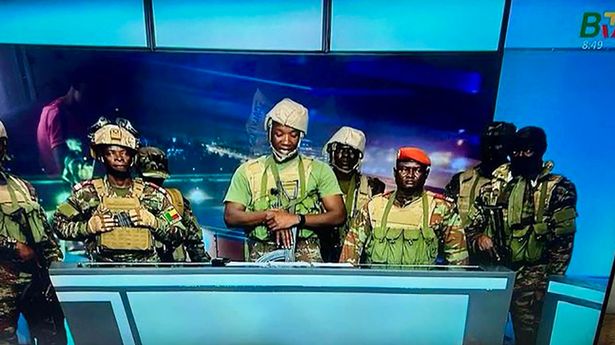
The crisis began in the early hours when a group of soldiers appeared on national television, declaring that they had seized power. Gunfire erupted near the presidential residence in Cotonou, Benin’s largest city, as citizens feared a wider confrontation.
Later in the day, President Patrice Talon reassured the public that the situation had been resolved, describing it as “totally under control”.
Nigeria played a key role in supporting Benin, reporting that its jets helped “dislodge the coup plotters from the National TV and a military camp” after a request from Benin’s government.
Around midday, loud explosions shook Cotonou, believed to be from air strikes. Flight records show that three aircraft entered Benin from Nigeria before returning home, but the extent of any damage has not been confirmed.
Government spokesman Wilfried Leandre Houngbedji said that 14 people had been detained in connection with the attempted takeover. A local journalist reported that 12 of those arrested were involved in storming the offices of the state broadcaster, including a former soldier dismissed from service. The mutiny was reportedly led by Lt Col Pascal Tigri, whose current location is unknown.
In his evening address, President Talon said that loyal troops had “cleared the last pockets of resistance held by the mutineers”.
He praised their response, stating, “This commitment and mobilisation enabled us to defeat these opportunists and avert disaster for our country. This treachery will not go unpunished.” He also urged citizens to remain calm: “I would like to reassure you that the situation is completely under control and therefore invite you to go about your business peacefully.”
Although the government has not confirmed casualties, Talon expressed sympathy “to the victims of this senseless adventure, as well as to those still being held by fleeing mutineers”.
The West African regional organisation Ecowas has deployed troops from Nigeria, Ghana, Sierra Leone, and Ivory Coast to safeguard key sites and prevent further unrest. With a recent string of coups across the region, Ecowas has signaled a stronger commitment to defending elected governments.
Benin, a former French colony and a major cotton producer, has long been regarded as one of the region’s more stable democracies, though it ranks among the world’s poorest nations. Nigeria condemned the attempted takeover as a “direct assault on democracy”.
The rebel soldiers justified their actions by pointing to the government’s handling of security in northern Benin, where the army has faced losses from jihadist attacks linked to Islamic State and al-Qaeda spreading from Niger and Burkina Faso.
The mutineers accused Talon of neglecting soldiers and their families, claiming, “the ignorance and neglect of the situation of our brothers in arms who have fallen at the front and, above all, that of their families, abandoned to their sad fate by Patrice Talon's policies”.
They also criticised cuts in healthcare, such as stopping state-funded kidney dialysis, increased taxes, and restrictions on political activities.
President Talon, a businessman often called the “king of cotton,” is due to step down next year after finishing his second term. Elections are scheduled for April, and he has endorsed Finance Minister Romuald Wadagni as his successor.
While his tenure has seen economic growth, critics argue that his administration has limited opposition space. Last October, the electoral commission disqualified the main opposition candidate for failing to meet sponsorship requirements.
In recent months, lawmakers passed constitutional amendments that created a Senate and extended terms for elected officials from five to seven years, without changing the two-term presidential limit.
Sunday’s attempted coup came shortly after the removal of Guinea-Bissau’s leader Umaro Sissoco Embaló, an event that has raised regional concerns. West Africa has witnessed similar military takeovers in Burkina Faso, Guinea, Mali, and Niger in recent years.
Russia has strengthened its ties with these Sahel nations, and Burkina Faso, Mali, and Niger have left Ecowas to form the Alliance of Sahel States. BBC Monitoring reported that several pro-Russian social media accounts welcomed the attempted Benin takeover.
Both Ecowas and the African Union condemned the coup attempt.































Comments
Sign in with Google to comment, reply, and like comments.
Continue with Google