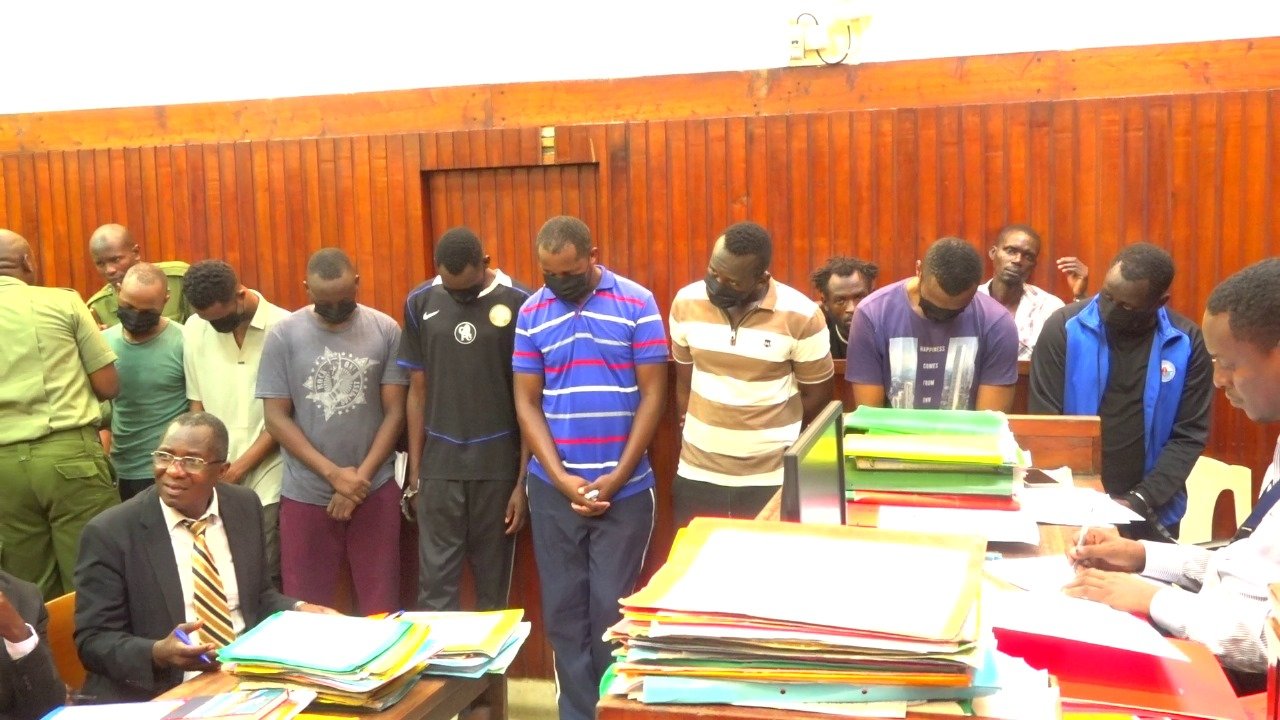
Seven soldiers accused of trafficking methamphetamine worth Sh192 million were on Monday released on bond after a Mombasa court declined to extend their custodial detention.
Senior Resident Magistrate Gladys Ollimo ordered each suspect to post a Sh500,000 surety bond or a similar cash alternative.
They were also required to provide a contact person and report weekly to the Anti-Narcotics Police Unit as investigations continue.
The accused, identified as Duke Nyamwaya, Juma Mwinyifaki, Michael Kariuki, Elijah Mbogo Gacog’u, James Ekiru, Abdulrehman Salad, and Abdirahman Abdi Kuno, allegedly trafficked 25 kilograms of methamphetamine, reportedly packed in whitish crystalline packets.
The court heard that the Office of the Director of Public Prosecutions (ODPP) is awaiting a report from the government chemist to guide appropriate charges.
Principal Prosecution Counsel Brenda Oganda and Prosecution Counsel Yassir Mohammed told the court that the substance must first be scientifically classified before charges can be formally approved.
“The decision to charge is guided strictly by facts, evidence, and the law and must meet the constitutional threshold set for criminal prosecutions,” they stated, emphasizing that neither investigators nor prosecutors have the mandate to classify suspected narcotics.
Detective Issack Njoroge of the Directorate of Criminal Investigations had requested that the suspects’ detention be extended pending the chemist’s report.
He informed the court that the seized substance had been forwarded for analysis, with the report expected by January 3.
However, defence lawyers opposed further custody, arguing that holding the soldiers without formal charges would be unconstitutional.
They contended that delays at the government chemist could not justify denying the suspects their liberty.
In her ruling, Magistrate Ollimo sided with the defence, releasing the soldiers on bond and directing that the matter be mentioned on January 6, 2026, for further directions.
She noted that the investigation would continue while ensuring the suspects’ rights are protected.
The case highlights ongoing challenges in prosecuting narcotics trafficking, particularly the dependency on scientific verification of seized substances.
Authorities have reiterated their commitment to upholding the law while ensuring that procedural and constitutional safeguards are observed in high-profile cases.
The ODPP will make its charging decision once the chemist’s report is received, with the aim of ensuring that the prosecution is firmly grounded in evidence and meets legal standards.































Comments
Sign in with Google to comment, reply, and like comments.
Continue with Google