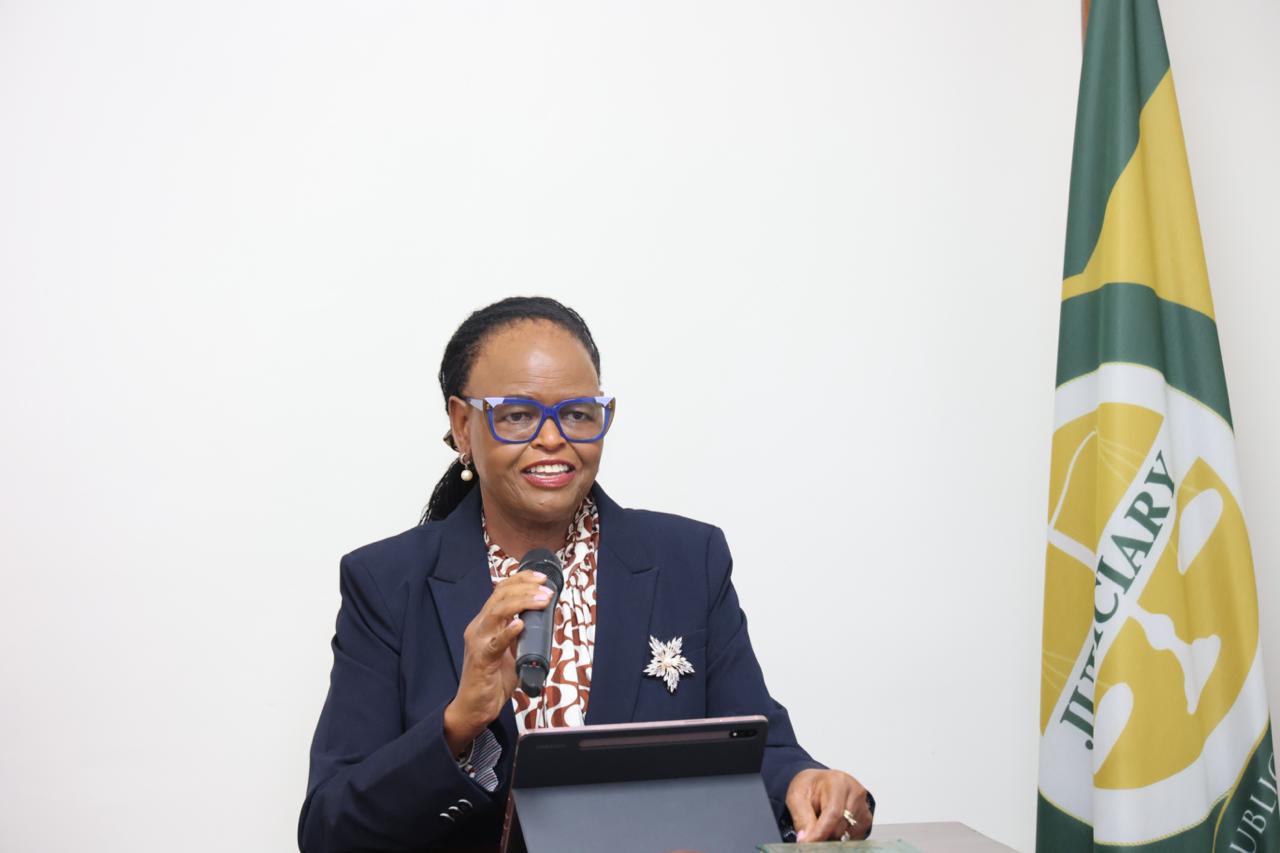
Chief Justice Martha Koome has urged the Employment and Labour Relations Court (ELRC) to take a leading role in advancing a paperless Judiciary, emphasising the use of digital platforms to enhance access, efficiency, and transparency in judicial processes.
Speaking during the installation of Monica Mbaru as the new Principal Judge of the ELRC at Milimani on Friday, Koome highlighted the progress made through virtual hearings while stressing the need to institutionalise digital innovations.
“Technology remains a key enabler of judicial transformation,” said CJ Koome.
“The Judiciary must deepen its reliance on digital tools to streamline processes and enhance service delivery.”
The Chief Justice linked the push for paperless courts to the Judiciary’s Social Transformation through Access to Justice (STAJ) Blueprint, which aims to ensure faster resolution of cases and reduce backlog, targeting no case remaining in trial courts for more than three years.
She also praised the ELRC for recording a case clearance rate of 132 percent in the last financial year, attributing the achievement to innovation and growing use of technology.
However, she cautioned that sustaining and improving these gains would require continuous commitment to digitisation and process reforms.
“At the same time, the Court should continue to strengthen its commitment to the multi-door approach to justice. Mediation and conciliation, as provided for under the Employment and Labour Relations Court Act, are vital tools for expeditious and amicable dispute resolution,” CJ Koome said, urging the ELRC to adopt localised innovations and enhance alternative dispute resolution mechanisms.
She further called on the court to develop jurisprudence that is socially responsive and grounded in constitutional values, serving employers, employees, and society while contributing to the global development of labour law.
“Leadership in the Judiciary is not vested in one individual alone; it is a collective responsibility. The Principal Judge, together with all judges and staff of the ELRC, must act as drivers of excellence—championing performance, innovation, and accountability,” CJ Koome added.
Deputy Chief Justice Philomena Mwilu noted that the Principal Judge’s office carries profound responsibility, calling for leadership that guides the Court in faithfully executing its constitutional mandate and improving service delivery to the people of Kenya.
Labour Principal Secretary Shadrack Mwadime, representing the Ministry of Labour and Social Protection, emphasized the ELRC’s strategic role in balancing workers’ rights, employer obligations, and economic stability, especially amid technological changes, labour mobility, and the rise of the gig economy.
Justice Monica Mbaru, elected unopposed by ELRC judges to a five-year term, pledged to advance the STAJ vision.
“I will champion efficiency in case management, strengthen institutional capacity, promote integrity, and support innovation within our courts. I will also prioritise access to justice for the most vulnerable and ensure that the ELRC continues to stand as a beacon of excellence,” she said.
Justice Mbaru succeeds Justice Byram Ongaya, who was elevated to the Court of Appeal after a four-year tenure marked by significant improvements in service delivery and jurisprudence.