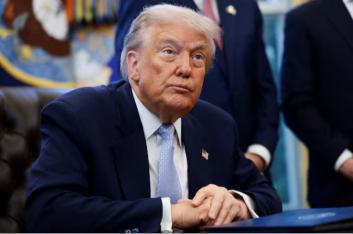
Tensions between the United States and Iran have escalated as President Donald Trump warned that Tehran is running out of time to reach a nuclear agreement.
The president highlighted the rapid deployment of a substantial US naval force to the Gulf, raising concerns about a possible confrontation.
Trump described the military movement as a “massive Armada” “moving quickly, with great power, enthusiasm, and purpose” towards Iran. The fleet, he said, was prepared to carry out its mission “with speed and violence, if necessary,” underscoring the urgency for Tehran to negotiate.
Iran’s Foreign Minister Abbas Araghchi responded by saying the nation’s forces are ready “with their fingers on the trigger” to “immediately and powerfully respond” to any attacks, whether by land or sea. He reiterated Iran’s position that its nuclear programme is entirely peaceful and that it has no intention of developing nuclear weapons.
The warning comes after Trump previously pledged US support for those affected by the harsh crackdown on demonstrations earlier this month. “Help is on the way,” he said, later noting that he had received credible information that executions of demonstrators had stopped.
Human Rights Activists News Agency reports that more than 6,301 people, including 5,925 protesters, have been killed since the unrest began in late December.
The agency is also looking into an additional 17,000 deaths reported during the nearly three-week internet blackout. Another organisation, Norway-based Iran Human Rights, warns that the total death toll could surpass 25,000.
Trump’s recent statements focused heavily on Iran’s nuclear ambitions. On Truth Social, he wrote: “Hopefully Iran will quickly 'Come to the Table' and negotiate a fair and equitable deal - NO NUCLEAR WEAPONS.” He added that the naval force deployed to the Gulf is even larger than the one sent to Venezuela before the seizure of former leader Nicolás Maduro.
The US has increased the presence of military aircraft in the region, with satellite images showing at least 15 fighter jets landing at Jordan’s Muwaffaq Air Force Base.
More aircraft have been observed at bases in Jordan, Qatar, and Diego Garcia. Cargo planes, refuelling aircraft, and spy drones have also been active near Iranian airspace.
A naval force led by the USS Abraham Lincoln aircraft carrier has entered the Middle East, confirmed by a US defence official. Flight data suggests that US carriers are operating near the Gulf, with an Osprey aircraft recently landing in Oman after leaving an offshore location.
Megan Sutcliffe, a risk analyst, said: “In the past two weeks, the US has surged naval and aerial assets to the region, significantly increasing its regional posture.”
Iran has also deployed the IRIS Shahid Bagheri, a drone carrier ship, close to its coast. Under the 2015 nuclear deal, Iran was restricted from enriching uranium above 3.67 percent and barred from enrichment at the Fordo facility for 15 years. Trump withdrew from the agreement in 2018, reinstating sanctions and arguing the deal did not stop Iran from pursuing a nuclear weapon.
In response, Iran has gradually breached several limits in the deal, particularly on uranium enrichment. US officials have said Iran must halt enrichment, curb its missile programme, and end support for proxy groups as part of any new nuclear agreement.
The US last struck Iranian nuclear facilities in June last year, targeting Fordo, Natanz, and Isfahan. Officials described the operation, called “Midnight Hammer,” as a setback to Iran’s nuclear ambitions.
However, Hassan Abedini claimed Iran “didn't suffer a major blow because the materials had already been taken out.” Iran later launched missiles at a US base in Qatar, which Trump described as “very weak” and “expected.”































Comments
Sign in with Google to comment, reply, and like comments.
Continue with Google