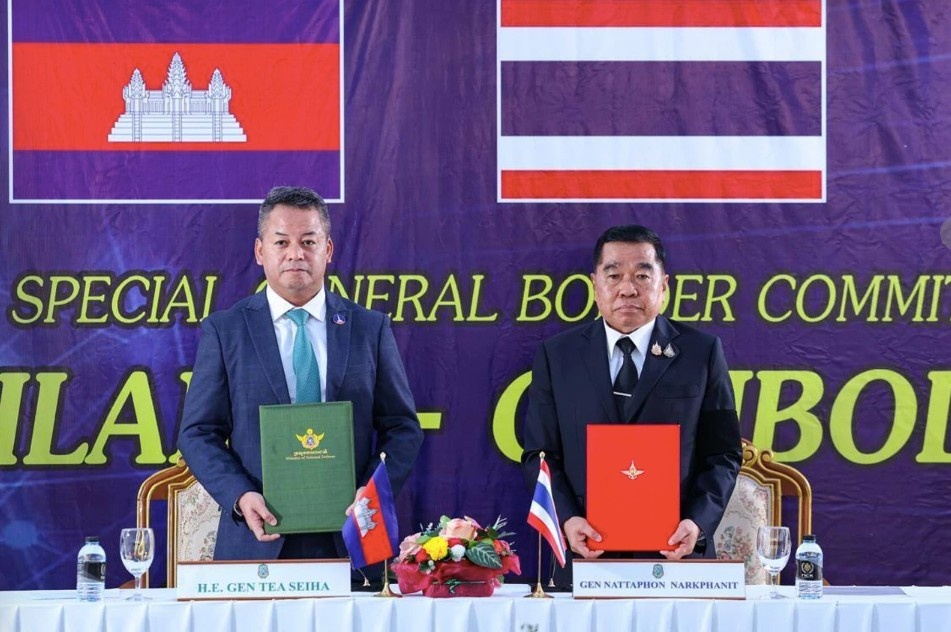
After weeks of deadly skirmishes, Thailand and Cambodia have reached a ceasefire, halting military operations along their contested border and providing relief to communities caught in the crossfire.
The accord, signed Saturday at a border checkpoint by Cambodia’s Defence Minister Tea Seiha and his Thai counterpart Nattaphon Narkphanit, mandates that both sides immediately suspend troop movements and refrain from conducting air operations over the area.
The clashes are rooted in unresolved territorial claims along sections of the Thailand–Cambodia border that remain poorly marked decades after colonial-era boundaries were drawn.
While previous diplomatic efforts attempted to manage tensions, renewed fighting erupted earlier this year, intensifying in December.
Initial clashes broke out in July and lasted five days before Malaysia mediated a temporary truce, reinforced by warnings from the United States that trade benefits could be withheld if hostilities continued.
Although a detailed ceasefire plan was laid out in October at a regional meeting in Malaysia, it failed to prevent further violence.
The December flare-up involved heavy weaponry, resulting in multiple casualties and forcing hundreds of thousands to flee their homes.
Under the new agreement, Thailand has promised to return 18 Cambodian soldiers captured during the July fighting once the ceasefire has been observed for 72 hours, a central demand from Cambodia.
The deal also includes measures to respect international bans on land mines and to cooperate on humanitarian de-mining.
Thailand reports that at least ten of its soldiers were injured this year by what it claims were newly planted Cambodian mines, though Cambodia rejects the allegation.
Both countries have pledged to curb misinformation, continue efforts to demarcate the border, and work together against transnational crime, including large-scale online scams operating in the region.
“Today’s ceasefire paves the way for the displaced people who are living in the border areas to be able to return to their homes, work in the fields, and even allow their children to be able to return to schools and resume their studies,” Tea Seiha said after the signing.
Thai officials warned that any attacks within 72 hours would indicate Cambodia’s unwillingness to commit to peace.































Comments
Sign in with Google to comment, reply, and like comments.
Continue with Google