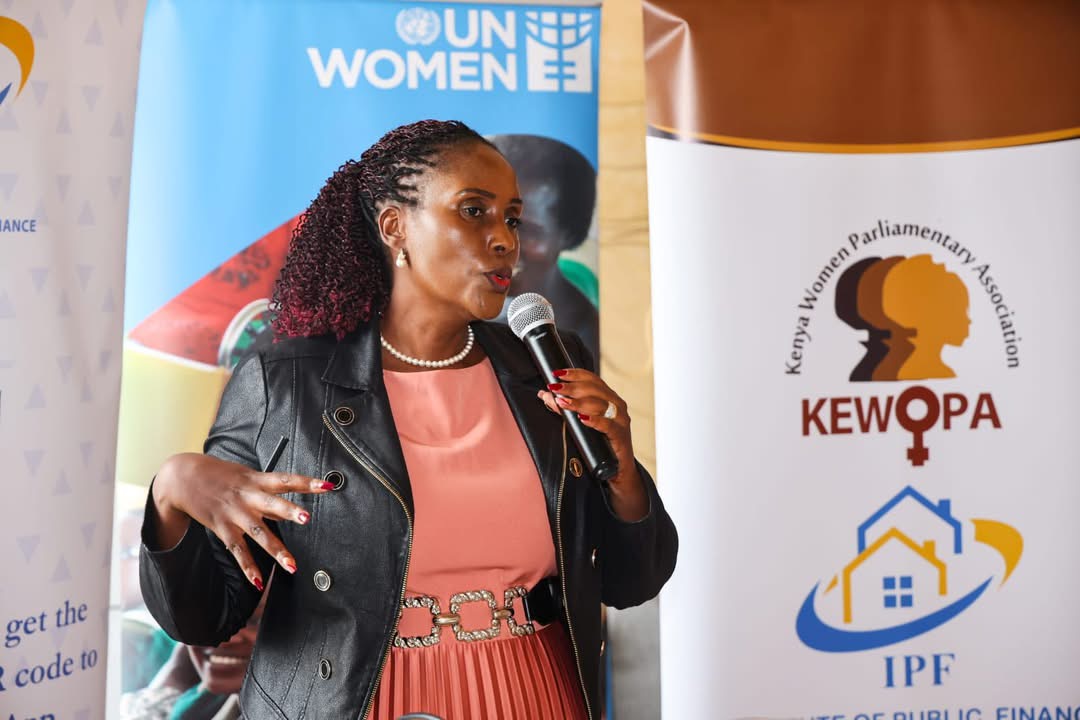
Members of the National Assembly Departmental Committee on Social Protection have called for greater clarity on how the proposed Women Economic Empowerment Policy will be implemented, warning that poor structuring could interfere with existing programmes under the National Government Affirmative Action Fund (NGAAF).
The concerns were raised during a sensitisation workshop held in Kiambu County and organised by the Ministry of Gender, Culture and Children Services through the State Department for Gender and Affirmative Action, in partnership with the Institute of Public Finance and UN Women.
Lawmakers said while they support initiatives aimed at uplifting women economically, the proposed framework must clearly outline the institutions responsible for implementation, funding mechanisms and how the policy would complement existing empowerment programmes.
Committee Chairperson Alice Ng’ang’a said the ministry must address uncertainty surrounding the rollout of the policy before it is considered for passage by Parliament.
“Even as we engage on how to support this process as legislators, the Ministry must also come clear on how the programs will be effected without taking away from the milestones already made by NGAAF,” Ng’ang’a said.
She questioned whether the policy could undermine the role currently played by County Woman Representatives through NGAAF, which has funded bursaries, women’s groups and community projects across the country.
“If the policy passes at the National Assembly, who will be mandated and empowered to implement it, and how will the Ministry ensure that the role played by the County Woman Representatives is not overtaken?” she asked.
Committee members also sought assurances that the policy would bring direct benefits to women in low-income communities rather than remain a broad policy framework with limited practical outcomes.
Phyllis Bartoo said elected leaders wanted to see measurable transformation in the lives of women, especially those facing economic hardship.
“We want to see this policy transforming women’s lives, and not just being used as a document to muzzle conversations about women’s needs and rights,” Bartoo said.
She added that the initiative should result in improved livelihoods, access to credit, business opportunities and social advancement for women across the country.
Vice-Chairperson Hillary Kosgei urged the government to back the policy with adequate resources, saying ambitious goals would fail without sufficient budgetary allocation.
He warned that failure to prioritise women’s economic needs could derail the entire process and leave the policy ineffective.
Other lawmakers, including Paul Abuor, cited weak enforcement of existing gender laws and policies, saying loopholes in implementation should first be addressed to avoid repeating past mistakes.
The Kenya Women Parliamentarians Association (KEWOPA) also backed the consultations, describing the forum as an opportunity to build consensus and strengthen proposals before the policy returns to the House.
Responding to the concerns, Principal Secretary for Gender and Affirmative Action Anne Wang’ombe assured MPs that the proposed framework was intended to strengthen, not replace, NGAAF.
“This policy is meant to tap into all the other Departments, consolidate resources, and formalize mechanisms for delivering services to women with minimal constraints,” Wang’ombe said.
She said the government developed the policy to dismantle systemic barriers that continue to limit women’s participation in economic activities, including lack of access to capital, markets and decision-making opportunities.
Wang’ombe further insisted that the proposal was not in competition with NGAAF but would serve as a multiplier of ongoing empowerment efforts.
The proposed Women Economic Empowerment Policy is currently under review by the National Assembly, where lawmakers are expected to consider stakeholder views before deciding on its future.































Comments
Sign in with Google to comment, reply, and like comments.
Continue with Google