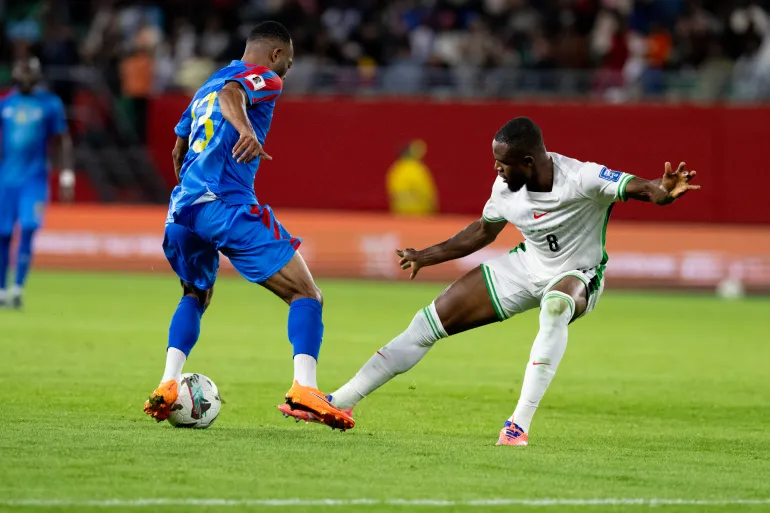
Nigeria has formally challenged the Democratic Republic of Congo’s victory in last month’s African World Cup play-off, accusing the Leopards of fielding players who were not eligible to play.
The complaint, submitted to Fifa, comes after Nigeria lost on penalties in Morocco, which handed DR Congo a place in the intercontinental qualifiers in March. The outcome now determines which teams will claim the final slots for next year’s World Cup in Canada, Mexico, and the United States.
The Nigeria Football Federation claims the dispute revolves around a set of players who recently changed their international allegiance. Among them are Aaron Wan-Bissaka and Axel Tuanzebe, both of whom appeared in the match.
The NFF argues these players violated Congolese law, which prohibits dual citizenship, yet they reportedly hold European and French passports.
“Our contention is that Fifa was deceived into clearing them,” said NFF general secretary Mohammed Sanusi.
“The Congolese rule (law) says you cannot have dual nationality, but some of their players have European and French passports.
“There is what we consider to be a breach of (Fifa's) regulations. We are saying it was fraudulent.”
The NFF says it has provided Fifa with all relevant documents and legal arguments to support its case. The governing body has been contacted for comment but has not yet issued a response.
DR Congo’s football federation, Fecofa, has dismissed Nigeria’s petition, describing it as an attempt to overturn the result through legal manoeuvres rather than on the field.
On the Leopards’ official social media channels, the federation said: “The World Cup must be played with dignity and confidence. Not with lawyers' tricks.” It also accused Nigeria of being “bad losers” and said the complaint reflects poor sportsmanship.
Fifa regulations specify that a player may change the national association they represent only once, and the process requires a formal request approved by Fifa’s Players Status Committee.
Players must hold a passport from the nation they wish to represent, although dual nationality is not prohibited under Fifa rules. Nigeria’s case argues that Congolese law conflicts with these regulations, raising questions about the eligibility of the players involved.
If Fifa investigates a protest, several outcomes are possible. The complaint could be dismissed if the evidence is deemed insufficient, leaving DR Congo’s qualification untouched.
The body could issue administrative sanctions, such as warnings or fines, without affecting the match result. In extreme cases, sporting penalties may apply, including awarding the match to the opposing team, ordering a forfeit, or deducting points, particularly where falsification or deliberate misrepresentation is found.
Previous cases show Fifa is willing to act on eligibility breaches. During the 2026 World Cup qualifiers, Equatorial Guinea lost six points after captain Emilio Nsue was found ineligible due to prior appearances for Spain’s youth teams, though the decision was later reversed. South Africa also had a victory overturned when they fielded a suspended player, with the match awarded 3-0 to Lesotho.
Nigeria now waits for Fifa’s verdict, hoping it can reopen the path to the World Cup. DR Congo, meanwhile, maintains confidence that its qualification will remain valid and that the legal challenge will fail.































Comments
Sign in with Google to comment, reply, and like comments.
Continue with Google