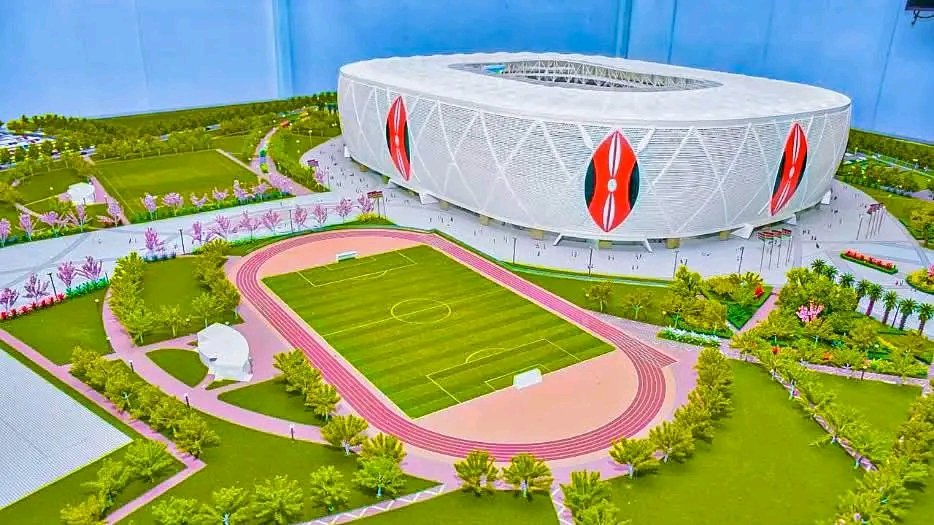
East Africa is building a stage for football drama. As AFCON 2027 draws nearer, Kenya and Tanzania are racing to finish two flagship arenas that promise to reshape the region’s sporting skyline. In Nairobi and Arusha, concrete, steel, and imagination are converging to create venues that are as much cultural statements as they are sporting machines.
Progress and Timelines
Talanta Sports City, Nairobi, is sprinting toward the finish line. At roughly 85 per cent complete, the stadium’s bones are set, and the final, visible touches are underway. Workers are installing the specialised GrassMaster pitch and fitting out a 60,000-seat bowl designed to pull fans right into the heart of the action. After a public debate over seating choices, the government moved quickly to secure premium foldable seats to guarantee comfort and a world-class matchday experience. The target for full readiness is April 2026.
Samia Suluhu Stadium, Arusha, is no less ambitious, though it takes a different path. At about 75 per cent complete, the main steel superstructure is topped out, and attention has shifted to the circular roof and internal systems. Groundbreaking in April 2024 set a steady pace, and disciplined government payments have kept the project on schedule. The projected handover sits around July 2026, giving Arusha time to polish its offering before the continent’s eyes arrive.
Scale and Design Philosophy
These two stadiums answer different briefs and tell different stories. Talanta is conceived as a 60,000-seat football-only cauldron that removes the running track to bring supporters inches from the pitch. Its silhouette borrows from the Maasai Shield, a bold cultural motif translated into sweeping lines and a fierce, intimate atmosphere.
By contrast, Samia Suluhu Stadium is a 30,000-seat boutique arena that reads like an architectural love letter to Tanzania. Its form draws inspiration from the blue-violet Tanzanite gemstone and the profile of Mount Kilimanjaro, producing a venue that is both elegant and versatile. Built as a multi-purpose hub, it will host athletics as well as football, offering a different kind of intimacy and community use.
Urban Impact and Infrastructure
Beyond the stands, both projects are catalysts for urban transformation. Kenya is investing heavily in the last-mile experience, awarding a Sh3.9 billion contract to upgrade walkways and roads around the Jamhuri grounds so fans arrive and depart with ease. The focus is on matchday flow, safety, and the small comforts that make a stadium feel world-class.
Tanzania is using Arusha’s stadium to decentralise sport from Dar es Salaam and to supercharge the Northern Circuit as a sports tourism destination. Investments in hospitality and transport aim to turn the city into a year-round draw for visitors, athletes, and events beyond AFCON.
Design Details That Matter
Talanta: 60,000 seats; football-only; no running track; Maasai Shield inspired; GrassMaster pitch; premium foldable seating.
Samia Suluhu: 30,000 seats; multi-purpose for athletics and football; Tanzanite and Kilimanjaro inspired; circular roof; integrated city development.
Final Whistle
Talanta may be closer to completion, but both stadiums showcase high-level engineering and distinct visions. One is a roaring, modern coliseum built to amplify the crowd. The other is a refined, multi-use jewel that anchors a city’s sporting ambitions. When the opening whistle blows in 2027, East Africa will not only host a tournament; it will unveil two very different answers to what a modern African stadium can be.































Comments
Sign in with Google to comment, reply, and like comments.
Continue with Google