In Gaza’s overcrowded hospitals, the sounds of machines and quiet whispers of worry fill the air as children fight for their lives. Despite a fragile ceasefire, many families remain in despair, waiting for a lifeline that has yet to come. The World Health Organization (WHO) reports that nearly 15,000 people urgently need to be taken out of Gaza for treatment, but only a few have been allowed to leave.
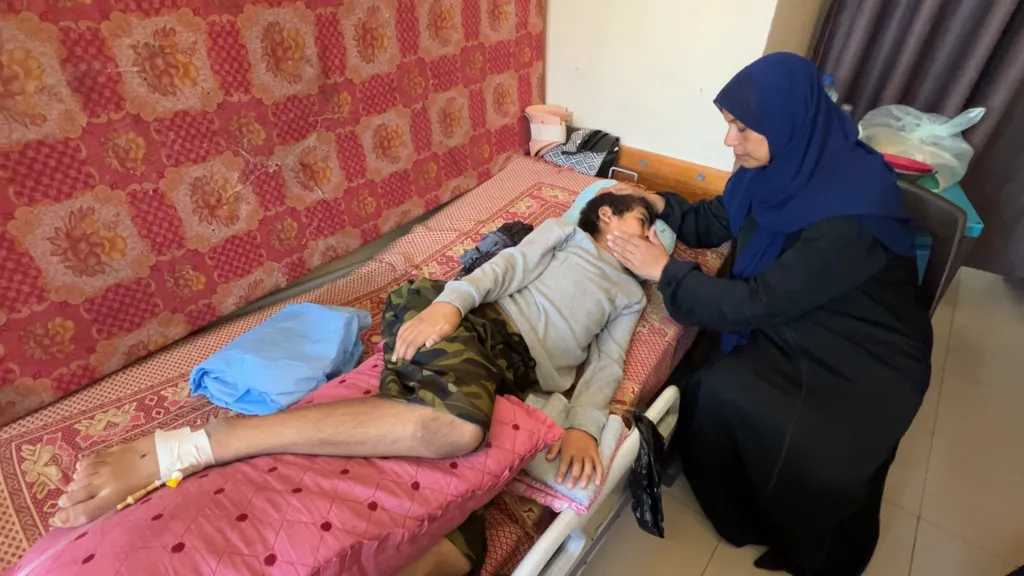
At Nasser Hospital in Khan Younis, ten-year-old Amar Abu Said lies completely still, unable to move anything below his neck.
His mother, Ola, sits beside him, gently brushing his hair as she explains what happened. The family had been sheltering in a tent when an Israeli drone fired nearby. A stray bullet struck Amar, damaging his spine and leaving him paralyzed. “He needs surgery urgently,” Ola says. “But it’s complicated. Doctors told us it could cause his death, a stroke or brain hemorrhage. He needs surgery in a well-equipped place.”
Such facilities no longer exist in Gaza. After two years of bombings, shortages, and power cuts, hospitals are in ruins. Doctors work without proper tools, supplies, or medicine. For children like Amar, every passing day brings more risk.
In another ward, ten-year-old Ahmed al-Jadd faces a different struggle. He has a brain tumor that local doctors cannot remove. His sister, Shahd, stays close to him, watching over him as he sleeps. “He’s only 10 and when our situation got so bad, he used to go out and sell water to help bring some money for us,” she says quietly.
The first signs of his illness appeared months ago. “Ahmad’s mouth started drooping to one side,” Shahd recalls. “One time he kept telling me: ‘Shahd my head hurts,’ and we just gave him paracetamol, but later, his right hand stopped moving.”
With their father gone and their home destroyed, she fears losing her brother too. “We can’t lose him. We already lost our father, our home and our dreams,” she says. “When the ceasefire happened it gave us a bit of a hope that maybe there was a 1% chance that Ahmed could travel and get treated.”
That small hope turned into cautious optimism when, for the first time since the truce began on October 10, the WHO organized a convoy to take patients out of Gaza. The group included 41 patients and 145 caregivers, who were moved through the Kerem Shalom crossing into Israel before being taken to Jordan for treatment. Some remain there for care, but thousands of others are still waiting.
The WHO says more evacuations must happen quickly to save lives. It wants to reopen the Rafah crossing with Egypt, previously used to transfer patients abroad. But Israel has kept the crossing closed since taking control of the Gaza side in May 2024.
Officials in Tel Aviv say it will not reopen until Hamas meets its ceasefire obligations, including returning the bodies of hostages who died during the conflict.
Speaking at a press conference, WHO Director-General Dr Tedros Adhanom Ghebreyesus said allowing Gazan patients to receive care in the occupied West Bank and East Jerusalem would be “the most impactful measure.” Before the war, this arrangement saved many lives.
Foreign ministers and top EU officials, including those from the United Kingdom, have echoed that call, saying they are ready to offer funding, doctors, and medical supplies. Yet for now, Gaza’s hospitals remain overwhelmed, and families like Amar’s and Ahmed’s can only wait — holding on to hope that help will arrive before it’s too late.































Comments
Sign in with Google to comment, reply, and like comments.
Continue with Google