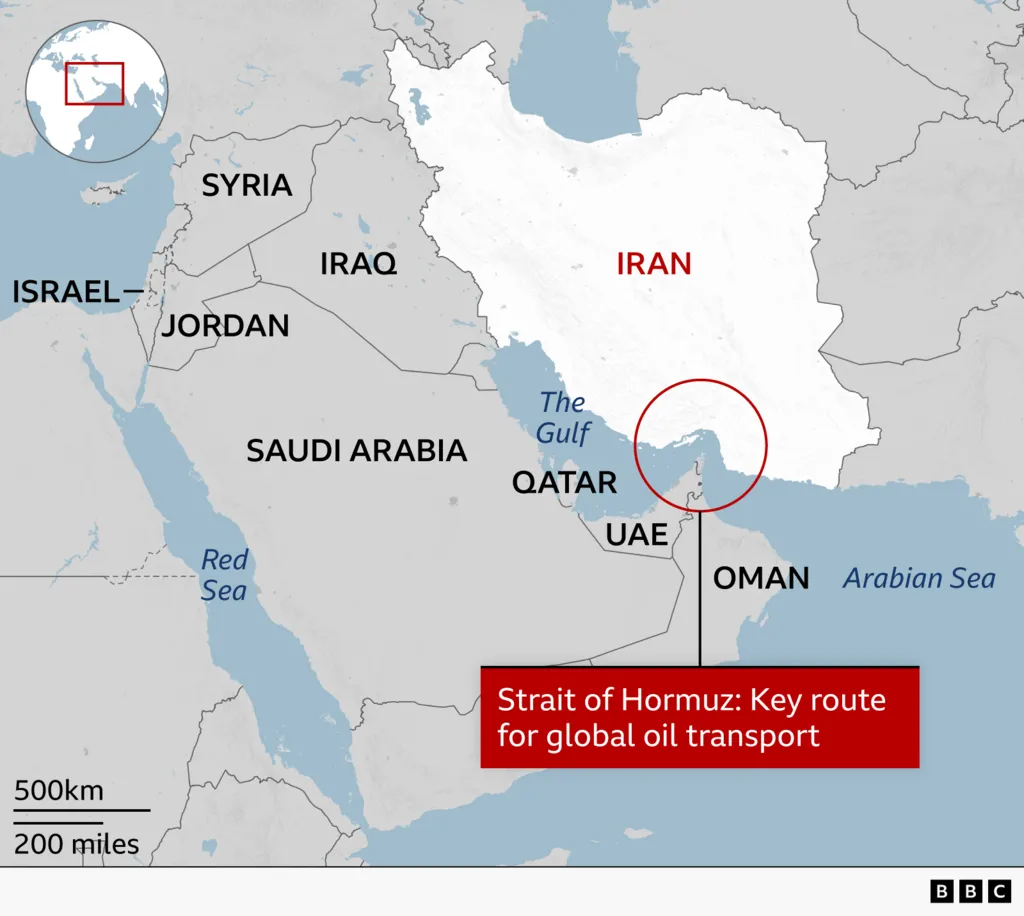
The Strait of Hormuz has emerged as a central pressure point in the tensions between Iran and the United States, with its status as a global energy artery making it a key factor in the recent ceasefire agreement that now hinges on guaranteed safe passage through the narrow waterway.
The corridor, through which a large share of the world’s oil and gas flows, was effectively disrupted during the hostilities, triggering sharp reactions in energy markets and prompting urgent diplomatic efforts to restore movement of ships.
Located between Iran to the north and Oman and the United Arab Emirates to the south, the Strait of Hormuz connects the Persian Gulf to the Arabian Sea. At its entrance and exit, the passage is roughly 50km wide, narrowing to about 33km at its tightest point.
Despite its limited width, the strait is deep enough to accommodate the largest crude oil tankers in operation today, making it one of the most important maritime routes for global trade.
The waterway carries a substantial portion of the world’s energy supply. Estimates from the United States Energy Information Administration show that in 2025 about 20 million barrels of oil and oil products moved through the strait each day.
This volume represents nearly 20% of global oil trade and is valued at close to $600bn each year. The supplies originate not only from Iran but also from Iraq, Kuwait, Qatar, Saudi Arabia and the United Arab Emirates, all of which depend on the route to reach international markets.
Liquefied natural gas also moves heavily through the same corridor. Around 20% of global LNG passes through Hormuz, with Qatar accounting for the largest share of shipments.
LNG is gas converted into liquid form to allow easier transport, and later turned back into gas for use in homes, industries and power generation. In 2024, Qatar exported about 9.3 billion cubic feet per day through the strait, while the United Arab Emirates contributed about 0.7 billion cubic feet per day.
Beyond energy, the strait also supports global trade in fertiliser, much of which is produced in the Middle East using natural gas. Roughly one-third of global fertiliser trade typically moves through the corridor. It also serves as a key route for essential imports into the region, including food, medicines and technology products.
During the recent conflict, shipping activity through the strait dropped sharply. Around 3,000 ships normally pass through each month, but this number fell steeply after tensions escalated.
Iran issued threats against vessels and deployed a range of military tools including drones, missiles, fast attack boats and the possibility of sea mines, creating a high-risk environment for maritime traffic. Reports indicated that at least 24 commercial vessels were hit and several others narrowly avoided damage.
The legal geography of the strait adds to its sensitivity. United Nations rules allow coastal states to control waters up to 12 nautical miles from their shoreline. At its narrowest point, the Strait of Hormuz falls entirely within the territorial waters of Iran and Oman, giving those states considerable influence over passage through the channel.
The disruption also created financial and logistical challenges. Shipping insurance became difficult or extremely costly to obtain, further discouraging movement of vessels.
Energy-dependent regions felt the impact, particularly in Asia, where countries rely heavily on imports flowing through Hormuz. China alone purchases about 90% of Iran’s exported oil, making it highly exposed to any interruption. Some governments responded with emergency measures such as remote work directives, reduced working weeks, early university closures and conservation policies.
In Africa, South Sudan and Mauritius introduced steps to limit electricity use, while in Europe Slovenia became the first European Union member state to implement fuel rationing. These reactions reflected the global ripple effects of instability in a single maritime corridor.
Before the ceasefire, some limited movement of ships continued under restricted conditions. Iran indicated that it would allow non-hostile vessels to pass if they coordinated with Iranian authorities. Between early and mid-March, a small number of ships crossed the strait, including vessels linked to China, India, Oman and France. However, overall traffic remained far below normal levels, with estimates suggesting a drop of about 95%.
Efforts to secure the strait have historically involved military action. The United States has previously taken steps to ensure maritime flow in the region, including during the Iran-Iraq conflict in the late 1980s, when attacks on oil tankers escalated into what became known as the tanker war.
At that time, American warships escorted vessels through the Gulf in one of the largest naval operations since the Second World War. More recently, US forces carried out airstrikes on Iranian anti-ship missile sites near the strait in an effort to reduce threats to shipping.
Despite these measures, the latest ceasefire agreement places renewed emphasis on diplomacy and coordinated safety guarantees rather than direct military escort. The condition of “safe passage” reflects the importance of the strait to global stability, as even limited disruptions can quickly influence oil prices and international supply chains. Following the ceasefire announcement, oil prices fell by around 15%, reflecting relief in markets over the reduced risk to one of the world’s most critical energy routes.
Countries in the Gulf have also developed alternative infrastructure to reduce reliance on the strait. Saudi Arabia operates a long pipeline capable of transporting up to five million barrels of crude oil per day, while the United Arab Emirates has a pipeline linking inland oilfields to the port of Fujairah with a capacity of at least 1.5 million barrels per day.
However, shifting large volumes of oil through these routes would still leave a gap of several million barrels daily, and loading operations at Fujairah have faced disruption from drone attacks.
The Strait of Hormuz therefore remains a strategic chokepoint where geography, energy supply and geopolitics intersect, making its stability essential not only for the countries directly involved but for the global economy at large.






























