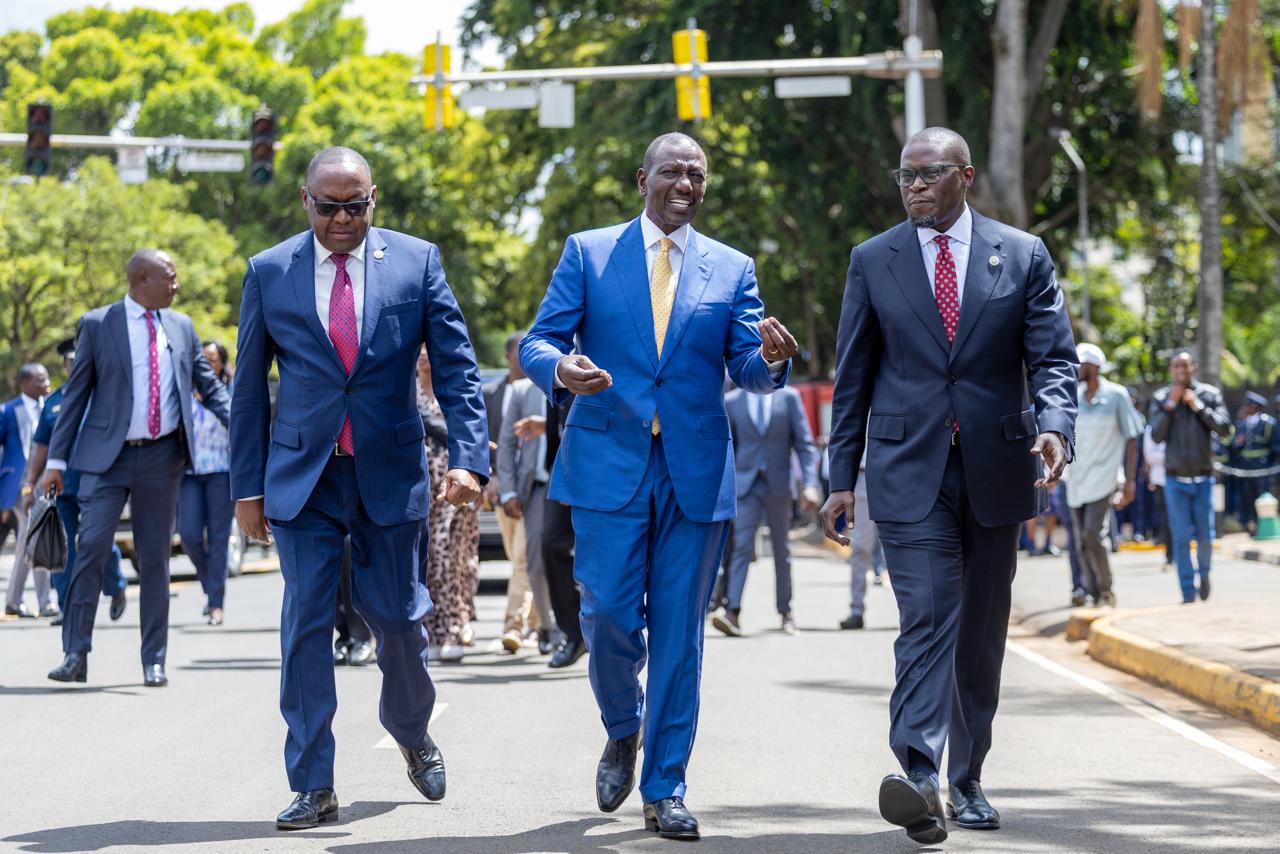
President William Ruto has unveiled a city-wide street lighting programme in Nairobi, aimed at improving safety, movement, and the overall order of the capital through the installation of new lights, repair of broken ones, and the rollout of smart and solar-powered systems.
Addressing members of the Nairobi City County Assembly on Thursday, the President said the plan will include 50,000 new street lights, repair of 40,000 non-functional units, and the addition of 10,000 solar and smart lights, bringing the total to 100,000 across the city.
He said work is already underway, with installation expected to begin this month. Visible changes, he noted, will start appearing in key areas and neighbourhoods by the end of May, with broader improvements anticipated within six months.
“Fabrication is already underway. Installation begins this month, and by the end of May, Nairobi will begin to see visible improvements across key corridors and neighbourhoods,” Ruto said. “Within six months, this city will be markedly brighter, safer, and more secure.”
Ruto framed the initiative as part of a wider effort to restore dignity, functionality, and order in Nairobi, which he described as central to Kenya’s economic strength and international standing.
He pointed to long-standing challenges facing the city, including flooding, poor waste management, traffic congestion, weak planning, and overstretched infrastructure.
“A capital city where too many residents still live without dignity in the very city whose labour, talent, and enterprise sustain our national economy. This cannot continue,” he said.
The street lighting programme is part of a broader Cooperation Agreement between the national government and Nairobi City County, formalised on February 27, 2026, and supported by Sh 80 billion to drive improvements in urban services.
Additional projects under the agreement include expanding electricity access in informal settlements, increasing water supply, constructing sewer lines and treatment plants, and building 247 kilometres of urban roads alongside drainage upgrades.
The President also highlighted security measures, including the creation of a Nairobi Metropolitan Police Unit and upgrades to the Integrated Command and Control Communications Centre. These upgrades will feature artificial intelligence systems and expanded CCTV surveillance across the city.
“This is not just about power. It is about dignity, safety, enterprise, and inclusion,” he said, noting that last-mile electricity connections will be extended to areas such as Hospital Ward, Kibra, Korogocho, Mathare, and Kamukunji.
Ruto urged leaders to focus on effective delivery and coordination, warning against delays and fragmented approaches in managing the capital.
“Let us be the generation that finally made Nairobi work. Let us do it now, firmly, unapologetically, and without turning back,” he said.