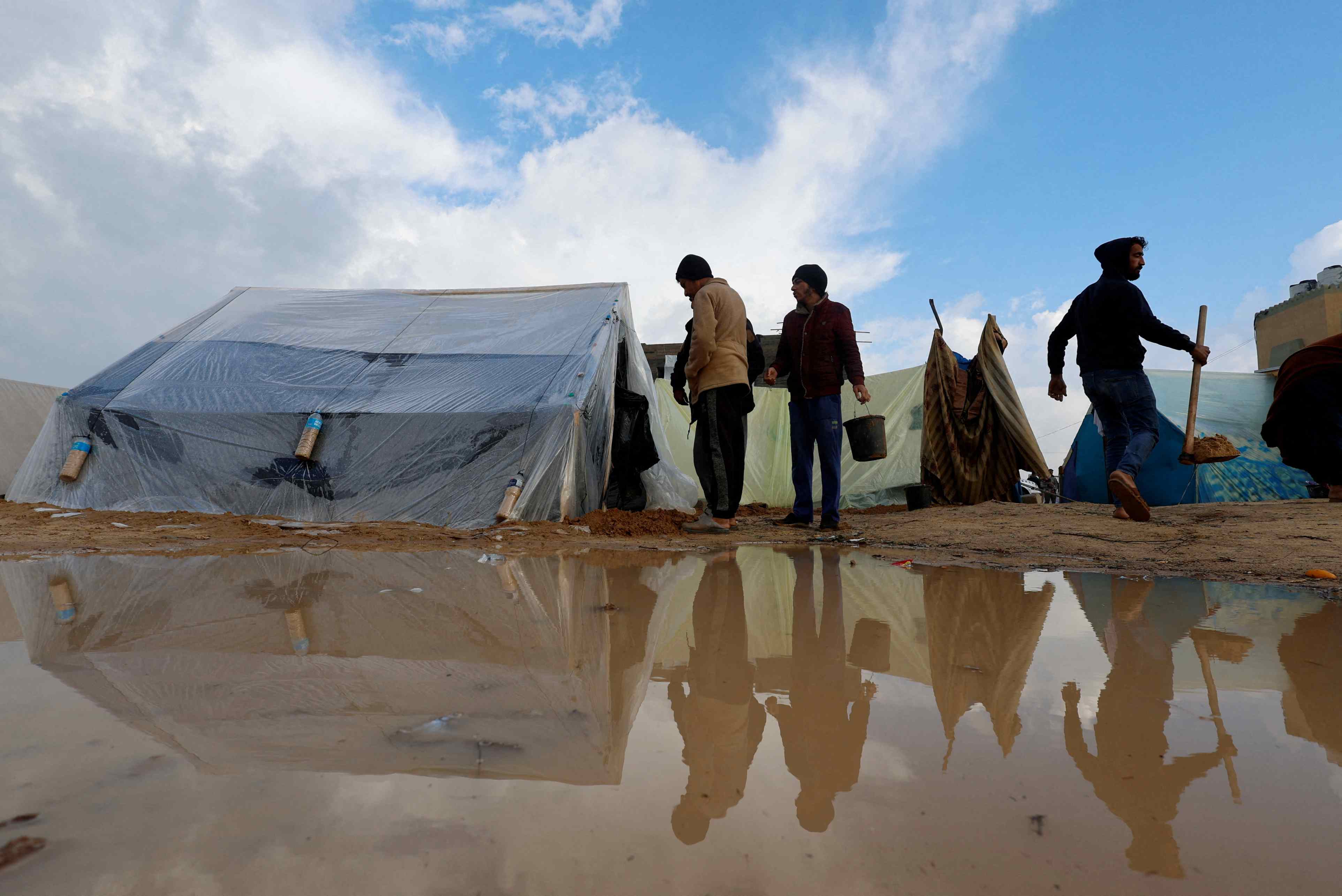
Persistent rains over the past week have plunged Gaza’s already vulnerable displaced population into a worsening humanitarian crisis, with families struggling to survive in flooded tents and collapsing structures.
UN agencies warn that the combination of heavy rain, cold temperatures, and fragile shelters is creating life-threatening conditions, particularly for children.
Jonathan Crickx, Unicef State of Palestine chief of communications, described the scene as extremely troubling. “Last night was really horrendous for the families. The heavy rains were so intense that we could see from our office and guest house 10cm, 15cm (4-6in) of water at some point. And the winds were so strong,” he told the BBC's Today programme on Wednesday.
He added that many residents were forced to try to remove water with buckets as shelters flooded. Most of the estimated one million people living in tents and temporary shelters have been displaced multiple times during the past two years of conflict between Israel and Hamas, leaving them with very few changes of clothing or blankets.
“When I was seeing [children] this morning, their clothes were damp. I could see parents trying to dry some of the blankets they had. But it has been raining almost all of the time in the past four or five days, so it is extremely difficult to keep the children dry,” Crickx said. He warned that with nighttime temperatures around 7C, 8C (45-46F), children face serious risk of hypothermia or worse.
Many tents are at risk of being torn apart or blown away by the strong winds, as they are mostly constructed from thin tarpaulin or plastic sheets over weak wooden frames. Unicef has increased aid during the ceasefire, delivering 250,000 winter clothing kits, 600,000 blankets, and 7,000 tents, but officials stress that the scale of the crisis far exceeds the support available.
Gaza’s health ministry reported that a two-week-old boy, Mohammed Abu al-Khair, died of hypothermia on Monday, just two days after being admitted to hospital. The ministry also said at least 11 people have died due to the collapse of war-damaged buildings during the storm, though the Civil Defence agency reports a higher death toll.
Mahmoud Bassal, a spokesman for Gaza’s Civil Defence, said 17 people, including four children, have died due to collapsing structures and extreme cold. He added that 17 residential buildings have completely collapsed and another 90 partially, leaving many families homeless.
Video footage from Shati refugee camp showed rescue teams recovering the body of a man from the rubble after his building’s roof collapsed suddenly.
“We call on the world to solve our problems and rebuild the territory so that people can have homes instead of being displaced and living in the streets,” Ahmed al-Hosari, a relative of one of the victims, told AFP.
The International Committee of the Red Cross said the destruction of already damaged buildings due to severe weather is deeply concerning, highlighting the urgent need for sustained humanitarian aid, including food, shelter, and materials for rebuilding.
Cogat, the Israeli military body controlling Gaza’s border crossings, rejected accusations of intentionally limiting aid, stating that hundreds of trucks enter daily, delivering tents, tarpaulins, blankets, and clothing. The UN, however, notes that the current amount of aid is still insufficient to meet the urgent needs of displaced families.
The second phase of the ceasefire includes plans for Gaza’s reconstruction, post-war governance, withdrawal of Israeli troops, and the disarmament of Hamas. Israel’s prime minister said last week that this phase is nearly complete, with only the body of one Israeli hostage remaining to be returned by Hamas under the first phase.
The war began on 7 October 2023, after a Hamas-led attack on southern Israel killed about 1,200 people and left 251 hostages. Gaza’s health ministry says Israeli attacks have since killed more than 70,600 people in the territory.































Comments
Sign in with Google to comment, reply, and like comments.
Continue with Google