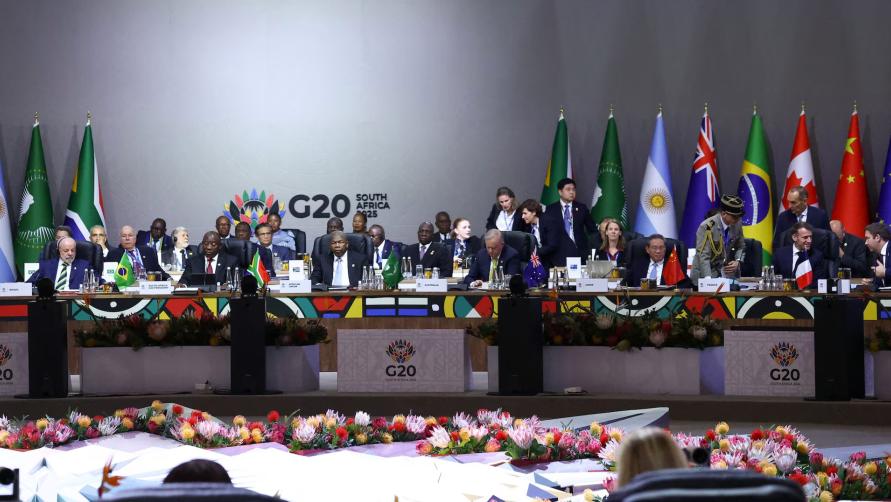
Leaders from the world’s 20 largest economies agreed on a summit declaration in Johannesburg on Saturday, tackling climate change, debt, and renewable energy, despite the United States opting out and opposing key language.
The move came after envoys drafted the document without U.S. involvement, highlighting growing tensions between Washington and the summit host, South Africa.
South African President Cyril Ramaphosa’s office emphasized that the declaration “can't be renegotiated,” signaling that Pretoria is determined to move forward with the consensus reached among other member states.
“We had the entire year of working towards this adoption and the past week has been quite intense,” Ramaphosa’s spokesperson said, underlining the effort that went into finalizing the declaration.
Ramaphosa, chairing the G20 gathering for the first time on African soil, highlighted the unity achieved among participating nations.
“There's been overwhelming consensus and agreement that one of the other tasks we should undertake right at the beginning is to ... adopt our declaration,” he said, stressing the importance of the summit for Africa’s role on the global stage. “We should not allow anything to diminish the value, the stature and the impact of the first African G20 presidency.”
The declaration, finalized on Friday, addresses climate change, renewable energy goals, and the heavy debt burdens of poorer countries.
This marks a clear divergence from U.S. positions, as the Trump administration has repeatedly challenged the scientific consensus on human-driven climate change and signaled its opposition to any references to it in official G20 documents.
The choice to proceed without U.S. input is seen by experts as a rebuke to President Trump, who had earlier announced that American officials would skip the summit over allegations that the South African government mistreats its white minority—a claim widely discredited.
Ramaphosa’s firm stance at the Johannesburg summit contrasts sharply with his more restrained approach during his visit to the White House in August, when he faced repeated false assertions about South Africa’s domestic affairs.
By advancing the declaration, South Africa signals its commitment to global cooperation on climate, energy, and development, asserting that multilateral dialogue and collective action cannot be held back by a single nation’s objections.