Long-time Ladysmith Black Mambazo member, Albert Mazibuko dies at 77
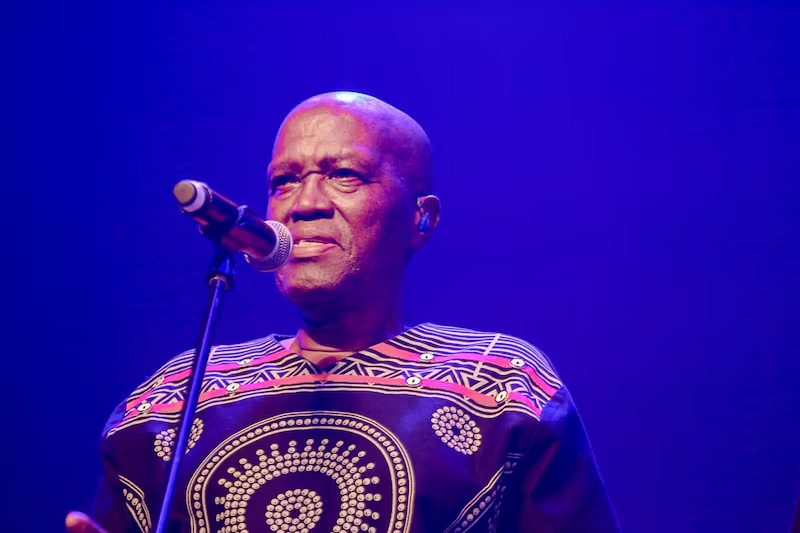
The group announced that Mazibuko died on Sunday following a short illness. His role in the ensemble stretched back to 1969, when he joined the lineup that would go on to achieve worldwide recognition, earn five Grammy awards, and feature on the widely acclaimed album Graceland by Paul Simon.
The death of a long-time voice behind one of South Africa’s most recognised musical groups has drawn attention to a career that helped carry local sound to the global stage, as Albert Mazibuko, a key figure in Ladysmith Black Mambazo, has passed on at the age of 77 after falling ill briefly.
The group announced that Mazibuko died on Sunday following a short illness. His role in the ensemble stretched back to 1969, when he joined the lineup that would go on to achieve worldwide recognition, earn five Grammy awards, and feature on the widely acclaimed album Graceland by Paul Simon.
In a message shared through their Facebook page, Ladysmith Black Mambazo described Mazibuko as a central figure within the group, noting the personal qualities that made him stand out among his peers and younger members.
"He loved traveling the world, spreading the mission and music of Ladysmith Black Mambazo," the statement said.
"He never tired of talking about the group's history and its desire to spread 'peace, love and harmony' everywhere people had ears to listen."
Born and raised in uMnambithi, also known as Ladysmith, Mazibuko left school early and later took up work on a farm before music became his lifelong path. His entry into the group was influenced by family connections, as his cousin Joseph Shabalala, who established the group in 1960, invited him to join years later.
The group became widely known for its unique blend of traditional Zulu music and isicathamiya, a style of a cappella singing accompanied by gentle, coordinated dance movements. Their early breakthrough came in 1970 after a radio appearance led to a recording contract, which paved the way for their 1973 release Amabutho, the first album in Africa to reach gold status.
Their international profile grew after working with Paul Simon on the Graceland album, a collaboration that attracted debate at the time due to the cultural boycott against apartheid-era South Africa, but later helped introduce their music to audiences across the world.
Tributes have continued to come in following Mazibuko’s death, including from South Africa’s Culture Minister Gayton McKenzie, who said he represented more than just a performer. He was described as a figure who helped preserve and share a distinctive South African sound that resonated beyond borders.
For decades, the group’s music carried messages of unity and hope during apartheid, a period marked by strict racial segregation. Mazibuko once reflected on those years, describing the harsh conditions faced by black South Africans.
"Apartheid was very harsh to us," Mazibuko told the BBC's Soul Music show in 2015.
"I was working at a cotton factory... when we came out from work we saw the police, they were lining up," he recalled.
He spoke about the constant fear of arrest tied to carrying identity documents required under the system.
"If you don't carry it, you're arrested. In my life i was so afraid of being arrested… even now I'm afraid."
He also recalled the moment South Africans participated in the country’s first democratic election in 1994, describing the sight of long queues of voters as deeply emotional.
He added that seeing people form "miles and miles" of queues to vote in the first post-apartheid election in 1994 was "like heaven".
At the time of his passing, Ladysmith Black Mambazo continued to perform with a mix of long-standing members and newer voices. The group had been touring in the United States since February and was expected to conclude its final performance in the country later in the week.


Comments
Sign in with Google to comment, reply, and like comments.
Continue with Google