Nigeria has ordered an immediate stop to all Christian pilgrimages to Israel and the occupied West Bank, following rising tensions and fighting across the Middle East.
Authorities said the measure is aimed at protecting Nigerian travellers as airspace closures and cancelled flights leave many stranded. Approximately 600 Nigerians already in the region were evacuated to Jordan before returning home safely.
The move was announced by the Nigerian Christian Pilgrim Commission, which coordinates state and private pilgrimages. In its statement, the body said the decision prioritises the "safety and comfort" of all Nigerian pilgrims.
The current conflict intensified after US and Israeli strikes killed Iran’s supreme leader, Ayatollah Ali Khamenei. Iran has responded with attacks targeting Israel and other US-aligned states in the Gulf, spreading instability across the region.
Flights in and out of affected countries have been cancelled, leaving travellers in uncertainty. Many nations have closed their airspace, forcing passengers to delay or reroute their journeys.
Rev John Hayab of the Christian Association of Nigeria told the BBC that all Nigerians who were on pilgrimage have now returned home after being evacuated to Jordan. He confirmed that about 600 people were safely brought back after the conflict began on Saturday.
The travel suspension covers all pilgrimages organised by the government and private tour operators. Officials emphasised the ban will remain until authorities consider the situation safe for travel.
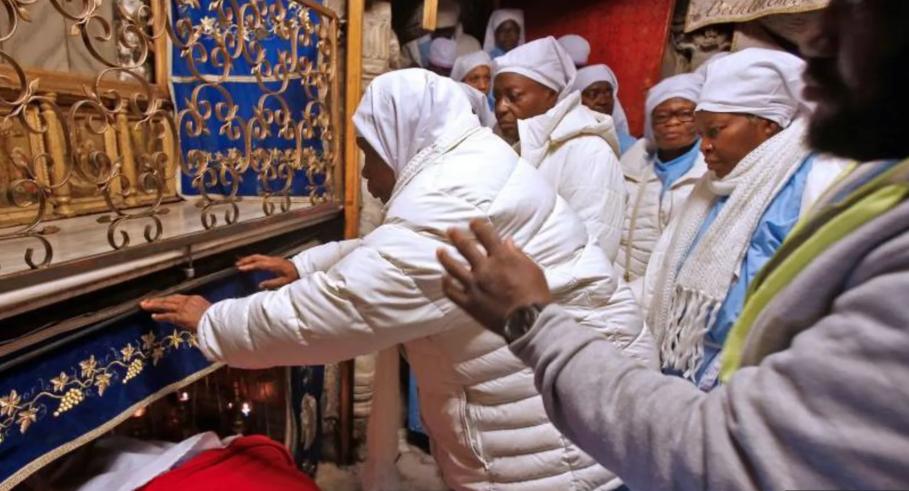
Christian pilgrimages to Jerusalem, Bethlehem, and Nazareth attract thousands of Nigerians each year. Many pilgrims spend years saving for these journeys, which are considered deeply spiritual and form an essential part of Nigeria’s religious calendar. Easter, which is approaching, is normally the peak period for these trips.
The disruption has also affected Nigerian Muslims intending to perform Umrah in Mecca, Saudi Arabia. Unlike the Hajj, which has fixed annual dates, the Umrah can be undertaken at any time and involves a shorter set of rituals.
Alhaji Zaharaddeen Abubakar, stuck in Kano, said he had planned his journey with tickets and accommodation in Mecca, but is now unable to travel. "I wish to be there too but I can't at the moment. I'm still hoping," he told BBC Hausa.
Alhaji Musa Rabi'u Muhammed, head of Murna travel agency in Kano State, described how some travellers had already boarded flights before being turned back. "Some of our people had even boarded planes ready for take-off, but they had to be brought back down, and now they are at home," he said.